

What Full-Service Storage Costs in NYC (and How It Compares to Renting a Unit)
If you have a self-storage listing open in another tab, you have already seen the pitch: a low monthly rate, big and bold. The question you are actually asking is harder. Is full-service storage worth the difference, and what does it really cost once everything is added up?
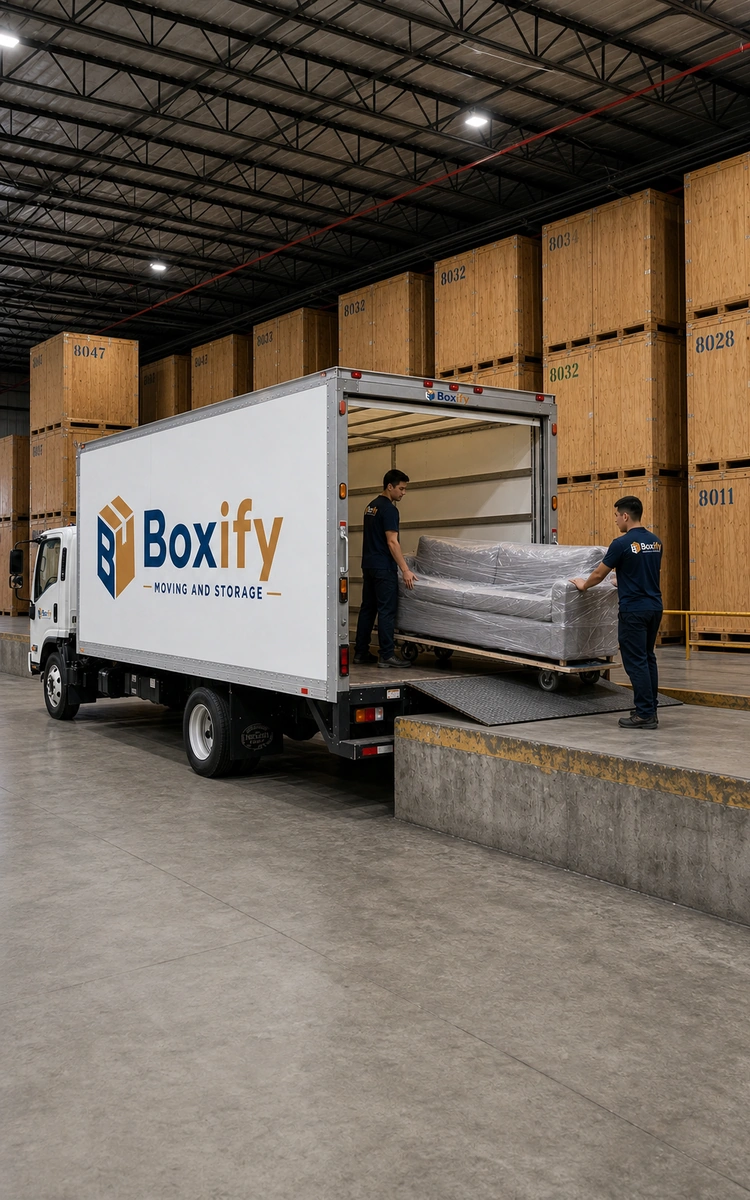
Full-service storage is easy to sum up in one line: a company picks your things up, stores them, and delivers them back, so there is no unit to rent or visit. If you want the full definition, start with what full-service storage is. This guide handles the money honestly: what full-service costs, what actually drives the price, what a self-storage unit really costs once you add the truck and your own time, and how to get your real number.
What full-service storage costs in NYC, in plain terms
Full-service storage in NYC is priced by your plan (how much you store and for how long), not by a unit size, and it is quote-based: you get a free, upfront number instead of a public rate card. There is no single sticker price, because the price follows your things, not a shelf.
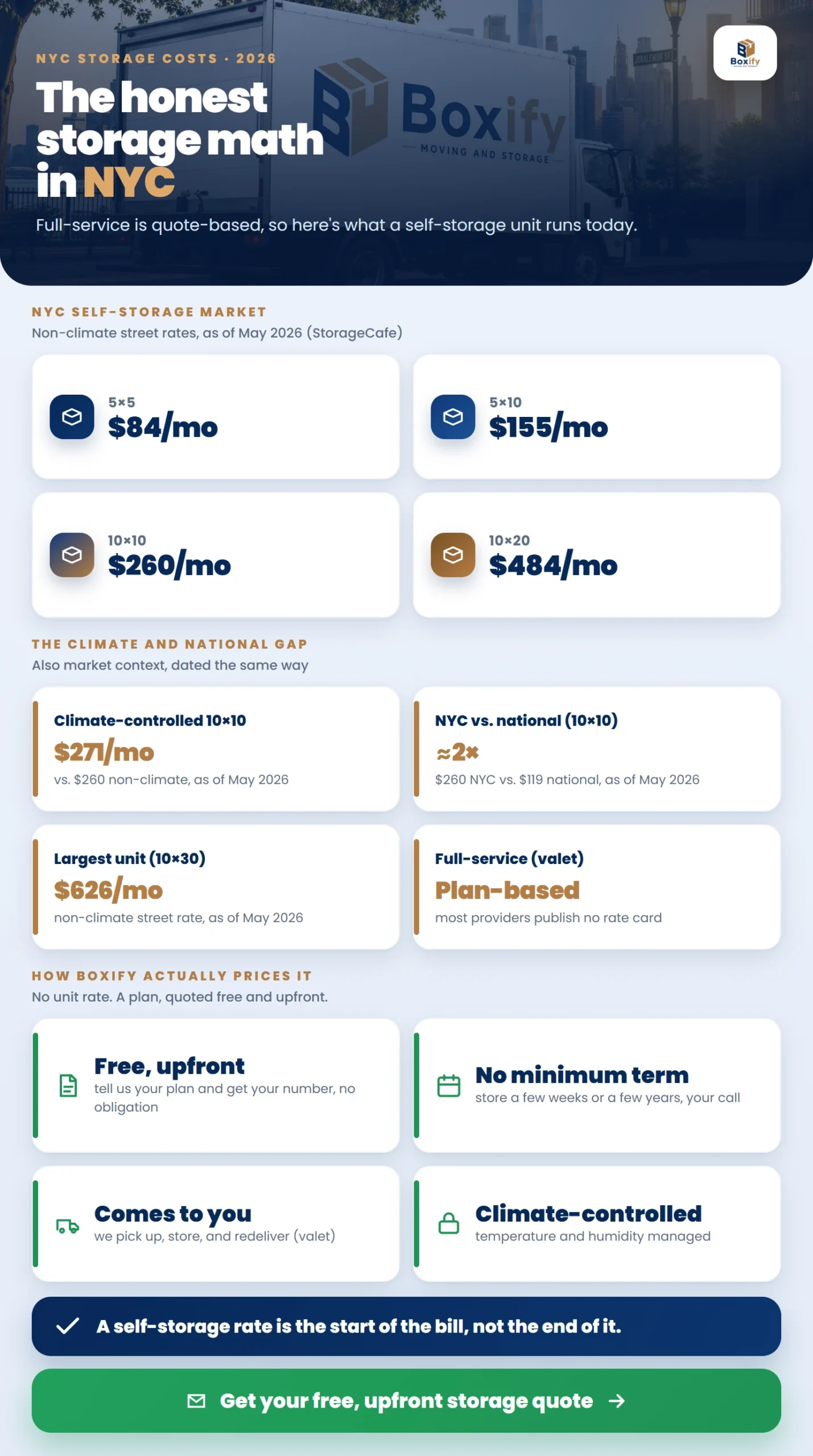
For a sense of the market, a self-storage unit in NYC averaged about $155 a month for a 5×10 and $260 for a 10×10 as of May 2026 (StorageCafe), before you add the truck, your time, and the round trips. Full-service folds those parts into the plan; a unit leaves them to you.
Key takeaways
- It's priced by plan, not by unit size. A full-service price is built around how much you store and for how long, so it comes as a free, upfront quote rather than a public rate card.
- A unit's sticker rate isn't its true cost. Add the truck, your own time and labor, and the round trips, and the low monthly rate on a self-storage listing is only the start of what you spend.
- NYC self-storage runs high. A 10×10 unit averaged about $260 a month as of May 2026, roughly twice the $119 national average for the same unit (StorageCafe).
- Watch the fees a low rate can hide. In 2026 New York City's consumer regulator sued a major national self-storage operator over bait-and-switch pricing and undisclosed fees; an honest quote names every line up front.
- Full-service isn't cheapest for everyone. If you want to visit your things weekly, or you have a car and time and are storing long-term, a self-storage unit may cost you less. See the full comparison of the three options.
- The way to a real number is a free quote. Tell Boxify what you need stored and for how long, and you get an upfront price with no hidden fees.
What drives the price of full-service storage
The price of full-service storage is driven by how much you store and for how long, not by the size of a unit you rent, which is exactly why it comes as a quote instead of a rate card.
A handful of things move a full-service price up or down:
- How much you store (your plan or volume). A full apartment's worth of furniture is a bigger plan than a few seasonal bins. If you are still deciding what to keep versus store when you're out of room, right-sizing the load is the first lever on the price.
- How long you store it. A few weeks between leases is priced differently from several months.
- Access at pickup. A fourth-floor walk-up, a long carry to the truck, or an elevator to book all add labor at the pickup end.
- Where you are in NYC. Pickup distance across the five boroughs factors in.
- Whether you want packing done for you. Boxify can pack it, full or partial, and handle specialty or fragile pieces like art or antiques, which adds to the plan.
That is the honest reason full-service is quote-based rather than a public rate card: the price follows your things and your building, not a shelf size you pick off a list. Because full-service (valet) storage means the company picks your things up, stores them, and brings them back, there is no unit for you to rent or size, so the number is built around your actual load.
How much is a self-storage unit in NYC?
As of May 2026, a self-storage unit in NYC averaged about $260 a month for a 10×10 and $155 for a 5×10, based on non-climate-controlled street rates from StorageCafe. Here is the fuller picture by unit size:
| Unit size | Average NYC street rate (May 2026)* |
|---|---|
| 5×5 | $84/mo |
| 5×10 | $155/mo |
| 10×10 | $260/mo |
| 10×15 | $371/mo |
| 10×20 | $484/mo |
| 10×30 | $626/mo |
*Non-climate-controlled averages, StorageCafe, as of May 2026. A climate-controlled 10×10 runs a little higher, about $271. These are market figures, not a Boxify price.
Two things stand out. NYC is expensive: that 10×10 average is roughly twice the $119 national average for the same unit. And these are just the sticker rates, the monthly number on the listing, before anything it takes to actually use the unit.
The parts a unit's sticker price hides
A self-storage unit's monthly rate is only the start of what it costs you, because the sticker price leaves out the truck, your own time, and every round trip you make.
What a unit really costs you
With a self-storage unit, the monthly rate is the beginning of the bill, not the end of it. To use the unit, add:
- A truck or van. Plenty of New Yorkers don't own a car, so getting a load to a storage facility means renting a van or paying someone to move it.
- Your own time and labor. You pack, carry, load, drive, and unload, and you do it yourself.
- The round trips. Every time you need something out of the unit, that's another trip across the city.
- The two moves. Your things go in when you rent the unit, then come back out when you're done. You handle both ends.
One cost worth flagging, drawn from years of writing about how New Yorkers actually budget storage: the part people most underestimate isn't the truck, it's the round trips. A unit that felt like a quick subway ride at signup becomes a half-day errand every time a cold snap sends you back for one winter coat you packed near the bottom. You price the unit once; you pay that trip every time you visit. Over a year of dip-ins, that quiet, uncounted cost is often what tips the honest math against a low sticker rate.
Full-service storage folds the pickup and redelivery into the plan itself, so the honest comparison isn't rate against rate. It is a unit's sticker price plus everything you still do yourself, against a plan that already includes the parts you would otherwise handle.
Full-service is priced by plan and length, the way full-service works, not by a unit you rent. Most full-service providers, Boxify included, don't publish a public rate card; you get a quote instead.
Portable containers, the kind dropped at your curb, are a third option, but there is no published NYC price for them; they are quote-based.
Who full-service isn't cheapest for
Here is the honest part most comparisons skip: full-service isn't the cheapest choice for everyone. If you want to drop by your things every week, or you own a car, have the time, and plan to store for the long haul, a self-storage unit may well cost you less. Full-service earns its price when you would rather not rent a truck, climb the stairs, or make the trip twice. Working through which of the three options fits your situation is worth doing before you book.
Watch for the fees a low rate can hide
A low advertised storage rate can hide fees that show up only after you move in, a risk a New York regulator put on the record in 2026.
In February 2026, New York City's consumer regulator, the Department of Consumer and Worker Protection (DCWP), sued a major national self-storage operator over what it called bait-and-switch pricing: advertising low rates, then raising them suddenly and steeply after move-in, despite written assurances of 30 days' notice, along with undisclosed junk late fees. In July 2026, the company settled for $1.7 million in restitution and penalties and agreed to change its practices. The case was settled, not decided by a court, but the pattern it describes is the one to watch for on any storage listing.
In its own complaint, DCWP described the operator as "precipitously raising prices with little to no notice" and charging "previously undisclosed junk 'late fees'" for allegedly delayed payment (DCWP, February 2026).
This is exactly the tactic an honest quote removes. When Boxify gives you a number, every line is named up front, and the price we quote is the price you pay, with no hidden fees. You can't get a surprise increase from a rate that was never the real rate to begin with.
How to get a full-service storage price
You get a full-service storage price the same way you would want any price: for free, up front, and with no line left off, by telling Boxify what you need stored and for how long. Boxify is a Greater-NYC moving and storage company based in Queens that both moves and stores.
Here is how a free, upfront storage quote actually works:
- You tell us what you're storing and for how long. A few seasonal bins, a studio's worth of furniture between leases, or a whole apartment during a renovation; the plan is built around your load.
- We give you the number up front, for free. There's no form to fill just to see a price, and no obligation.
- Every line is named before you decide. The price we quote is the price you pay, with no hidden fees.
You can reach us by phone, through an online form, or in person, whichever is easiest. When you're ready to set it in motion, here is how to book a storage pickup, or you can ask for your number now.
FAQ
How much does full-service storage cost in NYC?
Full-service storage in NYC is priced by your plan (how much you store and for how long), not by a unit size, and it is quote-based, so you get a free, upfront number rather than a public rate card. For a market reference point, a self-storage unit in NYC averaged about $260 a month for a 10×10 as of May 2026, before you add the truck and your own time.
How much is a storage unit in NYC?
As of May 2026, average NYC self-storage street rates were about $84 a month for a 5×5, $155 for a 5×10, $260 for a 10×10, and $626 for a 10×30, for non-climate-controlled units (StorageCafe). A climate-controlled 10×10 runs a little higher, about $271. NYC's 10×10 average is roughly twice the $119 national average for the same unit.
Is full-service storage cheaper than renting a unit?
It depends on your situation, because a unit's monthly rate isn't its full cost. Once you add a truck or van, your own time and labor, and a round trip every time you need something, a low unit rate often adds up to more than it looks. Full-service is usually cheaper on effort and can be cheaper overall if you have no car and don't want to move twice; a self-storage unit can cost less if you have a car, the time, and you're storing long-term.
What makes full-service storage cost more or less?
Five things drive a full-service storage price: how much you store, how long you store it, access at pickup (walk-ups, long carries, elevators), how far the pickup is across NYC, and whether you want packing done for you. Because the price follows your things and your building rather than a fixed unit size, it comes as a quote instead of a rate card.
Are there hidden fees with storage?
There can be with a self-storage unit: in 2026, NYC's consumer regulator (DCWP) sued a major national self-storage operator over bait-and-switch pricing and undisclosed junk fees, and the company settled for $1.7 million. The protection is an honest quote: with Boxify, every line is named up front and the price we quote is the price you pay, with no hidden fees.
How do I get a full-service storage price?
Ask for a free, upfront quote: tell Boxify what you need stored and for how long, and you get the number back for free, with every line named and no hidden fees. You can request it by phone, through an online form, or in person. When you're ready, book a storage pickup.
A unit's rate isn't what it costs you
Full-service storage in NYC is priced by your plan and quoted free and up front, so there is no sticker price to compare, only a number built for your things. A self-storage unit's low monthly rate looks cheaper until you add the truck, your time, and the round trips, and for many New Yorkers that math flips. The honest way to know which is cheaper for you is to get your real number and weigh it against everything a unit would ask you to do yourself.
Get a real number on full-service storage
Want your actual number, with every line named up front?
Get a free, upfront Boxify storage quote
Tell us what you're storing and for how long, and we'll give you the price: free, upfront, and with no hidden fees.



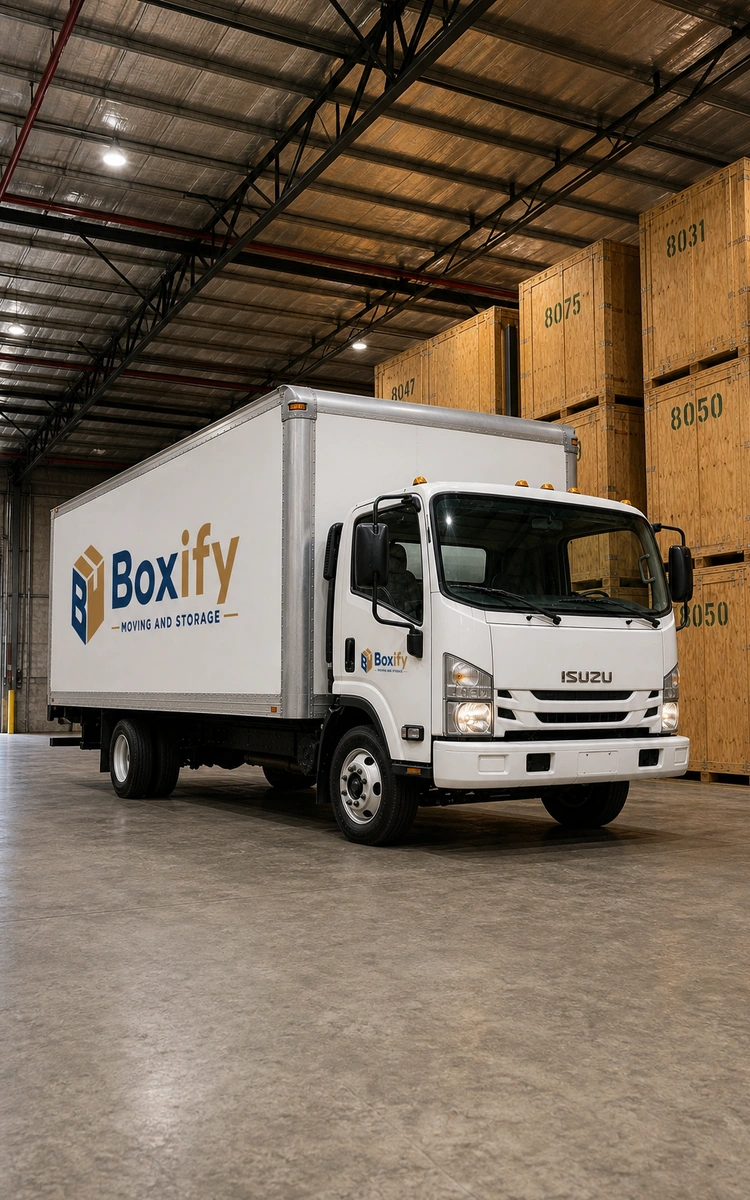
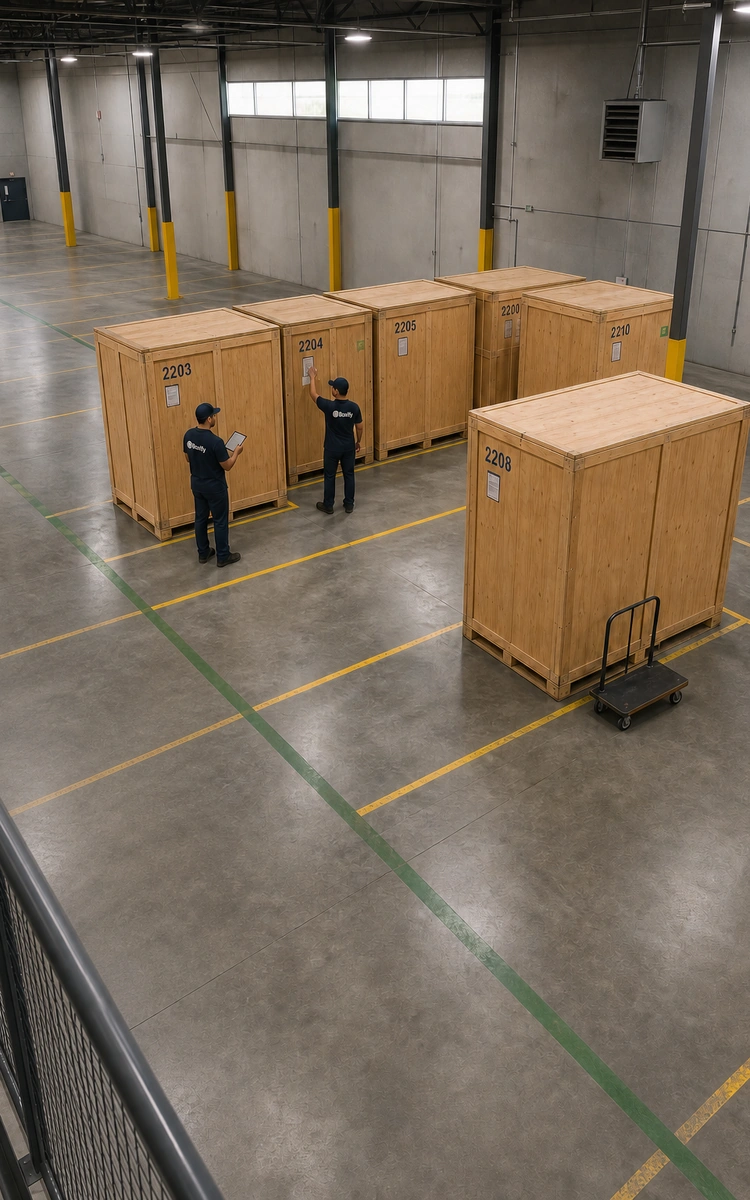

- What full-service storage is: the plain-English guide to the category and how it differs from a self-storage unit.
- Full-service vs. self-storage vs. containers: an honest side-by-side of what each option is best and worst for.
- What to store when you're out of room: a room-by-room take on reclaiming space.
- Book a storage pickup: from a free, upfront quote to a scheduled pickup.
Market figures are attributed and dated; they reflect NYC storage context, not Boxify prices.
- StorageCafe: average NYC self-storage street rates, as of May 2026, and the NYC-versus-national comparison.
- NYC Department of Consumer and Worker Protection (DCWP): the February 2026 suit and July 2026 settlement with a national self-storage operator over its pricing and fee practices.
These market figures reflect NYC storage context as of the dates shown; we refresh them when the market moves.
Rita Penn, Author. Rita Penn is a copywriter with over eight years of experience writing for home service businesses and service providers. She specializes in the moving and storage industry and has created content for several moving companies, along with businesses across other service-based industries.
Eddie Torr, Editor. Eddie Torr is an AI content editor: the independent quality-and-compliance gate every draft passes before it advances. He checks each claim against its approved source, tests the piece against the editorial standards, ranks it, and returns a verdict. He never rewrites the piece himself and never approves delivery; a human reviewer does that.
Maya Ellison, Reviewer. Maya Ellison is an editorial lead with more than 11 years across copywriting, editing, content strategy, and editorial operations. She holds a bachelor's in Communications (Professional Writing and Digital Media) and a master's in Information and Knowledge Management. Those are the two sides of her work: creating clear content, and building the systems that produce it consistently. She gives every piece a final human review before it ships, confirming each claim is fairly represented, tied to a checked source, and dated.
Reviewed on this post: On this cost guide she checked that every market figure is dated and attributed, that a market range never reads as a Boxify quote, that no Boxify storage price is stated, and that the regulator's action is framed as a suit and settlement, not a finding of guilt.