

When Is the Cheapest Time to Move in NYC? Seasonal and Mid-Month Pricing
Most "best time to move" articles are secretly about cheaper rent: winter lease deals, not moving trucks. This one is about what movers actually charge, and why the same crew can cost 15 to 30% more in July than in January. The short answer is above; here's the reasoning, the catch included. Timing is one lever on what a move costs.
The cheapest time to move in NYC: the short version
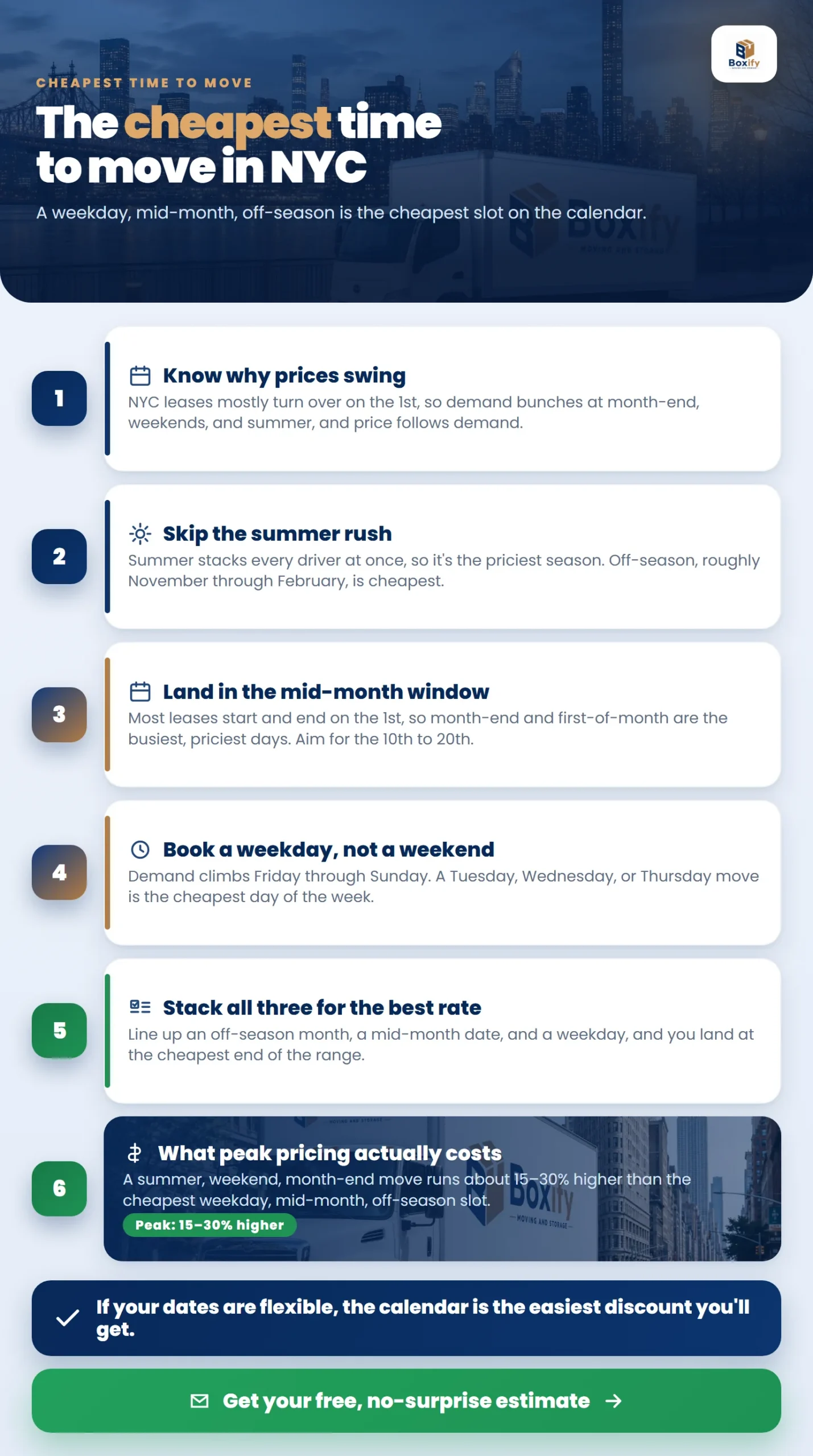
The cheapest time to move in New York City is a mid-week day (Tuesday through Thursday) in the middle of the month, during the off-season of roughly November through February. Peak slots cost more: summer, weekends, and the month-end rush run about 15 to 30% higher, driven by NYC's heavy first-of-the-month lease turnover.
Why NYC moving prices swing with timing
NYC moving prices swing with timing because demand for movers is bunched, not steady: most leases in New York turn over on the first of the month, so movers get slammed at month-end, on weekends, and all summer, and they price to that rush.
That "why" is the part most timing guides skip. They'll tell you winter is cheaper without saying what makes it cheaper, and what makes it cheaper is the whole game. When half the city is trying to move on the same weekend, a mover can charge more and still fill the calendar. When demand thins out in the middle of a February week, that same crew has empty slots to fill, and the price softens.
Note that this is about mover pricing, not rent. Plenty of articles answer "cheapest time to move to NYC" by talking about cheaper winter apartments, a different question entirely. What we're talking about here is the crew, the truck, and the hours, and those are priced by how busy the calendar is.
The cheapest season: off-season vs. summer
The cheapest season to move in NYC is the off-season (roughly November through February), while summer is the most expensive stretch of the year.
Summer is peak because it stacks every demand driver at once: school's out, leases flip, and everyone who can move in good weather does. That's convenient for you and expensive for exactly the same reason: you're competing with the largest pool of other movers for the same trucks and crews. Move in the off-season and you're one of few instead of one of many, which is what pulls the price down.
The cheapest week: mid-month vs. month-end
Within any given month, the middle is cheaper than the ends: a mid-month move beats the first-of-the-month and end-of-month rush, when NYC's lease turnover packs the calendar.
Most city leases start and end on the 1st, so the last few days of one month and the first few of the next are the single busiest window movers see. Aim for roughly the 10th through the 20th and you sidestep that crush: the same move, minus the peak-demand markup.
The cheapest day: a weekday beats the weekend
The cheapest day to move in NYC is a mid-week weekday (Tuesday, Wednesday, or Thursday), while weekends carry a premium.
Weekends are when most people are off work and want to move, so demand, and price, climbs from Friday through Sunday. Mondays and Fridays sit close to that weekend rush; the true valley is the middle of the week. If you can take a Tuesday or Wednesday off to move, that single choice often does more for your bill than any coupon.
How much can timing actually save you?
Timing your move well can cut roughly 15 to 30% off the bill: the swing between a peak slot and an off-peak one, according to multiple NYC moving sources.
That range is per lever, and the levers stack. A summer, weekend, month-end move sits at the top of what a given job costs; the same job on an off-season, mid-week, mid-month day sits near the bottom. Line all three up in your favor and you land at the cheaper end of that swing rather than the pricier one. It won't cut a move in half, but 15 to 30% off a typical local move is real money, and it's yours simply for being flexible about the date.
The honest trade-offs of moving off-peak
Moving off-peak isn't free of downsides, and here's the part a mover selling you a booking usually skips: the cheap dates come with real trade-offs, and steering you toward them means quieter weeks for movers like us.
A February move can mean snow, ice, and four-thirty sunsets: harder on your belongings and on the crew, and occasionally a weather delay. Off-peak dates also give you fewer options if your building only allows moves on certain days, and less room to reschedule if plans slip.
Timing is also just one lever. It sets the demand you're moving into; it doesn't change how many flights of stairs you have, whether your building requires a reserved elevator window, or how far the truck has to park from your door. Save on the date, and you still plan the rest of the move like everyone else. The NYC moving budget checklist pulls every other cost into one place.
We'll tell you this straight because we'd rather you spend less and trust us than book a premium date you never needed. The price we quote is the price you pay, no surprises, whatever week you land on.
What else drives your NYC move's cost
Timing is one lever among several; the rest of your price is set by the move itself, not the calendar. How many flights of stairs, how long the carry from the truck, whether your building needs a reserved elevator or a certificate of insurance, and how much you're actually moving all push the number too.
We name each of them in what makes a NYC move cost more, worth a read before you lock a date, so you know which costs a smart move-date can and can't save you. If you'd rather see the whole picture first, start with what a NYC move actually costs.
FAQ
What's the cheapest month to move in NYC?
The cheapest months to move in NYC fall in the off-season, roughly November through February, when demand for movers is at its lowest. Summer months are the most expensive, so an off-season move can run meaningfully less for the same work.
What's the cheapest day of the week to move?
A mid-week weekday (Tuesday, Wednesday, or Thursday) is the cheapest day to move in NYC, because weekends are when demand and prices peak. If your schedule allows a weekday move, it's one of the simplest ways to lower the bill.
How much cheaper is it to move off-season?
Moving off-peak instead of at peak times can save roughly 15 to 30%, the typical swing between NYC's busiest and quietest moving slots, per multiple NYC moving sources. Stack an off-season month, a mid-month date, and a mid-week day and you land at the cheaper end of that range.
Is it really cheaper to move mid-month?
Yes. A mid-month move is generally cheaper than one at the start or end of the month, because most NYC leases turn over on the first, packing demand into the month-end rush. Aiming for the middle of the month sidesteps that peak.
What's the most expensive time to move in NYC?
Summer, weekends, and the end of the month are the priciest windows: they run roughly 15 to 30% higher than the cheapest slots. If your dates are flexible, avoiding all three at once is the single biggest lever on the bill.
A weekday, mid-month, off-season is cheapest
The best time to move in NYC, the cheapest one anyway, is a weekday in the middle of an off-season month, and the priciest is a summer weekend at month-end. Timing won't rewrite your whole bill, and a peak-date move is still fair when the price is honest and no surprises are waiting on moving day. But if your dates are flexible, the calendar is the easiest discount you'll ever get.
Planning the move itself?
If you're sorting out the move and not just the date, Boxify gives a free, no-surprise estimate, and the price we quote is the price you pay, whatever week you choose.
See what your move would actually cost, honestly.









- What a NYC move actually costs. The whole number, line by line, so you know what a good move-date is saving you a percentage of.
- What makes a NYC move cost more. The drivers beyond timing: stairs, long carries, elevator windows, and bulky items that move the number up.
- Your NYC moving budget checklist. Every cost to plan for in one place, so a well-timed move fits into the full budget.
- Multiple NYC moving sources: the roughly 15 to 30% peak-to-off-peak price swing and the cheapest-window pattern (off-season, mid-month, mid-week weekday) reflect the consensus across several independent NYC moving sources.
Rita Penn, Author. Rita Penn is a copywriter with over eight years of experience writing for home service businesses and service providers. She specializes in the moving and storage industry and has created content for several moving companies, along with businesses across other service-based industries.
Eddie Torr, Editor. Eddie Torr is an AI content editor: the independent quality-and-compliance gate every draft passes before it advances. He checks each claim against its approved source, tests the piece against the editorial standards, ranks it, and returns a verdict. He never rewrites the piece himself and never approves delivery; a human reviewer does that.
Maya Ellison, Reviewer. Maya Ellison is an editorial lead with more than 11 years across copywriting, editing, content strategy, and editorial operations. She holds a bachelor's in Communications (Professional Writing and Digital Media) and a master's in Information and Knowledge Management. Those are the two sides of her work: creating clear content, and building the systems that produce it consistently. She gives every piece a final human review before it ships, confirming each claim is fairly represented, tied to a checked source, and dated.
Reviewed on this post: For this post she checked that the one timing figure is sourced and framed as attributed NYC-market context rather than a Boxify price, that the off-peak trade-offs are disclosed honestly, and that the piece keeps its promise: a straight money-saving answer, no upsell.