

What a NYC Move Actually Costs in 2026: An Honest, Line-by-Line Breakdown
Call three NYC movers for the same one-bedroom (same date, same address) and you'll likely get back three different numbers, sometimes hundreds of dollars apart. One's a flat rate. One's hourly with a two-hour minimum. One is suspiciously low. So which one is real?
Usually, all three are "real." They're just built differently, and the cheapest is often the one hiding the most. The gaps come from two places: how each mover reads your building (a fourth-floor walk-up with a long carry from the truck costs more than a doorman building with a loading dock), and which add-on fees each one names up front versus buries until moving day. That gap is what makes a NYC move cost more.
This guide gives you the whole number, honestly: the real cost range by home size, every fee named in plain English, what drives your total up or down, and the protections you have if a bill runs high. That way you can tell a fair quote from a lowball before you sign.
What a NYC move actually costs, up front
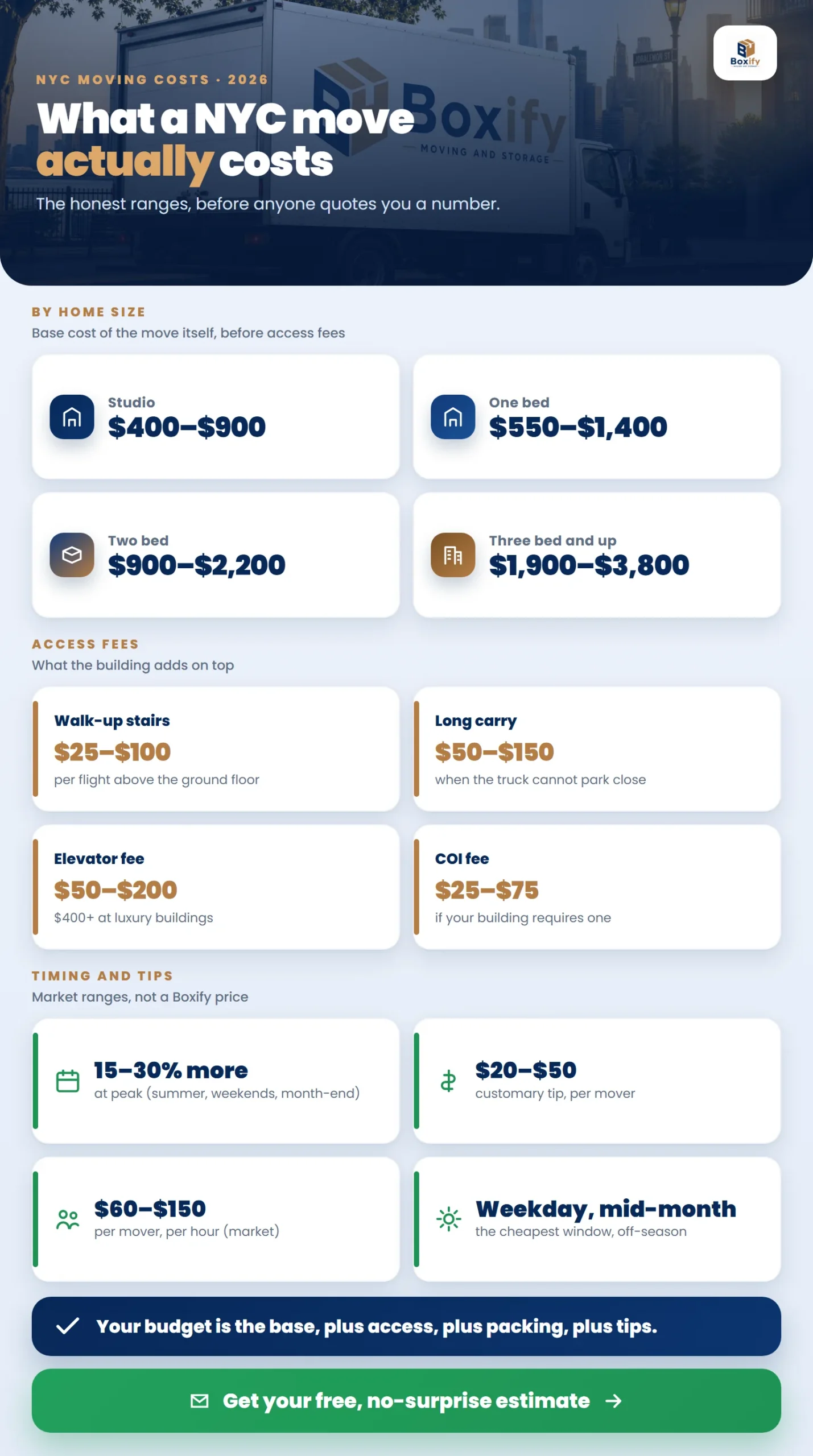
As of 2025-26, a local New York City move (short distance, roughly 5 to 10 miles) generally runs about $400 to $900 for a studio, $550 to $1,400 for a one-bedroom, $900 to $2,200 for a two-bedroom, and $1,900 to $3,800 for a three-bedroom or larger, according to NYC moving-market sources.
These are wide ranges, not averages. Your real price depends on four things: the size of your home, how far you're going, the crew and hours the job takes, and your building access. That last one covers stairs, elevators, and how far the crew has to carry your things from the truck.
There is no single "average NYC move" figure, so an honest quote comes as a range until a mover sees your specific job.
This is the hub of our NYC moving-cost series. Each section below links to a deeper guide when you want to go further.
Here's the honest breakdown ahead: what a move costs by home size, how movers price the job, and every add-on fee named, including the ones others bury. Then what pushes your total up or down, the protections New York and federal rules give you, what to tip, and how Boxify builds a quote you can trust.
Key takeaways
- Cost scales with home size: a studio typically runs a few hundred dollars and a 3-bedroom-or-larger several thousand. See the full range-by-size table below. These are attributed NYC market ranges, not a single "average".
- Movers price three ways: by the hour, by weight, or as a written binding estimate that locks the price up front. Only a written binding estimate guarantees an exact number.
- The fees others bury, named: stairs/walk-up and long-carry are almost always charged when they apply; elevator reservation, Certificate of Insurance (COI), and parking are situational.
- Timing swings the price 15 to 30%: summer, weekends, and month-end cost more; the cheapest window is a mid-week, mid-month, off-season date.
- You have protections: New York caps how far a non-binding in-state estimate can be exceeded, and sets a baseline for what's covered if something breaks.
- Tips are customary, not required: about $20 to $50 per mover for a local NYC move.
- Boxify's promise: the price we quote is the price you pay, with no hidden fees.
What's in this guide
- What a NYC move costs by home size
- What's in the number: how movers price a NYC move
- The add-on fees, named (not buried)
- What drives your total up or down
- Your protections: binding estimates, liability, and NY's overage caps
- Tipping and the costs people forget
- The honest-quote difference: how Boxify builds a number you can trust
- Explore the rest of this series
What a NYC move costs by home size
A local NYC move ranges from about $400 for a small studio to $3,800 or more for a three-bedroom home, as of 2025-26. Here's the typical spread by home size:
| Home size | Typical local NYC move (2025-26)* |
|---|---|
| Studio | $400 to $900 |
| 1-bedroom | $550 to $1,400 |
| 2-bedroom | $900 to $2,200 |
| 3-bedroom or larger | $1,900 to $3,800 |
*Attributed to NYC moving-market sources. These are wide ranges reflecting real variation, not a single average, and not a Boxify price. They cover short-distance local moves (roughly 5 to 10 miles); long-distance moves, storage, and specialty items like a piano or large art are priced separately.
Why so wide? Because a "one-bedroom move" isn't one thing. A one-bedroom on the ground floor of a building with a loading dock and a light load lands near the bottom of the range; the same apartment on a fifth-floor walk-up, with a long carry to the truck and a full load of furniture, lands near the top. That's normal, and it's exactly why a mover who hasn't seen your job can only give you a range, not a promise. Anyone quoting a precise number sight-unseen is guessing (and may revise it upward later).
What the range doesn't cover: long-distance or interstate moves, storage, and specialty/fragile handling are separate line items: budget them on top of, not inside, these figures.
What's in the number: how movers price a NYC move
NYC movers price a job one of three ways: by the hour, by weight, or as a written binding estimate that locks the price up front. For a move within New York State, NYSDOT recognizes all three of these pricing methods, and only a written binding estimate locks in an exact price before move day.
Here's the plain-English version of the two terms that trip people up:
A binding estimate guarantees the price up front; a non-binding estimate is only the mover's best guess, and the final bill can come in higher. Flat-rate is a common name for a binding, guaranteed number; hourly and weight-based estimates are non-binding by nature, so the total moves with the actual job.
- Hourly: you pay a rate per mover, per hour, plus travel time. In NYC, hourly rates commonly run about $60 to $150 per mover, per hour, with the total depending on crew size and how long the job takes. (That's market context, not any one company's rate.)
- Flat-rate / binding: the mover inspects the job, then guarantees a single price. Good when you want certainty and no surprises.
- Weight-based: the price is set by the weight of your shipment; more common on longer moves.
Each type has its place, and no single one is "best" for every move. For a head-to-head on which quote type suits your situation, see the guide to flat-rate, hourly, or binding quote types. To decode an actual estimate line by line (travel fees, minimums, and the surprise charges), see how to read a NYC moving quote.
The add-on fees, named (not buried)
The charges that surprise people on moving day usually aren't secret; they're just left off the quote. Here they are, named, with the typical NYC ranges:
| Add-on fee | When it applies | Typical NYC range* |
|---|---|---|
| Stairs / walk-up | No elevator, charged per flight above a set floor | ~$25 to $100 per flight |
| Long carry | A long distance from the truck to your door | $50 to $150 |
| Elevator reservation | Buildings that require a booked service elevator | $50 to $200 typical ($400+ at luxury/high-rise buildings) |
| Certificate of Insurance (COI) | Buildings that require proof of the mover's insurance | $25 to $75 |
| Parking permit | Where a permit or reserved space is needed | $20 to $250 |
*NYC market ranges; situational fees vary by building. Stairs are charged per flight above a set floor; the NYC DOT moving permit itself is free, and the parking charge is the mover's service fee for pulling it.
A few definitions, since these are the fees people don't see coming:
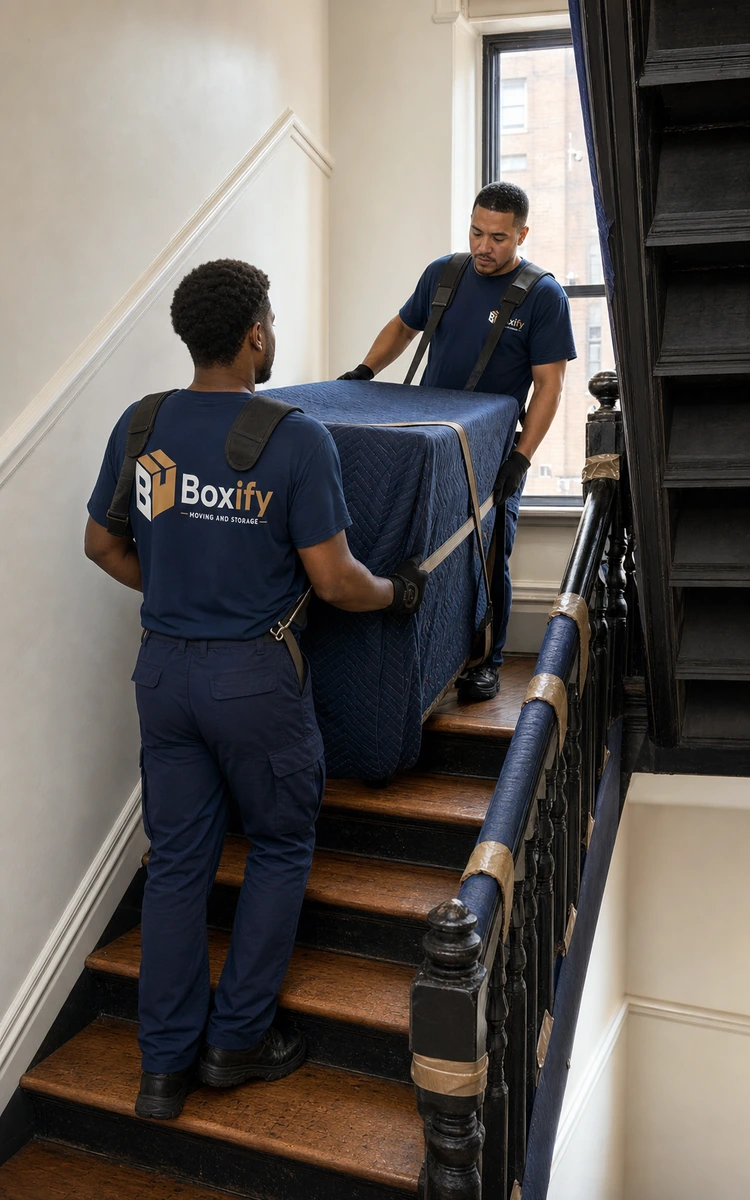
- A walk-up is a building with no elevator, so crews charge for carrying your things up and down the stairs, usually per flight above a set floor.
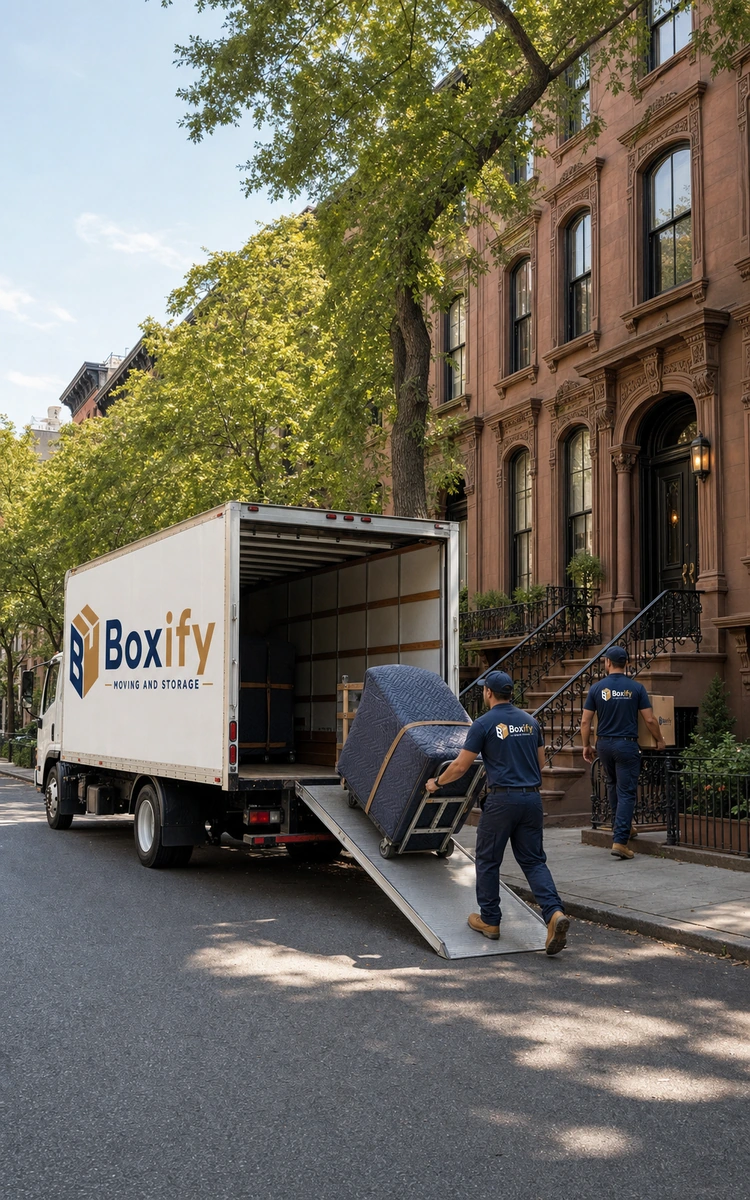
- A long carry is a long distance between where the truck can park and your door, common in NYC, where a loading zone can be half a block away.
- A Certificate of Insurance (COI) proves the moving company carries the liability coverage your building requires; most NYC co-ops, condos, and managed rentals require one before letting movers in.
Stairs/walk-up and long-carry are almost always charged when they apply; elevator reservation, COI, and parking are situational. None of them should be a surprise. An honest quote names the ones that apply to your building before you book; it doesn't spring them on you at the curb. That's the whole difference between a fair number and a lowball that balloons on moving day. For the deep, line-by-line version of how these show up on an estimate, see how to read a NYC moving quote.
What drives your total up or down
Beyond home size, three things move your NYC price the most: building access, crew and hours, and timing.
- Building access: stairs, elevators, and long carries (above) are the single biggest swing between the low and high end of a range. A ground-floor move with a loading dock is a different job from a fifth-floor walk-up.
- Crew and hours: more stuff means more movers and more time, and on an hourly job that's the whole bill.
- Timing: NYC moving prices swing with the calendar. Summer, weekends, and month-end run roughly 15 to 30% higher; the cheapest window is a weekday (Tuesday to Thursday), mid-month, in the off-season, driven by NYC's heavy first-of-month lease turnover.
This is an overview. For the full list of what raises a NYC move's price (stair counts, bulky items, elevator windows), see the guide to what makes a NYC move cost more, along with the money-saving guide to the cheapest time to move in NYC.
Your protections: binding estimates, liability, and NY's overage caps
You're not powerless if a bill runs high. Both New York State and federal rules cap how much a mover can add at delivery and set a baseline for what's covered if something breaks. Which rules apply depends on whether your move stays inside New York or crosses state lines.
For a local move within New York (intrastate), the state sets the guardrails:
- New York caps how far a non-binding in-state estimate can be exceeded at delivery: the estimate +25% on hourly moves and +10% on weight-based or binding moves, with 15 days to pay any balance. Check NYSDOT's Summary of Information for Shippers for the exact window.
- A written binding estimate locks in an exact price up front, so there's no overage to worry about.
- Under New York's default (minimum) liability, you generally won't be paid near your goods' full value unless you declare their actual cash value or buy full-replacement-value protection, both of which cost more.
For an interstate (out-of-state) move, federal FMCSA rules apply instead:
- Estimates come in two types: binding (guarantees the price) and non-binding (best guess). On a non-binding interstate estimate, the mover can't require more than 110% of the estimate at delivery; if the bill is higher, they must still deliver on payment of that 110% and bill the rest later.
- Full-Value Protection is the default liability level: your goods are covered at replacement value unless you actively waive it in writing.
- The free waiver, Released-Value protection, is minimal: the mover is liable for only 60¢ per pound, per item, so a lost 10-lb item worth $1,000 pays just $6. Valuation is not the same as insurance.
This is the brief version so you know your footing. The canonical, plain-English explainer of these terms (and how to spot them on your paperwork) lives in how to read a NYC moving quote.
Tipping and the costs people forget
Tipping is customary but not required: for a local NYC move, most people tip about $20 to $50 per mover, more for a harder job. It's discretionary, a thank-you for careful, hard work, not a line on your bill.
Beyond the tip, a few costs slip most budgets: packing supplies (boxes, tape, wrap), building fees (a COI or an elevator reservation), and any deposits your move requires. The full tipping question (per-mover versus total, cash norms, and when not to tip) has its own guide: how much to tip movers in NYC. A complete budget checklist that pulls every one of these into one place lives in your NYC moving budget checklist.
The honest-quote difference: how Boxify builds a number you can trust
Everything above is why Boxify quotes the way it does. We're a Greater-NYC moving and storage company based in Queens, handling residential apartment and home moves across the five boroughs. Here's the actual process behind a Boxify number, step by step:
- We start with a free, upfront quote: no obligation, and nothing gated behind a form to see the number.
- We name every fee that applies to your job, before you book. Stairs, a long carry, an elevator reservation, a COI, parking: if it applies to your building, it's on the quote up front, not sprung on you at the curb.
- We fit the pricing structure to the job. A flat-rate/binding number when you want certainty, or hourly where that's genuinely fairer for a smaller move, whichever is honest for your move, not whichever is easiest to lowball.
- Your move is handled by our own in-house crew, not subcontracted out to whoever's available that day.
- We put the number in writing and hold to it. The price we quote is the price you pay, with no hidden fees.
Want the fees checked before you book?
Ask for a free, no-surprise Boxify estimate and we'll name every line up front, so the number you see is the number you pay.
Your NYC moving-cost checklist
Plan your budget around these lines, the ones an honest quote should already account for:
- ☐ The base move, by home size
- ☐ Add-on fees that apply to your building: stairs/walk-up, long carry, elevator reservation, COI, parking
- ☐ A timing premium if you must move on a weekend, at month-end, or in summer
- ☐ Tips: about $20 to $50 per mover
- ☐ Packing supplies: boxes, tape, wrap
- ☐ Your protection level: Full-Value versus Released-Value, or a declared value
- ☐ Building requirements: COI lead time and any elevator reservation
A complete NYC moving budget checklist that pulls these together lives in your NYC moving budget checklist.
FAQ
How much does it cost to move a 1-bedroom in NYC?
As of 2025-26, a local one-bedroom move in NYC typically runs about $550 to $1,400. Where you land in that range depends mostly on building access. A walk-up with a long carry costs more than a ground-floor move with a loading dock.
How much are NYC movers per hour?
NYC movers commonly charge about $60 to $150 per mover, per hour, with the total depending on crew size and how long the job takes. That's market context, not any single company's rate, and an hourly quote is non-binding, so the final bill moves with the actual hours.
What's the cheapest time to move in NYC?
The cheapest window is a weekday (Tuesday to Thursday), mid-month, in the off-season; summer, weekends, and month-end run roughly 15 to 30% higher, driven by NYC's heavy first-of-month lease turnover. For the full money-saving timing playbook, see the cheapest time to move in NYC.
How much do I tip movers in NYC?
For a local NYC move, most people tip about $20 to $50 per mover, more for a harder job; it's customary but discretionary. For per-mover-versus-total norms and when not to tip, see how much to tip movers in NYC.
What hidden or add-on fees should I watch for?
The fees most likely to surprise you are stairs/walk-up charges (usually about $25 to $100 per flight above a set floor) and long-carry charges (typically $50 to $150), which NYC movers almost always add when they apply, plus situational ones like elevator-reservation, certificate-of-insurance, and parking-permit fees. An honest quote names these up front; a lowball leaves them off and tacks them on come moving day.
Why do two NYC movers quote such different prices for the same move?
Most of the gap comes from how each mover reads the job: the distance, crew size, hours, and especially your building access (stairs, elevators, and how far the crew carries your things), and which add-on fees each one names up front versus buries. The cheapest quote is often the one hiding the most, so compare what's included, not just the bottom-line number.
Does a moving quote include packing and supplies?
Usually not: most movers quote packing and materials as a separate line, so a bare "moving" price may not cover boxes, wrapping, or the labor to pack. Boxify offers full or partial packing, so confirm what's included before you compare two quotes side by side.
An honest number has nothing to hide
A NYC move doesn't have one price; it has an honest range, and the movers worth hiring will show you the whole of it: the base cost by home size, the fees that apply to your building, and the protections behind the number. The ones to walk away from are the ones that quote low and stay quiet about the rest. Now that you know what's in the number, the next step is getting one built for your actual job.
Get a number you can trust
Ready for a quote with every fee named up front?
Get a free, no-surprise estimate
We itemize what applies to your building, fit the pricing to your move, and put it in writing. The price we quote is the price you pay.







This guide is the hub; each deeper guide below links back up here.
Understanding your quote
- How to read a NYC moving quote. Decode an estimate line by line and spot the surprise fees before you sign.
- Flat-rate, hourly, or binding quote types: which suits your move, and the risk each carries.
What to tip
- How much to tip movers in NYC: a straight answer on the range, per-mover vs. total, and when not to.
Who to trust
- How to vet a NYC moving company: red flags and what licensing to check before you book.
When it costs more / when to move
- What makes a NYC move cost more: the drivers behind the number, named.
- The cheapest time to move in NYC: the mid-week, mid-month, off-season money-saver.
What to budget
- Your NYC moving budget checklist: every cost in one place.
Get a real number
- Ready for a real number? What a free Boxify estimate includes: every fee named up front.
Regulatory facts are cited to their primary source; NYC cost figures are attributed market ranges (as-of 2025-26), not Boxify prices.
- FMCSA, "Your Rights and Responsibilities When You Move": binding vs. non-binding estimates, the 110% non-binding rule, Full-Value Protection (default), and Released-Value protection at 60¢/lb.
- NYSDOT, "Summary of Information for Shippers" (Rev. 11-2025): New York's three intrastate pricing methods, the +25%/+10% overage caps with 15 days to pay, and NY default liability.
- NYC moving-market sources (multiple, 2025-26): cost-by-size ranges, hourly rates, add-on-fee ranges, the 15 to 30% timing swing, and customary tip ranges. (Attributed market context from several NYC moving providers; not a single source.)
Cost ranges are as-of 2025-26 and reflect NYC market context; we refresh them when the market moves.
Rita Penn, Author. Rita Penn is a copywriter with over eight years of experience writing for home service businesses and service providers. She specializes in the moving and storage industry and has created content for several moving companies, along with businesses across other service-based industries.
Eddie Torr, Editor. Eddie Torr is an AI content editor: the independent quality-and-compliance gate every draft passes before it advances. He checks each claim against its approved source, tests the piece against the editorial standards, ranks it, and returns a verdict. He never rewrites the piece himself and never approves delivery; a human reviewer does that.
Maya Ellison, Reviewer. Maya Ellison is an editorial lead with more than 11 years across copywriting, editing, content strategy, and editorial operations. She holds a bachelor's in Communications (Professional Writing and Digital Media) and a master's in Information and Knowledge Management. Those are the two sides of her work: creating clear content, and building the systems that produce it consistently. She gives every piece a final human review before it ships, confirming each claim is fairly represented, tied to a checked source, and dated.
Reviewed on this post: On this guide she checked that each price range, regulation, and protection is stated accurately, tied to a checked source and a date, and that a market range never reads as a firm quote.