
What Makes a NYC Move Cost More? Walk-ups, Stairs, Long Carries, and Timing
You called around, got a quote, and it came in higher than your friend's for what looks like the same move. Now you're stuck on one question: am I being overcharged, or is my building just harder?
Usually, it's the second one. This guide walks each driver behind the number (one at a time) so you can see why your quote moved and, just as important, what you can control before you book. For the timing side in depth, we point you to the cheapest time to move in NYC; for the full number by home size, what a NYC move actually costs.
Why a NYC move costs more than you expected
A NYC move costs more when the job is physically harder to carry out. Three things drive the number up: building access (walk-up stairs, long carries from the truck, and elevator buildings), bulky or specialty items like pianos, and your timing. This is NYC-local and reflects 2025-26 market ranges.
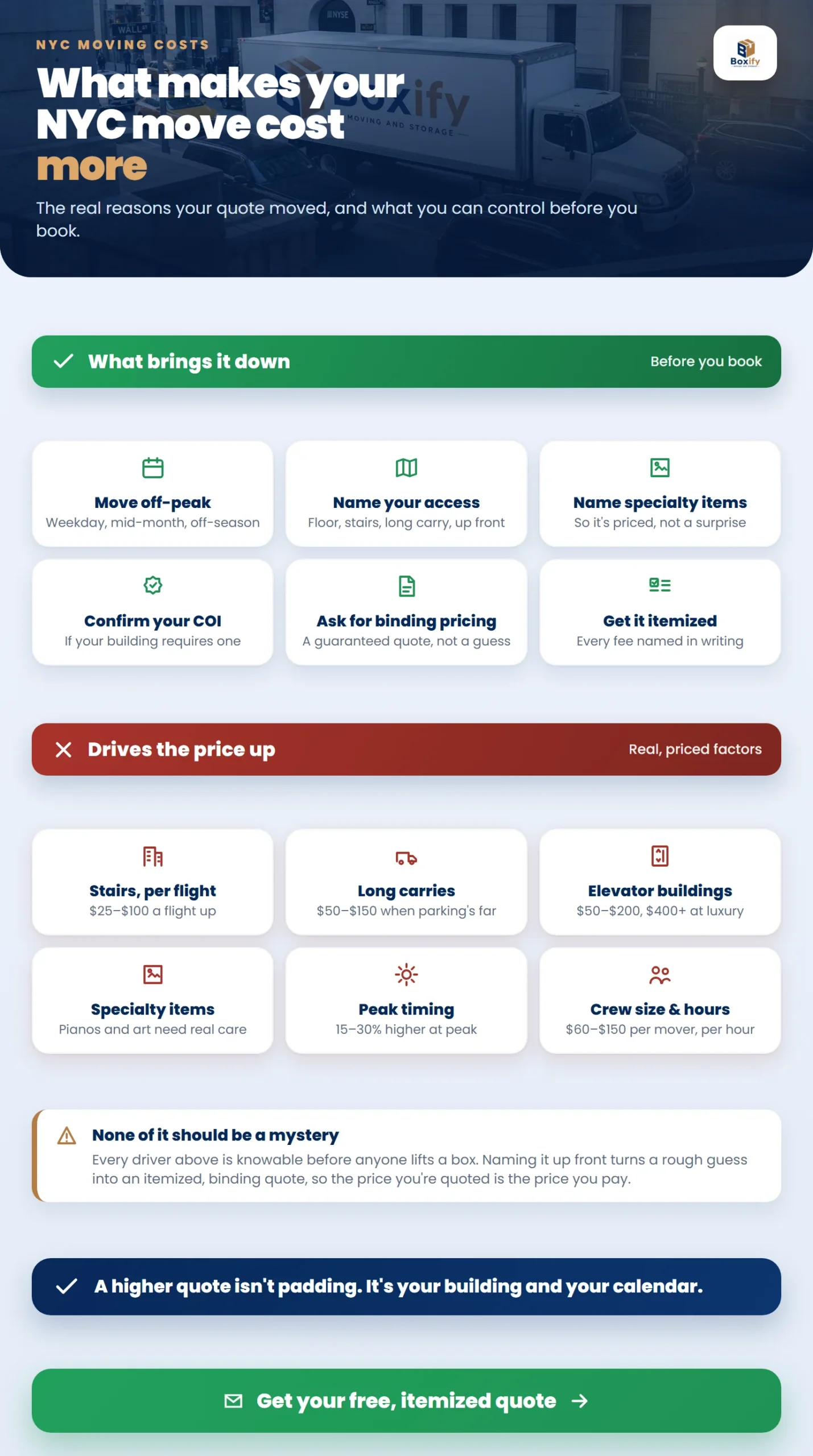
How much each adds depends on the job: stairs are charged per flight above the first floor (~$25 to $100 a flight), long carries run $50 to $150, and elevator fees are $50 to $200 (higher at luxury buildings), all as attributed NYC market ranges. Timing can swing the total roughly 15 to 30%.
The short version
- Stairs are charged per flight above the first floor: about $25 to $100 a flight, not one flat "stair fee".
- Long carries are near-universal when they apply: $50 to $150 when the truck can't park close to your door.
- Elevators, COIs, and parking are situational: they only hit some jobs; an elevator runs $50 to $200, and $400+ at luxury or high-rise buildings.
- Bulky and specialty items (pianos, antiques, art) cost more because they need special handling, not padding.
- Timing swings the total roughly 15 to 30%: summer, weekends, and month-end run higher.
- An accurate quote needs your access details: the honest fix is naming your floor, stairs, and specialty items up front.
Building access: walk-ups, stairs, and how movers count them
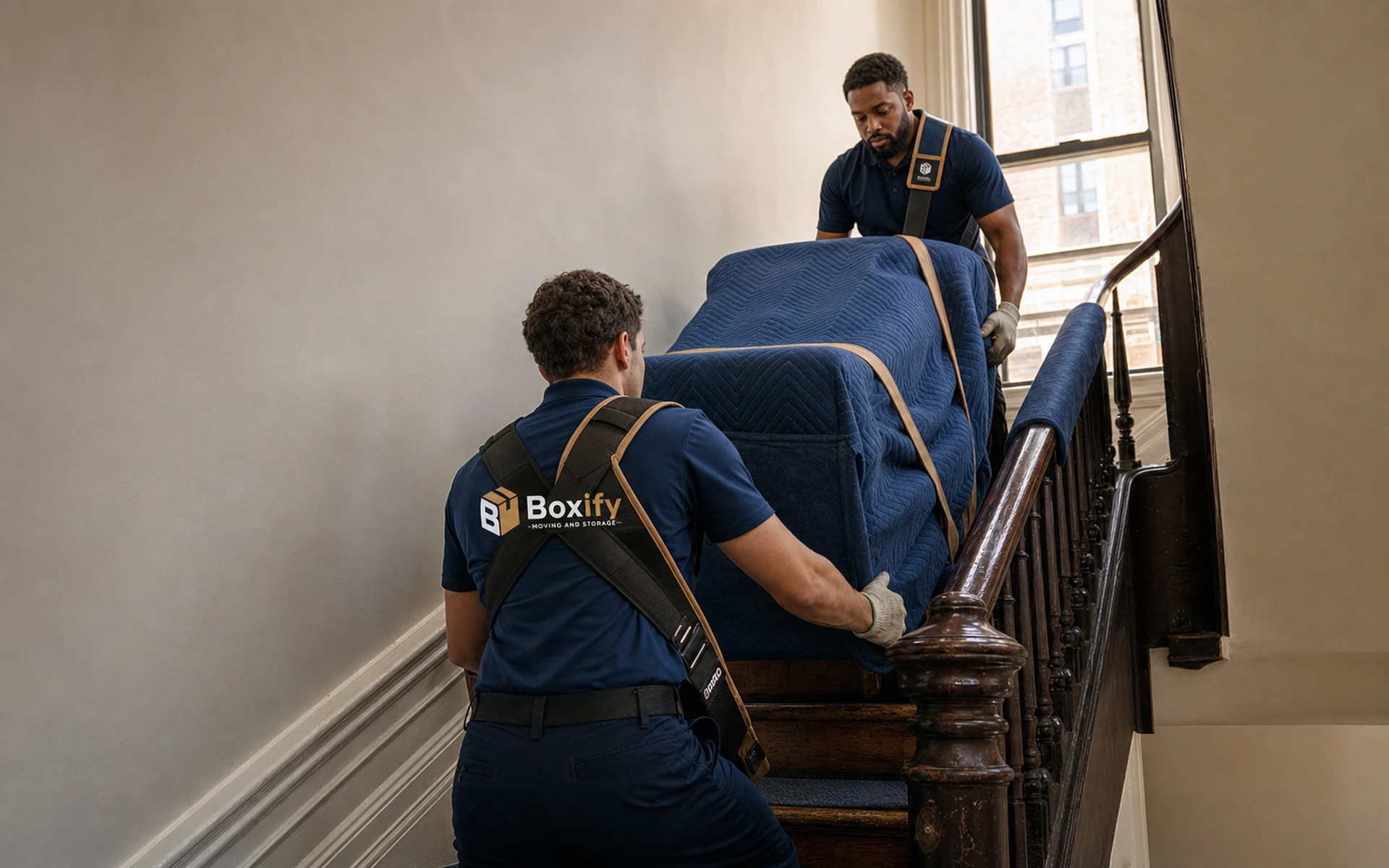
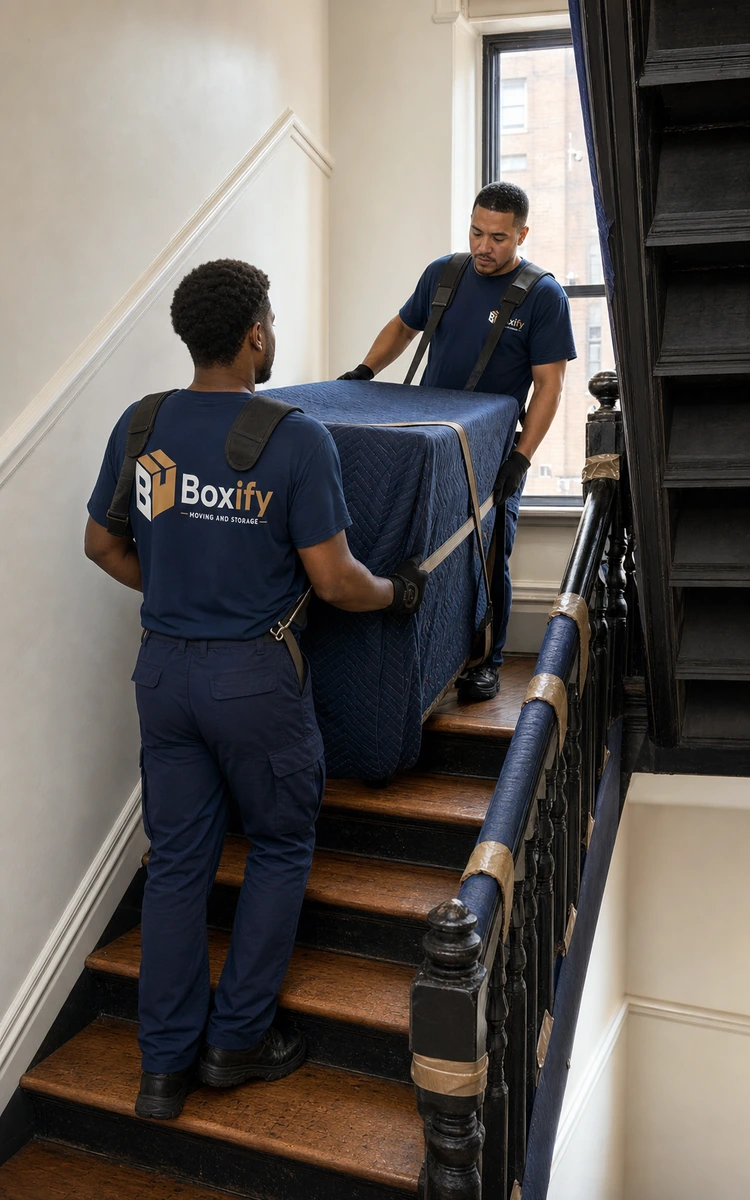
The single most misunderstood driver is stairs, and here's the part most pages get wrong: NYC movers charge for stairs per flight above the first floor, not as one flat "stair fee." Typical NYC market ranges run about $25 to $100 per flight above the first floor.
That per-flight math is why two similar apartments price so differently. A walk-up (a building with no elevator, where everything moves by stairs) on the fourth floor is roughly three flights above the ground floor, so the crew climbs and descends those same flights on every trip carrying your things. A second-floor unit is one flight; a fourth-floor walk-up is three. When stairs apply, this fee is near-universal, reflecting real, repeated labor.
The deeper logistics of building access (how a Certificate of Insurance gets approved, how you reserve a freight elevator, how a doorman gates move day) are their own topic. Here we're staying on what moves the price.
Long carries: when the truck can't park close
A long carry is when the movers have to carry your belongings a long distance between the truck and your door, usually charged when the truck can't park close. In NYC, where a legal loading spot is rarely right at the curb, this one comes up a lot: typical market ranges run $50 to $150, and like stairs, it's near-universal when it applies.
It isn't padding; it's paid time on foot. The farther the crew walks each box, sofa, and mattress, the longer the job runs, so honest movers name the long carry up front instead of springing it on move day.
Elevator buildings and reservation windows
An elevator building can be easier on the crew than a walk-up, but it carries its own situational fee. Typical NYC ranges are $50 to $200, and $400+ at luxury or high-rise buildings.
Most elevator moves use the building's service (freight) elevator, reserved for a set window on a weekday. The mechanics of booking that window, along with the Certificate of Insurance (COI, the document that proves a mover carries the liability coverage your building requires before letting the crew in), belong to the logistics of building access, a separate topic from pricing. For pricing, the point is simpler: an elevator fee only hits some jobs, so it's situational, not standard.
Bulky and specialty items
Bulky and specialty items (a piano, fine art, antiques) cost more to move because they genuinely need special handling and equipment, not because a mover is padding the bill. Boxify handles specialty and fragile pieces with white-glove care: the wrapping, the gear, and the crew time to move a piano safely are simply more than a job of ordinary boxes and furniture.
There's no standard market number for this, and we won't invent one; the cost depends entirely on the specific item and how it has to be moved. The honest move on your side is to name your specialty pieces up front and ask exactly what each one will take, so it's in the written quote rather than a surprise on the truck.
Timing: season, week, and day
Timing swings a NYC move's price by roughly 15 to 30%: summer, weekends, and the end of the month run higher, while a weekday (Tuesday to Thursday), mid-month, off-season move is the cheapest. The driver is NYC's heavy first-of-month lease turnover: when everyone's lease flips on the 1st, demand spikes and prices follow.
That's the overview. The full money-saving playbook (which weeks, which days, how far the swing goes by season) lives in the cheapest time to move in NYC. If your date is flexible, it's the single easiest lever to pull.
Parking and permits: why the "permit fee" isn't a city charge
Here's the honest tell most pages skip: the parking or permit line on your quote is the mover's service fee for handling the paperwork; the NYC DOT moving permit itself is free. Typical ranges run $20 to $250, and that charge covers the mover's time to arrange legal truck access for loading, not a fee the city collects.
It matters because a lot of pages imply the parking line is a government charge you simply have to eat. It isn't. NYC DOT doesn't sell you a paid "reserved space" for move day, so if a quote frames parking as a mandatory city fee, that's a fair thing to ask about. An honest mover explains the line for what it is: their service, priced up front.
What you can control, and how an honest quote prices it in
The good news is that most of what drives your number is knowable before anyone lifts a box, which is exactly why an honest quote asks about it up front instead of guessing. That's the process Boxify runs, and it's the difference between a real number and a lowball that grows.
To quote your move accurately, Boxify asks you to have a few things ready:
- Your floor number and walk-up vs. elevator at both ends of the move
- Whether there's a long carry or tricky parking at pickup or delivery
- Any specialty items (a piano, art, antiques)
- Whether your building requires a COI
- Your target move date, a full inventory, and both pickup and delivery addresses
Those answers get folded into a fully itemized written quote, the kind we break down line by line in how to read a NYC moving quote. Most Boxify moves are quoted as a binding, guaranteed price, so the price you're quoted is the price you pay. Boxify's quotes are free and upfront, from an in-house crew serving Greater NYC out of Queens. If you'd rather see your building access priced in now than discover it on moving day, that's exactly what a free, no-surprise estimate is for.
FAQ
Do NYC movers charge for stairs?
Yes, and it's charged per flight above the first floor, not as one flat fee. Typical NYC market ranges run about $25 to $100 per flight. So a fourth-floor walk-up (about three flights up) costs meaningfully more than a second-floor unit, because the crew carries every item up and down those flights. When stairs apply, the charge is near-universal.
What is a long-carry fee?
A long carry is when the movers have to carry your belongings a long distance between the truck and your door, usually charged when the truck can't park close. In NYC it's common, and typical market ranges run $50 to $150. It reflects the extra time on foot, so honest movers name it up front rather than adding it on move day.
Do movers charge more for a piano?
Yes, pianos, antiques, and art cost more because they need special handling and equipment. There's no standard market price for it; a mover prices each piece to how it actually has to be moved, so name your specialty items up front and ask what each will take, so it lands in the written quote instead of as a surprise.
Does moving cost more on weekends?
Yes. Timing swings a NYC move's price by roughly 15 to 30%: weekends, summer, and month-end run higher, while a weekday, mid-month, off-season move is the cheapest, driven by NYC's first-of-month lease turnover. For the full timing playbook, see the cheapest time to move in NYC.
Does an elevator building cost less than a walk-up?
Often, yes. Stairs in a walk-up are charged per flight above the first floor, roughly $25 to $100 a flight in the NYC market, so a high walk-up adds up fast. An elevator building usually avoids that, though a reserved service elevator can carry its own situational fee (about $50 to $200, and $400+ at luxury high-rises).
Does crew size or the number of hours change the price?
Yes. On an hourly move you pay per mover, per hour, so both the crew size and how long the job takes drive the total. NYC movers commonly charge about $60 to $150 per mover per hour, and a bigger crew can finish faster even at a higher hourly rate, so the fastest option isn't always the priciest.
It's usually your building and your timing, not a rip-off
A higher NYC quote usually isn't a mover padding the bill; it's your building and your calendar doing the math. Stairs are counted per flight, long carries add up when the truck can't park close, elevators and COIs and parking are situational, specialty items need real handling, and timing alone can move the total 15 to 30%. None of it should be a mystery. The fix is simple: get every driver named and priced before you book, so the number you see is the number you pay.
Want your building access priced in up front?
If your quote came in higher than expected, the honest next step is to see it itemized: every driver named, nothing saved for moving day. That's what a straight, no-surprise estimate does: it asks about your access up front so the price you're quoted is the price you pay. It's free, upfront, and itemized, with every driver named before the truck arrives.
Get a free, no-surprise Boxify estimate








- What a NYC move actually costs. The full, line-by-line cost breakdown by home size.
- The cheapest time to move in NYC. The mid-week, mid-month, off-season money-saver, in depth.
- Your NYC moving budget checklist. Every cost pulled into one place to plan for.
- The logistics of building access (COIs, freight-elevator reservations, and how buildings gate move day) are their own topic, separate from what drives your price.
- NYC moving-market ranges (multiple independent NYC movers, 2025-26). These are the add-on fee ranges cited here as market context, not Boxify prices: stairs per flight above the first floor, long-carry, elevator (with the higher luxury/high-rise cap), COI, and parking. The NYC DOT moving permit itself is free; the parking charge is the mover's service fee for pulling it.
- Multiple NYC moving sources (2025-26): the seasonal, day-of-week, and month-end price swing of roughly 15 to 30%, driven by NYC's first-of-month lease turnover.
- Multiple NYC movers: the hourly per-mover rate range cited in this guide, as market context only, not a Boxify price.
Fee and timing ranges reflect NYC market context (2025-26) and are refreshed when the market moves.
Rita Penn, Author. Rita Penn is a copywriter with over eight years of experience writing for home service businesses and service providers. She specializes in the moving and storage industry and has created content for several moving companies, along with businesses across other service-based industries.
Eddie Torr, Editor. Eddie Torr is an AI content editor: the independent quality-and-compliance gate every draft passes before it advances. He checks each claim against its approved source, tests the piece against the editorial standards, ranks it, and returns a verdict. He never rewrites the piece himself and never approves delivery; a human reviewer does that.
Maya Ellison, Reviewer. Maya Ellison is an editorial lead with more than 11 years across copywriting, editing, content strategy, and editorial operations. She holds a bachelor's in Communications (Professional Writing and Digital Media) and a master's in Information and Knowledge Management. Those are the two sides of her work: creating clear content, and building the systems that produce it consistently. She gives every piece a final human review before it ships, confirming each claim is fairly represented, tied to a checked source, and dated.
Reviewed on this post: On this guide she confirmed that stairs read as per flight (never a flat fee), that the elevator and parking figures carry their situational and luxury caveats, that the bulky-item driver stays qualitative with no invented price, and that every market range reads as NYC market context, not a Boxify quote.