
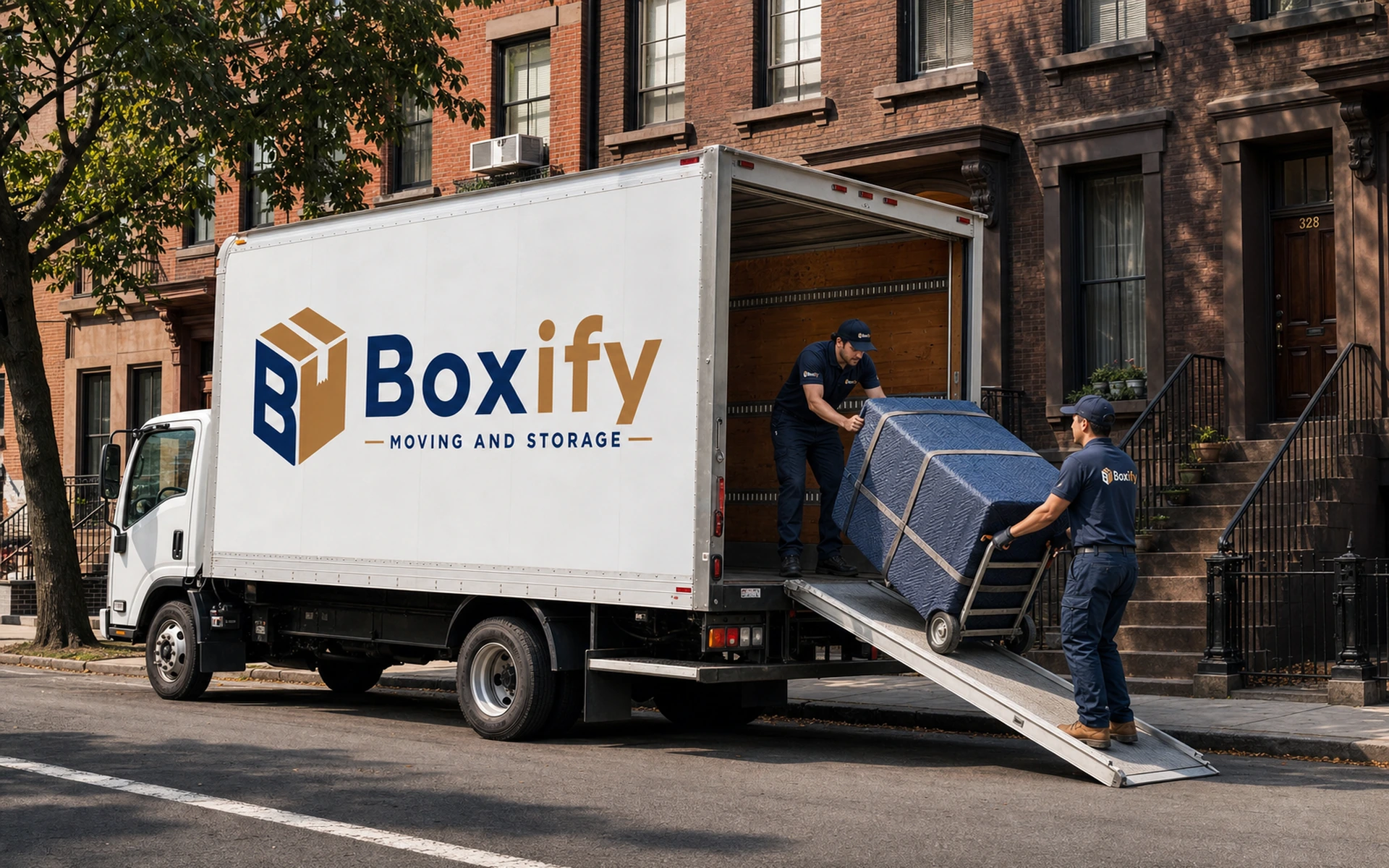
Parking a Moving Truck in NYC: Where It Can Legally Park (and Why You Can't Reserve a Spot)
Move day is close, your street is narrow or always packed, and you're staring at the curb wondering how a big truck is supposed to fit out front. Somewhere you heard you can get a permit to save the spot, the way a friend in another city did. It's a fair assumption, and in New York it's wrong.
The city doesn't work that way, and knowing the real rules now saves you a frustrating morning later. This post gives you the honest answer, the places a truck can legally park, and how a crew that does this every week works the curb. If you want the whole move-day picture, start with your NYC move-in day playbook; here we zoom in on the truck.
Can you reserve a parking spot for a moving truck in NYC?
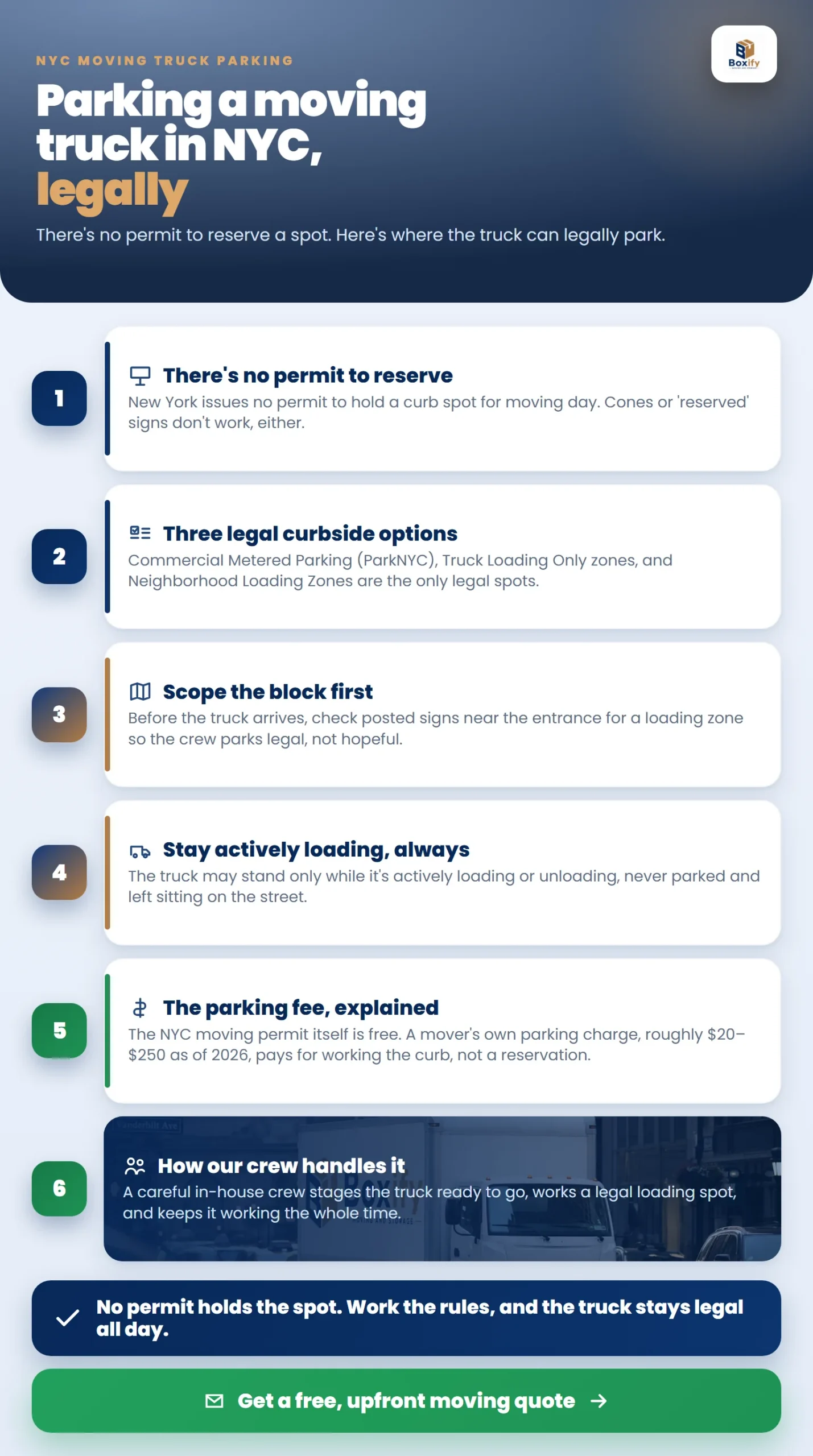
No. You can't reserve a parking spot for a moving truck in NYC. As of 2026, the Department of Transportation (NYC DOT) offers no permit to hold a space, and cones or "reserved" signs aren't allowed. A moving truck may stand only while actively loading or unloading, using metered commercial parking or a legal loading zone.
The short version
- No permit reserves a public street spot in NYC; the city doesn't issue one.
- Cones, "reserved" signs, or a friend standing in the space won't hold it either.
- A moving truck may stand only while actively loading or unloading.
- The legal curbside options are Commercial Metered Parking (ParkNYC), Truck Loading Only zones, and Neighborhood Loading Zones.
- A truck can't be stored on the street or left overnight in a residential area.
- Any "moving permit" fee a mover quotes is their service charge, not a reservation.
Why there's no permit to reserve the spot
No. There is no legal way to reserve or "hold" a public street parking space for a move in New York City. According to NYC DOT (as of 2026), the city issues no permit for it, and cones, "reserved" signs, or having someone stand in the spot aren't allowed either.
This is the part most people get wrong, and it's an easy mistake. Plenty of other cities do sell a temporary "no parking" permit that reserves curb space for moving day, so a friend who moved in another city may swear by it. New York simply doesn't offer that. Calling the local precinct to hold a space won't work, and neither will putting out cones the night before.
Once you know that, the question stops being "how do I reserve the spot?" and becomes "where can the truck legally park, and how do I make it work?" That has a real answer.
Where a moving truck can legally park in NYC
A moving truck can legally park in one of the city's regulated curbside loading spots, as long as it's actively loading or unloading. A loading zone is a stretch of curb where a commercial vehicle may stop to load or unload; it can't be reserved, and a moving truck may use it only while it's actively working.
Here are the three legal options NYC DOT provides, as of 2026:
- Commercial Metered Parking. Curb spots signed "Commercial Vehicles Only," paid through the ParkNYC app. A moving truck is a commercial vehicle, so it can use these while loading.
- Truck Loading Only zones. Curb set aside specifically for commercial loading and unloading during the posted hours on the sign.
- Neighborhood Loading Zones. Mixed-use curb where commercial vehicles get a short, timed window to load, shared with the block.
Whichever one you use, the same rule governs all of them: the truck stands only while it's actively loading or unloading. None of these can be booked ahead, so the move is a matter of finding a legal spot on the day and keeping the truck in active use while it's there.
What about parking overnight or leaving the truck on the street?
A moving truck can't be stored on the street or left overnight in a residential area. Under NYC DOT rules (as of 2026), it's a commercial vehicle that may stand only while actively loading or unloading, not one that parks and sits.
In practice that means the truck isn't meant to camp out front of your building. It shows up to load or unload, does the work, and moves on. If there's a gap in the day, or the truck arrives before you're ready, that's the mover's problem to manage, not a reason to leave it parked and unattended on a residential block overnight.
Do you need a permit, and do movers charge a parking fee?
You don't need a permit, and you can't get one that reserves a public spot. So if a moving quote lists a "parking permit" or parking fee, read it for what it is: a service charge, not a reservation.
Here's the honest breakdown. The NYC DOT moving permit itself is free, and it doesn't hold a space for you. When a mover charges a parking fee, that's their own situational service charge for handling the truck's parking logistics, and it runs roughly $20 to $250 depending on the job (multiple NYC movers, as of 2026). It pays for the labor and hassle of working the curb, not for a reserved spot, because no such reservation exists.
How a careful in-house crew handles truck parking on moving day
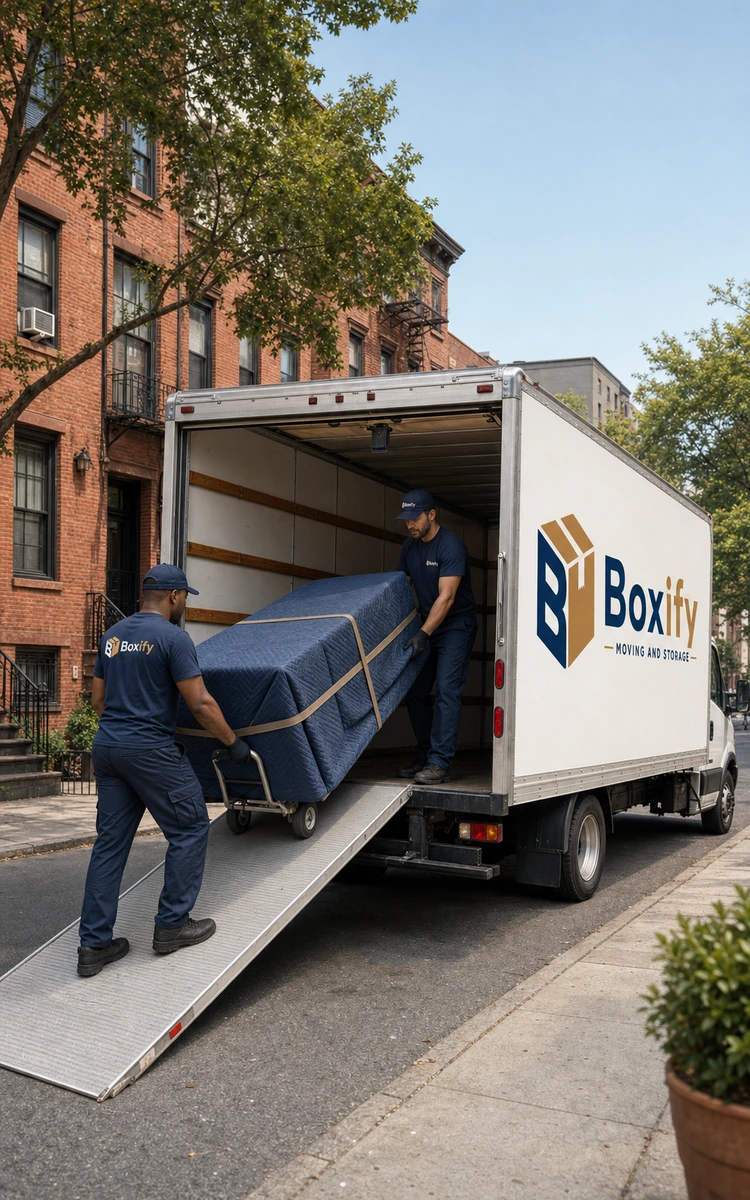
On a residential move, a careful in-house crew works the parking law rather than fighting it. Because nothing lets you hold the curb in advance, the practical way to keep your working space is to keep the truck in continuous, active use, with the crew staged and ready before it pulls in. Here's what that looks like on a tight block.
- Scope the block first. Before the truck arrives, someone reads the curb for a Truck Loading Only or Neighborhood Loading Zone near the entrance and checks the posted signs, so the crew parks legal, not hopeful.
- Stage the truck to stay working. The truck pulls in and stays actively loading or unloading the whole time, because that active use is exactly what makes the spot legal.
- Use a metered commercial spot when one's there. Where the block offers Commercial Metered Parking, the crew pays through ParkNYC at a "Commercial Vehicles Only" sign.
- Work the narrow-street reality. On a one-lane street with no open curb, the crew keeps the load moving so the truck is never just sitting, and coordinates the curb-to-door carry to keep it quick.
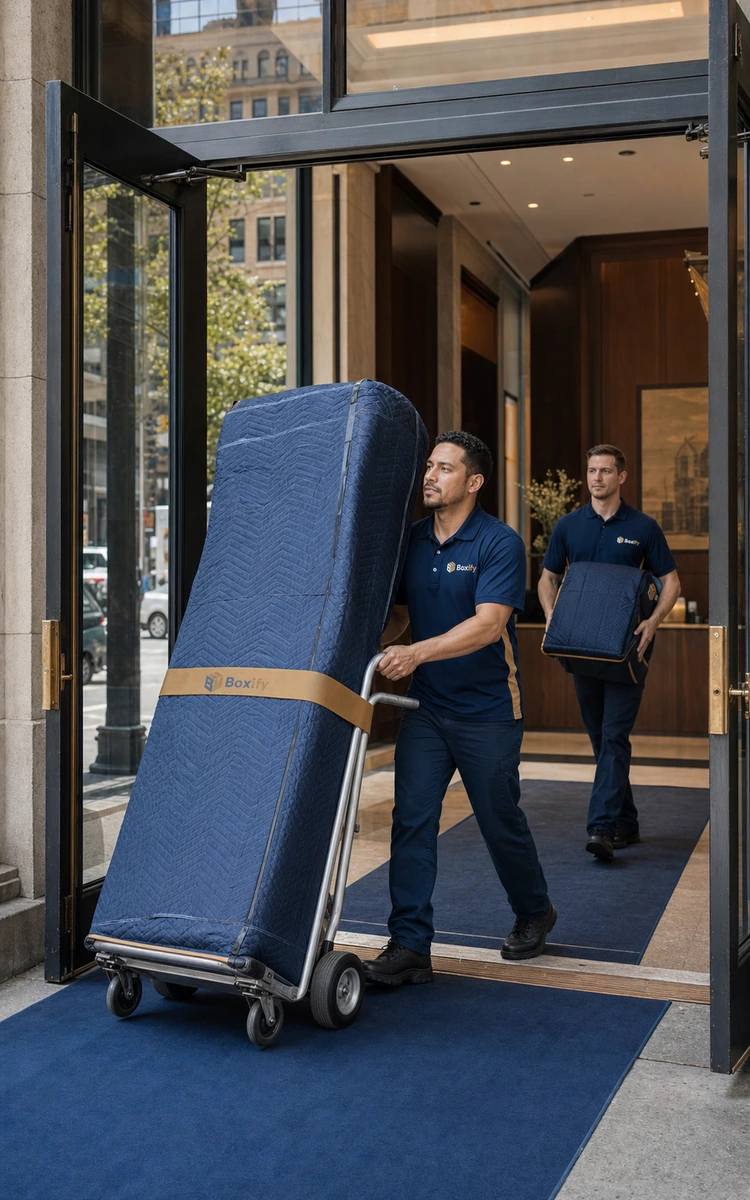
One thing you can reserve is the building's elevator, if you're in an elevator building. That's a booking you make with management ahead of time, and it's worth doing early; here's how reserving your building's elevator works. The street spot, though, stays first-come on the day.
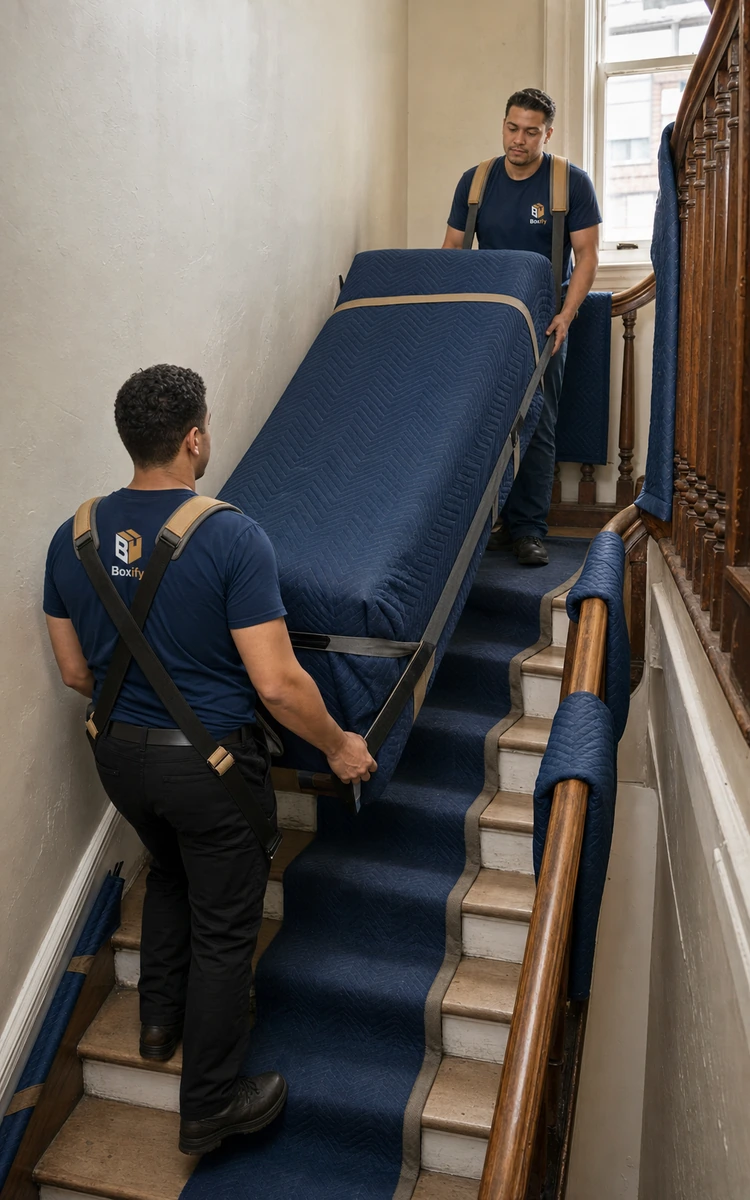
If choreographing the curb isn't how you want to spend move day, a careful in-house crew can handle the truck side within these rules, and you can read how Boxify handles building access across the rest of your move.
Frequently asked questions
Can I reserve street parking in NYC for a moving truck?
No. There is no legal way to reserve or hold a public street parking space for a move in NYC, and the city issues no permit for it. Cones and "reserved" signs aren't allowed either. The move works within the loading and unloading rules and the legal loading zones.
Do I need a permit to park a moving truck in NYC?
No permit reserves a space for you, so there's nothing to buy for that. A moving truck is a commercial vehicle that may stand only while actively loading or unloading, in metered commercial parking or a legal loading zone.
Can I park a moving truck on the street?
Yes, but only while it's actively loading or unloading. A moving truck is treated as a commercial vehicle in NYC, so it can use the curb to work, but it can't be stored on the street or parked and left sitting.
Where can I park a moving truck overnight in NYC?
You don't. A moving truck can't be stored on the street or left overnight in a residential area under NYC DOT rules. It comes to load or unload and then moves on, so it isn't left out front between jobs.
Where should the moving truck park on moving day?
In a legal loading spot near your entrance: Commercial Metered Parking (paid via ParkNYC at "Commercial Vehicles Only" signs), a Truck Loading Only zone, or a Neighborhood Loading Zone, kept in active use while the crew works.
Do movers charge a parking or permit fee?
Sometimes, but it's a service fee, not a reservation. The NYC DOT moving permit itself is free; a mover's parking charge is a situational service fee for handling the truck's curb logistics, roughly $20 to $250 depending on the job.
No permit holds the spot, so work the rules
There's no permit and no legal way to reserve a public street spot for a moving truck in NYC. A truck may stand only while actively loading or unloading, and the legal places to do it are Commercial Metered Parking, Truck Loading Only zones, and Neighborhood Loading Zones. Get those right, or hand the curb to a crew that parks a truck on NYC blocks every week, and move day starts a lot calmer.
Want the truck side handled?
A careful in-house crew can work the parking within the rules on your move, so you're not the one reading curb signs on the day. The quote is free and upfront, so you know the number before anything's booked.
Get a free, upfront moving quote




- Your NYC move-in day playbook: the calm, complete master walkthrough of what a NYC building asks for on moving day, from COIs to elevator windows.
- Reserving your building's elevator: the one move-day thing you actually can book ahead, and how long a window you get.
- How Boxify handles building access: the building-side paperwork and access, handled for you.
- NYC DOT (parking rules for commercial vehicles and the city's curbside loading options, as of 2026): a moving truck may stand only while actively loading or unloading, there is no permit to reserve or hold a public spot, and the legal options are Commercial Metered Parking (ParkNYC), Truck Loading Only zones, and Neighborhood Loading Zones.
- Multiple NYC movers (add-on fee context, as of 2026): a mover's parking charge is a situational service fee, roughly $20 to $250; the NYC DOT moving permit itself is free.
Parking rules and program names reflect NYC DOT guidance as of 2026 and are re-checked when the city updates them.
Rita Penn, Author. Rita Penn is a copywriter with over eight years of experience writing for home service businesses and service providers. She specializes in the moving and storage industry and has created content for several moving companies, along with businesses across other service-based industries.
Eddie Torr, Editor. Eddie Torr is an AI content editor: the independent quality-and-compliance gate every draft passes before it advances. He checks each claim against its approved source, tests the piece against the editorial standards, ranks it, and returns a verdict. He never rewrites the piece himself and never approves delivery; a human reviewer does that.
Maya Ellison, Reviewer. Maya Ellison is an editorial lead with more than 11 years across copywriting, editing, content strategy, and editorial operations. She holds a bachelor's in Communications (Professional Writing and Digital Media) and a master's in Information and Knowledge Management. Those are the two sides of her work: creating clear content, and building the systems that produce it consistently. She gives every piece a final human review before it ships, confirming each claim is fairly represented, tied to a checked source, and dated.
Reviewed on this post: Maya checked every parking-law statement against NYC DOT and confirmed each one ships attributed and dated. She verified the post names no permit to reserve a spot and frames any mover parking fee as a service charge, not a reservation.