

Moving Insurance vs. Valuation in NYC: Is Your Stuff Actually Covered When You Move?
This is for anyone in NYC about to hand their belongings to a moving crew and wondering, honestly, "am I actually covered?" You probably think you are, by the mover's insurance or your renters policy, and you're mostly not. If you want the whole moving-day picture first, start with your NYC move-in day playbook. Here, we'll stick to one question: what actually protects your stuff, and what only looks like it does.
Moving insurance and valuation in NYC: the short version
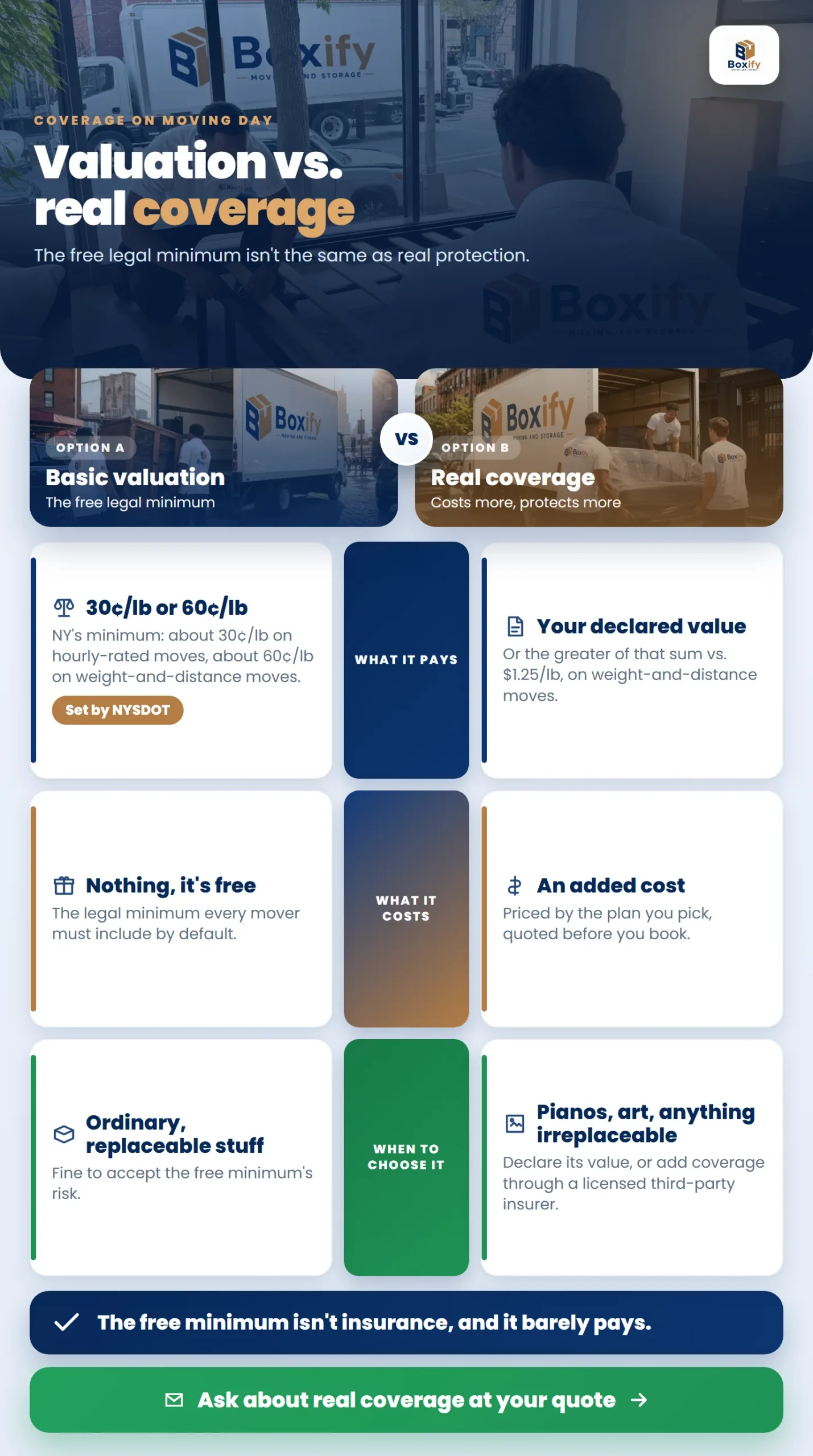
Valuation is not insurance. It's a mover's built-in liability limit, and its free level pays as little as 60¢ per pound, about $6 for a lost 10-pound item worth $1,000. Real coverage, which protects your belongings at their value, is a separate purchase that costs extra.
The gap is bigger than most people expect. On the free minimum, a mover pays you by the pound, not by what something was worth, so a lost box of electronics can pay a few dollars. Your own home policy works differently again. This guide walks through each one.
The short version
- Valuation is not insurance. It's a mover's built-in liability limit, and its free default pays as little as 60¢ per pound, per item.
- The free minimum barely pays. A lost 10-pound item worth $1,000 pays about $6 under Released-Value protection on an interstate move (FMCSA).
- New York sets its own numbers. For a move within NY State, basic liability runs about 30¢ per pound on hourly moves and 60¢ per pound on weight-and-distance moves (NYSDOT).
- Your renters or homeowners policy helps only a little. It provides limited coverage for belongings in transit, and your deductible still applies.
- Real coverage exists, for a cost. Full-value or declared-value protection pays your belongings at their value; decide by what you'd hate to lose.
- Boxify offers value-based coverage through a licensed third-party insurer, in more than one plan, quoted at booking.
Valuation is not insurance: the real difference
Valuation is a mover's built-in liability limit, not insurance, and on the free default it covers as little as 60¢ per pound. That catches most people off guard, because "valuation" sounds like a policy that pays you back. It doesn't. According to the Insurance Information Institute, a mover's valuation is not technically insurance and isn't governed by state insurance law.
On an interstate move, federal rules actually start you in the safer place. The FMCSA sets Full-Value Protection as the default liability level, so your goods are covered at their replacement value unless you actively sign that protection away in writing. The free option you'd be trading down to is Released-Value protection: the mover is liable for just 60¢ per pound, per item. Real moving insurance, or full and declared-value coverage, protects your belongings at their value for an added cost.
Here's the same idea side by side:
| Valuation (the free default) | Real coverage (full or declared value) | |
|---|---|---|
| What it is | The mover's built-in liability limit, not insurance | Protection that pays your belongings at their value |
| What it pays | As little as 60¢ per pound, per item | Up to your goods' actual or replacement value |
| What it costs you | Nothing, but you waive the fuller protection in writing | An added cost, quoted before your move |
| A lost $1,000, 10-lb lamp | About $6 | Its real value |
The default levels above are the federal (FMCSA) rules for interstate moves. New York State sets its own figures, which is the next section.
What the free minimum actually pays if something breaks
On the free minimum, a mover pays by weight, not by value, so what you'd get back has almost nothing to do with what an item was worth. On an interstate move, the FMCSA fixes that minimum at 60¢ per pound, per item under Released-Value protection. A 10-pound lamp worth $1,000 would pay about $6. That's the number that stops people cold, and it's exactly why valuation is not insurance.
A move within New York State follows NYSDOT's rules, not the federal ones, and the basic released liability depends on how your move is billed:
- On an hourly-rated move, basic liability is about 30¢ per pound, per article.
- On a weight-and-distance move, it's about 60¢ per pound.
- If you declare a higher value in writing on a weight-and-distance move, the mover's liability becomes the greater of your declared amount or $1.25 per pound.
- Under a written binding estimate, your shipment is valued at $5,000 unless you reject that figure in writing, in which case it drops back to 60¢ per pound.
Whichever method applies, New York's default minimum won't pay anywhere near your goods' value unless you declare their actual cash value or buy full-replacement-value protection, both of which cost more. The two NY bases are different, so it's worth knowing which one your quote is built on before you sign.
Does my renters or homeowners policy cover a move?
Your renters or homeowners policy is not the safety net most people assume it is on moving day. It provides only limited coverage for your belongings while they're in transit, and your policy deductible still applies. So "my renters insurance has me covered" is mostly wrong for the move itself.
The Insurance Information Institute is clear that a home or renters policy covers goods in transit only in a limited way, and that a mover's valuation is a separate thing entirely and not technically insurance. In practice, if a deductible sits in front of a claim, a modest loss may not be worth filing at all. It's fine to call your own insurer and ask exactly what a move is covered for. Just don't assume the answer is "everything."
Storage during a move is a separate question with its own coverage rules, and it isn't what this post is about. Here, we're only talking about the trip from your old place to your new one.
Do you need moving insurance, and how to protect your valuables
You need real moving coverage when the value at risk is high enough that losing it would genuinely hurt, and you can skip it when most of what you're moving is easily replaceable. If your load is mostly ordinary, everyday things, the free minimum may be a risk you're willing to take. If you're moving a piano, original art, antiques, or anything you couldn't buy again, the 60¢-per-pound default is not where you want that risk to sit.
This is where a careful crew earns your trust before the truck ever shows up. Because Boxify's moves are handled by its own in-house crew rather than subcontracted out, the conversation starts at the quote. When we build your number, we ask what you're moving, including any specialty items like a piano, art, or antiques, so nothing valuable quietly rides on the 60¢-per-pound minimum.
For belongings worth protecting at their real value, Boxify offers value-based coverage through a licensed third-party insurer, in more than one plan. What it costs and exactly what it covers depend on the plan you choose, so it's quoted at booking rather than pinned to a number here. The point isn't to sell you a policy. It's to make sure you decide with the real math in front of you.
Want a hand sorting out what's worth protecting? Ask for a free, upfront quote and we'll walk you through it.
The two sides of insurance on a move
There are really two kinds of insurance in play on a NYC move, and they protect different people. This post is about one side: coverage for your belongings. The other side is the building's certificate of insurance, which protects the building itself, not your stuff.
If your co-op, condo, or rental is asking your mover for paperwork before move day, that's the certificate of insurance, and it's a different topic with its own guide. While you're weighing your own coverage, it's also worth seeing how Boxify handles the building side so the paperwork isn't your problem.
Frequently asked questions
What's the difference between valuation and moving insurance?
Valuation is a mover's built-in liability limit, not insurance, and it isn't governed by state insurance law. Its free level, Released-Value protection, pays as little as 60¢ per pound, per item. Real moving insurance, or full-value protection, covers your belongings at their value for an added cost.
Does my renters or homeowners insurance cover my belongings during a move?
Only in a limited way. A homeowners or renters policy provides limited coverage for belongings in transit during a move, and your policy deductible applies. So it's rarely the full safety net people assume. It's worth calling your own insurer to ask exactly what a move is covered for. (Storage is a separate question with its own rules.)
What does a mover pay if they lose or break something?
Under the free minimum, as little as 60¢ per pound, per item, so a lost 10-pound item worth $1,000 pays about $6 on an interstate move (FMCSA). For a move within New York State, basic liability runs about 30¢ per pound on hourly moves and 60¢ per pound on weight-and-distance moves (NYSDOT). Declaring a higher value or buying full-replacement protection pays far more.
Do I need moving insurance for a NYC move, and is it worth it?
New York's default minimum won't pay anywhere near your goods' value unless you declare their actual cash value or buy full-replacement-value protection. It's worth it when the value at risk is high, for fragile, valuable, or irreplaceable items. If most of your load is easily replaceable, the free minimum may be a risk you're comfortable taking.
How do I protect valuable or fragile items when I move?
Declare a higher value or buy real coverage rather than leaving valuables on the 60¢-per-pound default, and tell your crew about specialty items, like a piano, art, or antiques, up front. Boxify offers value-based coverage through a licensed third-party insurer, in more than one plan, quoted at booking.
Is valuation the same as insurance?
No. A mover's valuation is not technically insurance and isn't governed by state insurance law; it's a built-in liability limit that, at its free level, pays only 60¢ per pound, per item.
Valuation is not insurance, so protect what you can't replace
Valuation is a mover's built-in liability limit, and its free level pays as little as 60¢ per pound, or about $6 on a lost $1,000 item. Your renters or homeowners policy helps only a little in transit, and your deductible still applies. Real coverage exists for a cost, and the honest way to decide is by the value you'd hate to lose. Now that you know what actually protects your stuff, the last step is a number you can trust.
Get your move quoted, with the coverage spelled out
Ready to protect what matters and see your real number?
Get a free, upfront Boxify moving quote
Tell us what you're moving, including anything valuable or fragile, and we'll walk you through your options up front, no pressure.





- Your NYC move-in day playbook: the calm, complete walkthrough of what a NYC building needs on moving day, with links to every piece of it.
- The building's certificate of insurance: the other side of insurance on a move, what a COI is, and why your building demands one before letting movers in.
- How Boxify handles the building side: how a careful in-house crew takes the building paperwork and access off your plate.
Every insurance and liability figure is attributed to its source and dated. These describe the law and industry rules in general; they are not claims about Boxify's own coverage.
- FMCSA: Full-Value Protection as the interstate default, and Released-Value protection at 60¢ per pound, per item. As of 2026.
- NYSDOT: basic released liability for a move within New York State (about 30¢/lb hourly, 60¢/lb weight-and-distance, the greater of a declared value or $1.25/lb, and the $5,000 written-binding-estimate value), and that the NY default won't pay near your goods' value without declared or full-replacement coverage. In force 2026.
- FMCSA (with NAIC): a mover's valuation is not technically insurance, and a home or renters policy covers belongings in transit only in a limited way, with the deductible applying. As of 2026.
Insurance and liability figures are as of the dates shown and reflect the rules in force; we refresh them if a regulation changes.
Rita Penn, Author. Rita Penn is a copywriter with over eight years of experience writing for home service businesses and service providers. She specializes in the moving and storage industry and has created content for several moving companies, along with businesses across other service-based industries.
Eddie Torr, Editor. Eddie Torr is an AI content editor: the independent quality-and-compliance gate every draft passes before it advances. He checks each claim against its approved source, tests the piece against the editorial standards, ranks it, and returns a verdict. He never rewrites the piece himself and never approves delivery; a human reviewer does that.
Maya Ellison, Reviewer. Maya Ellison is an editorial lead with more than 11 years across copywriting, editing, content strategy, and editorial operations. She holds a bachelor's in Communications (Professional Writing and Digital Media) and a master's in Information and Knowledge Management. Those are the two sides of her work: creating clear content, and building the systems that produce it consistently. She gives every piece a final human review before it ships, confirming each claim is fairly represented, tied to a checked source, and dated.
Reviewed on this post: Maya checked that every valuation and liability figure names its regulator and the right regime, with the interstate FMCSA numbers and the New York NYSDOT numbers kept distinct. She also confirmed the post never names an insurer or states a Boxify coverage figure, and cross-links the building's certificate of insurance without teaching it.