

Your NYC Move-In Day Playbook: What Your Building Requires and How to Get Ready
A NYC building move-in comes down to a handful of knowable requirements, and none of it has to be a surprise. Before the truck even shows up, your co-op board, condo association, or managing agent will want paperwork, a reserved elevator window, and a plan for the truck out front. It sounds like a lot. It is really just a short, knowable list.
This guide is the calm, complete map. It walks the whole building checklist in one place, separates what your building requires from what city law actually says, and points you to a focused guide for each detail, starting with what a certificate of insurance is and why your building demands one. Take a breath. Here is everything your building will ask for, and how to get ready.
What your NYC building requires on moving day, in one checklist
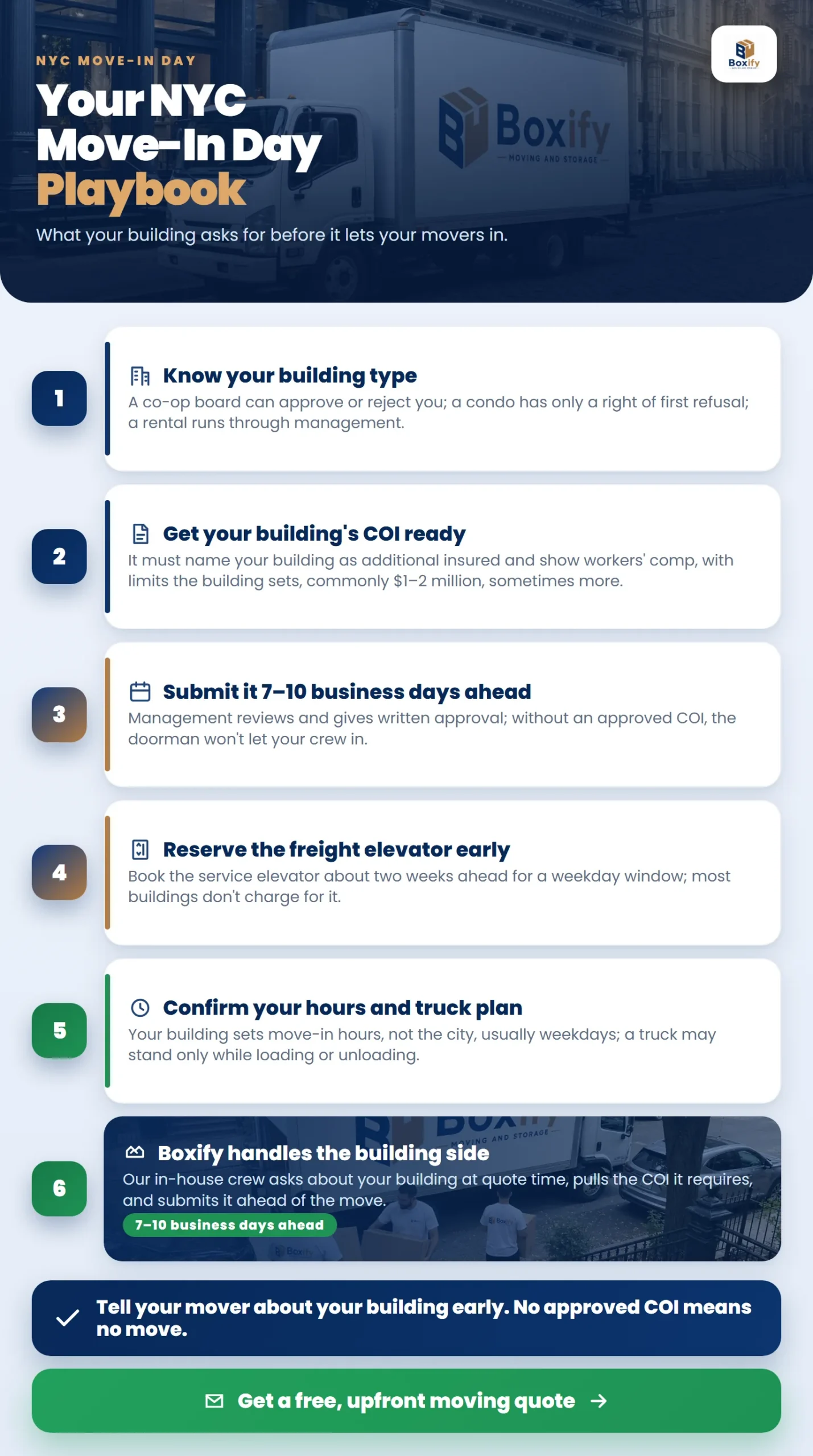
Before a NYC building lets your movers in, it usually requires five things, most arranged one to two weeks ahead:
- A certificate of insurance (COI) for your movers
- A reserved service (freight) elevator window
- The building's permitted move-in day and hours
- A truck loading and parking plan
- Any move-in fee or deposit
Key takeaways
- A COI comes first. Most NYC co-ops, condos, and managed rentals require a certificate of insurance from your movers before anyone carries a box inside.
- Reserve the elevator early. In an elevator building, book the service (freight) elevator about two weeks ahead for a two-to-four-hour weekday window; most buildings do not charge.
- Your building sets the hours, not the city. Move-in days and hours are your building's house rules, usually weekday mornings to late afternoon, with weekends often barred.
- No permit holds a parking spot. A moving truck may stand only while loading or unloading, and there is no legal way to reserve a public street space.
- Co-ops are usually the strictest. A co-op board can approve or reject you; a condo holds only a right of first refusal; a rental goes through management.
- Expect a possible fee or deposit. Many buildings charge a move-in fee or hold a refundable deposit; ask yours what applies.
- A good crew handles the building side for you. Boxify asks up front whether your building needs a COI and treats the paperwork as routine, so a move is not slowed.
What's in this guide
- What your building requires before it lets movers in
- Co-op vs. condo vs. rental: how the rules differ
- What days and hours can you move in?
- The certificate of insurance, in brief
- Getting the elevator, the truck, and the paperwork lined up
- Move-in fees and deposits, briefly
- How a careful in-house crew handles the building side
- Frequently asked questions
- Explore the rest of this series
What your building requires before it lets movers in
Almost every NYC building asks a mover for the same short list before move-in day: a certificate of insurance, a reserved elevator window, an approved move-in day and hours, a truck-parking plan, and any move-in fee or deposit. Think of it as your building's five asks. Get ahead of them and the day runs smoothly; miss one and the doorman may not let your crew in.
Here is the whole set at a glance, before we take each one in turn:
- The certificate of insurance (COI). A one-page document proving your movers carry the liability insurance the building requires. Most co-ops, condos, and managed rentals want it on file before anyone touches the door.
- The elevator reservation. In an elevator building, you book the service (freight) elevator for a set window, usually about two weeks ahead.
- The permitted day and hours. Your building decides when moves may happen, and the common pattern is weekday business hours with weekends often off-limits.
- The truck plan. There is no permit that reserves a street spot, so the plan is about legal loading zones and timing, not holding a space.
- The fee or deposit. Many buildings charge a move-in fee, hold a refundable deposit, or both; these are the building's charges, not your mover's.
Most of this is arranged one to two weeks ahead with the co-op board, the condo association, or the managing agent, whichever runs your building. The rest of this guide takes the five asks one at a time, tells you honestly which are rules and which are norms, and links you to a focused walkthrough when you want the full detail.
Co-op vs. condo vs. rental: how the rules differ
The kind of building you are moving into decides how strict the process is: a co-op is usually the tightest, a condo is lighter, and a rental runs through management. Knowing which one you are entering tells you a lot about what to expect on move-in day.
In a co-op, you do not own your apartment outright; you own shares in a corporation that owns the building, and its board can approve or reject an applicant, sometimes without giving a reason. Co-op boards tend to be the strictest on move logistics too: firmer rules on hours, COIs, elevator pads, and deposits.
In a condo, you own your unit, and the board holds only a right of first refusal, meaning it can step in to buy or match a deal but cannot simply veto you. Move-in rules exist, but they are generally lighter than a co-op's.
In a rental, there is no board at all; you deal with the landlord or the managing agent, and the requirements run through management. A large or luxury rental can still ask for a COI and a reserved elevator, so do not assume a rental means no paperwork.
The practical takeaway: if you are moving into a co-op, plan for the most paperwork and the earliest deadlines, and read your building's house rules closely.
What days and hours can you move in?
Your building, not any city law, sets your move-in day and hours in its house rules. There is no citywide NYC ordinance that says when you may move; the decision belongs to the co-op board, condo association, managing agent, or landlord, and it is written into the building's own rules.
The prevailing pattern across co-op, condo, and doorman buildings is weekdays only, roughly 9 AM to 5 PM, with weekends and holidays commonly prohibited or allowed only by special arrangement. Sunday moves are barred almost everywhere; Saturday depends on the building. This is a norm as of 2026, not a legal figure, and buildings vary, so the only reliable answer is the one in your building's house rules.
That is why the honest move is to ask your management office directly: what days are moves allowed, what hours, and is there any weekend option. Getting that in writing early keeps you from booking a crew for a day your building will not open the door.
The certificate of insurance, in brief
A certificate of insurance (COI) is a one-page document proving your movers carry the liability insurance your building requires. Most NYC co-ops, condos, and managed rentals demand one before letting movers in, which makes it the single most important piece of paperwork on this list.
Buildings ask for a COI to protect themselves, not your belongings. The certificate has to name the building's management as an additional insured and show that the mover carries workers' compensation, because no doorman building will allow a move without both. The required coverage limits are set by the building and vary widely, commonly $1 million to $2 million and sometimes $5 million or more in luxury buildings. Those are the building's required limits, not a claim about any one mover's policy.
The timing matters. The mover's COI is usually submitted to management about seven to ten business days ahead, management reviews it and gives written approval, and on move day the doorman or front desk gates access; with no approved COI, there is no move. Because this is where moves most often get stuck, it is worth a full walkthrough: see what a certificate of insurance is and why your building demands one for the annotated detail, including what a COI actually looks like.
Getting the elevator, the truck, and the paperwork lined up
In an elevator building you reserve the service (freight) elevator about two weeks ahead, and on the street no permit can hold a spot for your truck. These two logistics trip up more NYC moves than anything except the COI, so it helps to line them up early.
For the elevator, you book the service or freight elevator, not the passenger one, usually about two weeks ahead and more in peak season, for a two-to-four-hour weekday window. The building pads the elevator, usually wants the COI on file first, and most buildings do not charge, though some ask for a fee or a refundable deposit.
For how the reservation actually works, see how to reserve your building's elevator for a move.
For the truck, the honest answer surprises people: there is no legal way to reserve or hold a public street space for a move. According to the NYC Department of Transportation, a moving truck is a commercial vehicle that may stand only while actively loading or unloading, and the city offers no permit and no "reserved" cones to save a spot.
What the city does provide is regulated curbside options, such as Commercial Metered Parking, Truck Loading Only zones, and Neighborhood Loading Zones. For where a truck may legally park and how crews handle it, see where a moving truck can legally park in NYC.
Move-in fees and deposits, briefly
Many NYC buildings charge a move-in fee, hold a refundable move-in deposit, or both, and these are the building's charges, separate from what your movers cost. A move-in fee is usually non-refundable, while a move-in deposit is typically refundable, returned in whole or part if there is no common-area damage and the building's procedures were followed. These charges are per-building and not capped, so the reliable move is to ask your management office what applies rather than trust any published number.
There is a real legal frame around the rental side, though, and it is worth knowing:
- For a rental, a landlord may not charge more than one month's rent as a security deposit, under New York's Housing Stability and Tenant Protection Act (HSTPA) of 2019.
- A landlord may not demand a deposit or extra charge just to reserve an apartment; that "key money" is unlawful.
- A rental application or background-check fee is capped at $20 under New York Real Property Law §238-a.
- A rental security deposit must be returned within 14 days of move-out, again under the HSTPA.
One figure people confuse with a move-in fee is the co-op or condo board fee, which is a different charge.
When you are buying into a co-op or condo, the $20 application-fee cap does not apply, and boards commonly charge application or board fees ranging up to roughly $1,500, plus per-applicant processing fees of about $50 to $150, as of 2026. That is a purchase-side charge; a renter or subletter of a co-op or condo unit is still under the $20 cap. For the full picture on building move-in fees and who pays, see move-in fees and deposits in NYC buildings.
How a careful in-house crew handles the building side
A good NYC mover treats the building side as part of the job, not an afterthought, and Boxify handles it with its own in-house crew rather than a subcontractor. Here is what that actually looks like on a real move, step by step.
It starts before booking. When Boxify quotes a move, it asks up front what you need to have ready, including whether your building requires a COI, along with your inventory, both addresses, and the access at each end, such as floor number, walk-up or elevator, and any long carry or parking issue. Asking early is the whole trick, because it means the paperwork can start on time.
From there, the crew pulls the certificate the building requires: naming the building's management as additional insured, showing workers' compensation, and meeting that building's required coverage limits. It submits the COI about seven to ten business days ahead so management can review it and give written approval before move day. Because Boxify does this on move after move, a COI is routine, day-to-day work that does not slow a move down.
The one place this goes wrong is avoidable: a customer says no COI is needed, and it turns out the building requires one, which forces a last-minute scramble the day of the move. Telling your mover about your building up front is what keeps that from happening.
Want us to handle the building side for you? Get a free, upfront Boxify moving quote and we will walk you through the COI, the elevator window, and the truck plan, with an honest number and no surprises.
Frequently asked questions
What should be on my NYC apartment move-in checklist?
Your NYC move-in checklist has five building items: a certificate of insurance (COI) for your movers, a reserved service (freight) elevator window, your building's permitted move-in day and hours, a truck loading and parking plan, and any move-in fee or deposit. Most of these are arranged about one to two weeks ahead with your building's management. It is a short, knowable list, not an open-ended one.
Does my building require a certificate of insurance (COI) for movers?
Most likely, yes. Most NYC co-ops, condos, and managed rentals require a mover's certificate of insurance before letting anyone carry a box inside. The COI proves your movers carry the liability insurance the building requires and names the building's management as additional insured. For the full detail, see what a certificate of insurance is and why your building demands one.
What days and hours can I move into my NYC building?
Your building sets your move-in days and hours in its house rules, not any city law. The common NYC pattern is weekdays only, roughly 9 AM to 5 PM, with weekends and holidays often barred (Sunday nearly always, Saturday depending on the building) as of 2026. Because it varies by building, the only reliable answer is the one in your building's house rules, so ask your management office directly.
Do co-ops, condos, and rentals have different move-in rules?
Yes. A co-op board can approve or reject an applicant, sometimes without a reason, and tends to be the strictest on move logistics; a condo board holds only a right of first refusal; and a rental runs through the landlord or managing agent. If you are moving into a co-op, plan for the most paperwork and the earliest deadlines.
Can I reserve a parking spot for the moving truck?
No. There is no legal way to reserve or hold a public street parking space in NYC, and the city offers no permit for it. Per the NYC Department of Transportation, a moving truck may stand only while actively loading or unloading, and you use regulated curbside options like Truck Loading Only and Neighborhood Loading Zones instead. For the on-the-ground detail, see where a moving truck can legally park in NYC.
How far ahead do I reserve the building's elevator?
About two weeks ahead, and more in peak season. In an elevator building you reserve the service (freight) elevator for a two-to-four-hour weekday window, and most buildings do not charge, though some ask for a fee or refundable deposit. The building usually wants your movers' COI on file first. For the step-by-step, see how to reserve your building's elevator for a move.
Are move-in fees and deposits refundable, and are they legal?
It depends on the charge. A building's move-in fee is usually non-refundable, while a move-in deposit is typically refundable if there is no common-area damage and procedures were followed. On the legal side, a rental security deposit cannot exceed one month's rent and must be returned within 14 days of move-out under NY's HSTPA (2019), and a rental application fee is capped at $20; co-op and condo purchase board fees are separate and can run up to roughly $1,500 as of 2026. For the full breakdown, see move-in fees and deposits in NYC buildings.
A handful of knowable requirements, most arranged ahead
A NYC building move-in feels like a maze, but it comes down to five knowable requirements: a COI, a reserved elevator window, the building's permitted day and hours, a truck plan, and any fee or deposit. Most of it is arranged one to two weeks ahead with your management office, and the single thing that trips people up is treating a norm like the weekday-hours pattern as if it were law, when your building's house rules are what actually govern.
Line the five up early, ask your building the open questions, and moving day becomes ordinary. When you want a hand with the building side, the next step is a real number for your actual move.
Get your move-in day priced, building rules and all
Bracing for your building's rules and want someone who handles them every day?
Get a free, upfront Boxify moving quote
We will walk you through the COI, the elevator reservation, and the truck plan, and put an honest number in front of you, with no surprises on moving day.









This guide is the hub; each focused guide below goes deep on one part of moving day and links back up here.
The paperwork
- What a certificate of insurance is and why your building demands one. The single most confusing piece of move paperwork, explained, with an annotated example of what a COI looks like.
- Moving insurance vs. valuation, what actually protects your belongings: the other side of insurance, what covers your goods, and why 60 cents a pound is not enough.
- Move-in fees and deposits in NYC buildings: what the building actually charges, what is refundable, and the NY legal caps.
Getting in the door
- How to move into a NYC walk-up: the stairs method a careful crew uses to protect your belongings, the walls, and the stairwell.
- How to reserve your building's elevator for a move: how the service-elevator window works, how long you get, and what happens if you skip it.
- Where a moving truck can legally park in NYC. The real, on-the-ground answer to the permit question, and how to keep a spot on moving day.
Get ready and get help
- The questions to ask your building before moving day: a short, print-and-use list to take to your management office.
- How Boxify handles the building side for you: the payoff of the whole series, we handle the COIs and building access so you do not have to.
Cross-series
- What a NYC move actually costs: the honest price picture behind the whole move, by home size, with every add-on named.
Boxify's own service details (how its in-house crew handles COIs and the building side, what it asks for at quote time, and how it books a move) are stated from first-hand practice. The building requirements and every money or legal figure below are attributed and dated.
- What a COI is and that buildings require one (multiple NYC movers and real-estate outlets): most NYC co-ops, condos, and managed rentals require a mover's certificate of insurance, naming management as additional insured, before letting movers in; the COI is typically submitted about 7 to 10 business days ahead for written approval, and the doorman gates access on move day.
- The building's required coverage limits (multiple NYC movers): buildings commonly require $1 to 2 million in general liability, and luxury buildings often more, naming the building/management as additional insured; these are the building's requirement, not a statement of any mover's own coverage.
- Building types and rights (NY property law and real-estate outlets): a co-op board can approve or reject an applicant; a condo board holds a right of first refusal; a rental runs through management; co-ops are usually strictest.
- Elevator reservation norm (NYC movers and real-estate outlets): the service/freight elevator is typically reserved about two weeks ahead for a 2 to 4 hour weekday window, and most buildings do not charge.
- Truck parking law (NYC Department of Transportation): a moving truck is a commercial vehicle that may stand only while actively loading or unloading; there is no permit to reserve a public street space; regulated options include Commercial Metered Parking, Truck Loading Only, and Neighborhood Loading Zones.
- NY deposit and fee law (NYS Homes & Community Renewal; NY Real Property Law §238-a; NY General Obligations Law §7-108, HSTPA 2019): a rental security deposit may not exceed one month's rent; "key money" to reserve an apartment is unlawful; a rental application/background-check fee is capped at $20; a rental deposit must be returned within 14 days of move-out.
- Co-op/condo board fees (NY Real Property Law §238-a; NY Department of State guidance for condo boards; real-estate outlets, as of 2026): for purchase applications the $20 cap does not apply, and boards commonly charge application/board fees up to roughly $1,500 plus $50 to $150 processing per applicant; a renter/subletter of a co-op/condo unit remains under the $20 cap.
- Move-in deposit structure (Brick Underground): a co-op/condo move-in deposit is typically refundable if there is no common-area damage and procedures were followed; no fixed dollar amount is stated.
- Move-in hours (Brick Underground / Habitat Magazine / Hauseit; real-estate outlets, as of 2026): move-in days and hours are set by each building's house rules, not city law; the prevailing pattern is weekdays about 9 AM to 5 PM, with weekends and holidays commonly barred.
These figures reflect current New York law and market context as of 2026. The co-op/condo board-fee range and the move-in-hours norm are perishable and per-building; we refresh them when they move, and the reliable source is always your own building's house rules.
Rita Penn, Author. Rita Penn is a copywriter with over eight years of experience writing for home service businesses and service providers. She specializes in the moving and storage industry and has created content for several moving companies, along with businesses across other service-based industries.
Eddie Torr, Editor. Eddie Torr is an AI content editor: the independent quality-and-compliance gate every draft passes before it advances. He checks each claim against its approved source, tests the piece against the editorial standards, ranks it, and returns a verdict. He never rewrites the piece himself and never approves delivery; a human reviewer does that.
Maya Ellison, Reviewer. Maya Ellison is an editorial lead with more than 11 years across copywriting, editing, content strategy, and editorial operations. She holds a bachelor's in Communications (Professional Writing and Digital Media) and a master's in Information and Knowledge Management. Those are the two sides of her work: creating clear content, and building the systems that produce it consistently. She gives every piece a final human review before it ships, confirming each claim is fairly represented, tied to a checked source, and dated.
Reviewed on this post: On this guide she checked that move-in hours are stated as the building's house rules and not as city law. She also confirmed that the COI coverage limits are framed as the building's requirement rather than as Boxify's own coverage, that the move-in fee and deposit are described without an invented dollar amount, and that every legal figure carries its source and date.