
How to Reserve Your Building's Elevator for Moving Day (and What Happens If You Don't)
If your building has an elevator, moving day quietly depends on a small piece of paperwork most people have never heard of until they need it: the elevator reservation. Getting it right is simple once you know the steps, and it slots neatly into your NYC move-in day playbook. Skip it, though, and you can show up to a building that won't let your movers touch the elevator at all.
How to reserve your building's elevator for a move
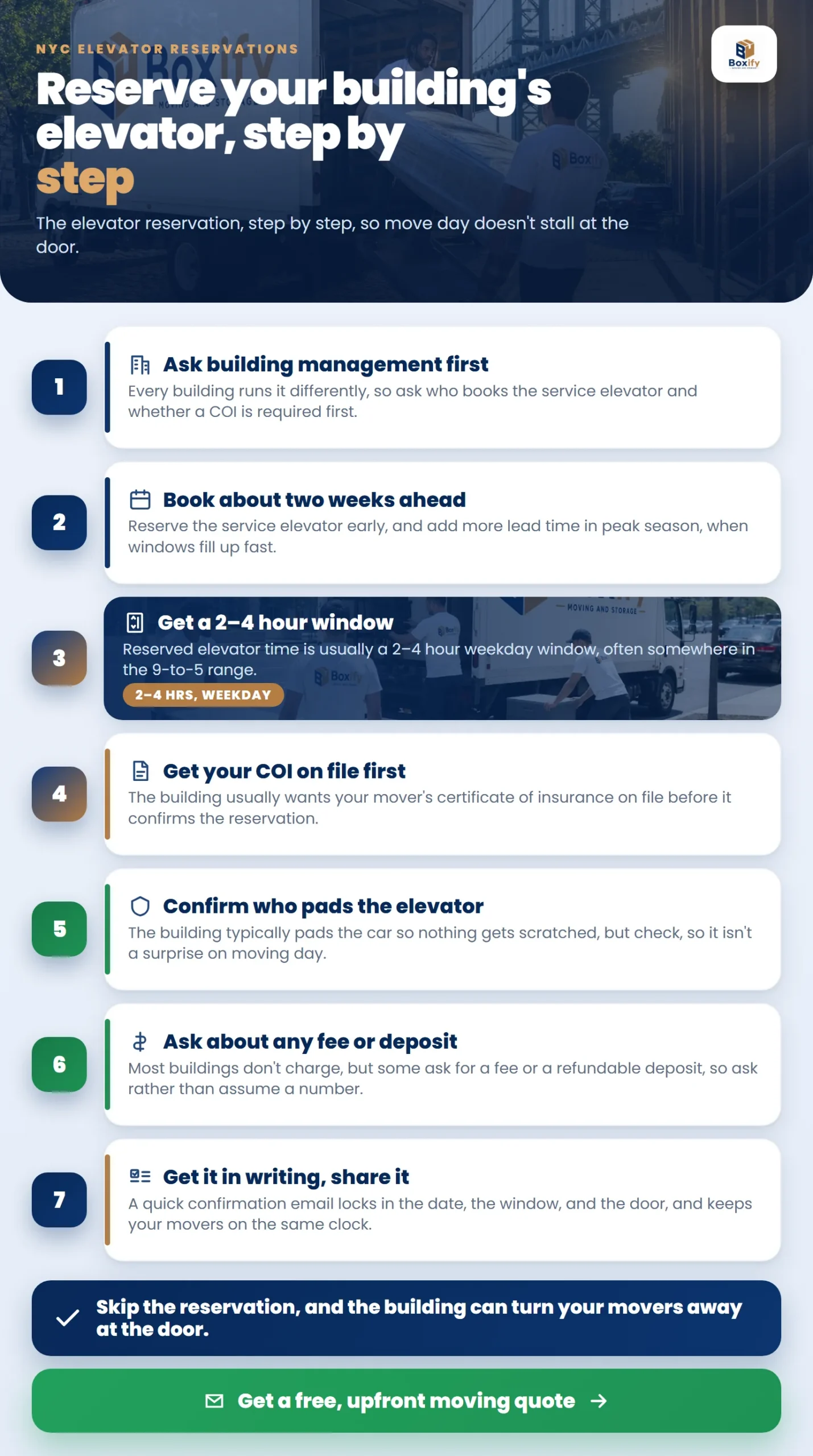
To reserve your building's elevator for a move, ask management to book the service (freight) elevator, usually about two weeks ahead, for a 2 to 4 hour weekday window; get your mover's COI on file first. Most buildings don't charge. Skip the reservation, and the building can deny elevator access on move day.
The short version
- Reserve early: book the service (freight) elevator about two weeks ahead, and more in peak season.
- You get a window, not the whole day: a 2 to 4 hour weekday slot, usually somewhere in the 9-to-5 range.
- COI first: the building usually wants your mover's certificate of insurance on file before it confirms the reservation.
- Most buildings don't charge: some ask a fee or a refundable deposit, so ask, but don't assume a cost.
- Skip it and you can be turned away: no reservation can mean no elevator on move day.
The elevator reservation, step by step
Reserving your building's elevator is a short, specific process you handle with building management, and it comes down to seven steps:
- Ask management how the building handles elevator reservations. Every building runs it a little differently, so start by asking who books it and whether your mover's COI is required first.
- Book the service (freight) elevator about two weeks ahead. Give yourself more lead time in peak season, when windows fill up fast.
- Reserve a 2 to 4 hour weekday window. You'll typically get a slot in the 9-to-5 range, so pick a start time that fits the size of your move.
- Get your mover's COI on file first. The building usually wants your mover's certificate of insurance in hand before it confirms the reservation.
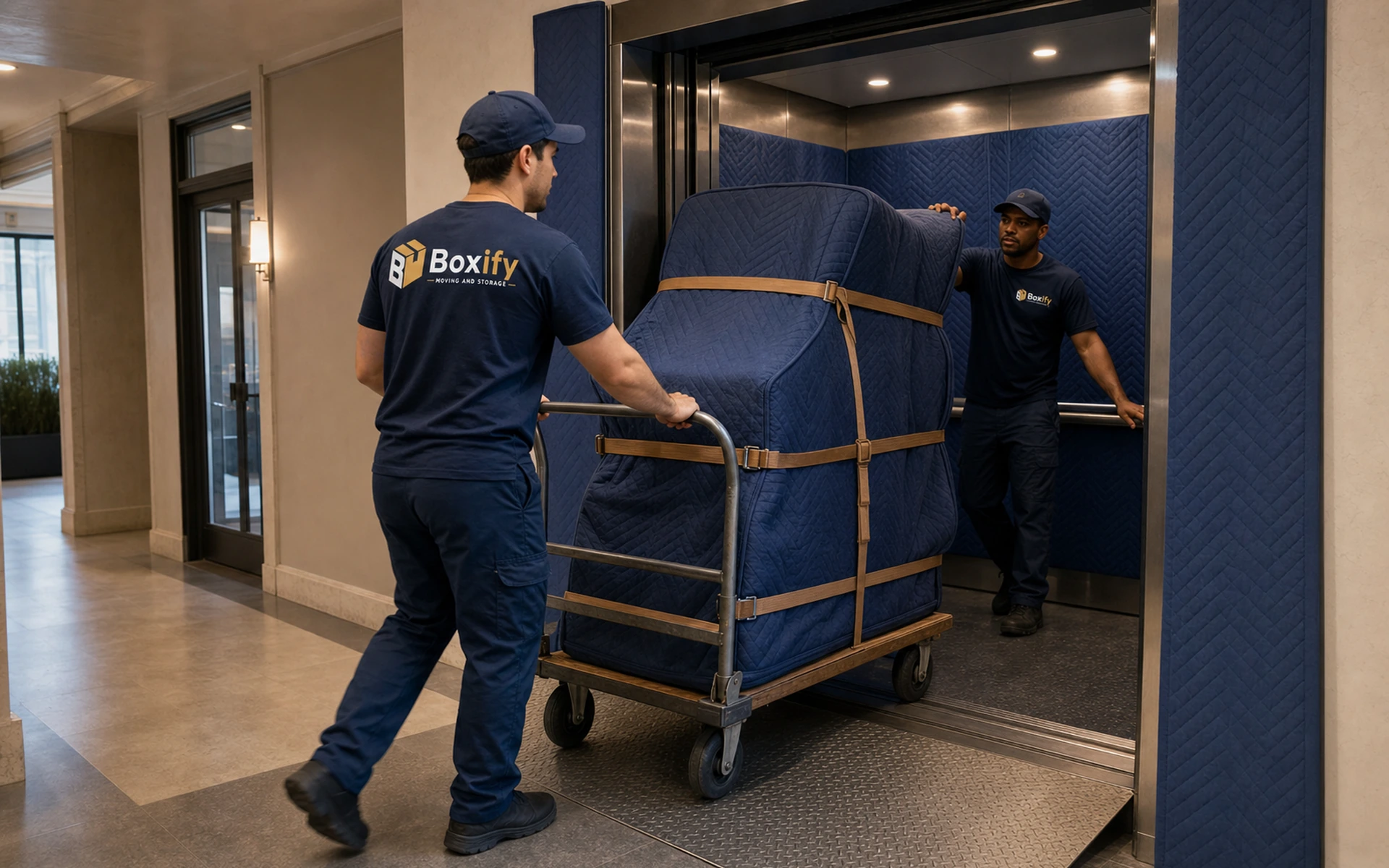
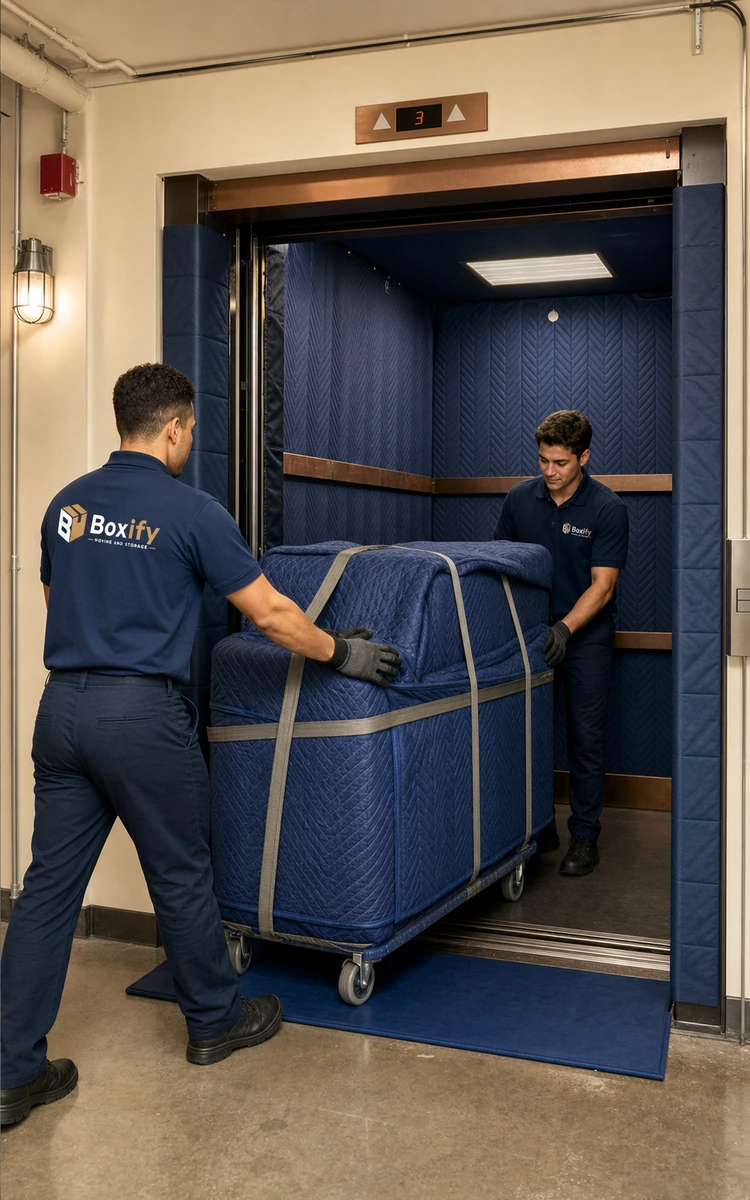
- Confirm who pads the elevator. The building typically pads the car so nothing gets scratched, but check, so it isn't a surprise on the day.
- Ask about any fee or deposit. Most buildings don't charge for the reservation, though some ask for a fee or a refundable deposit, so ask rather than assume a number.
- Get the reservation in writing and share it with your movers. A quick confirmation email locks in the date, the window, and the door, and keeps everyone working to the same clock.
The whole thing usually takes one phone call or email and a little lead time. The mistake is leaving it to the last week, when the window you want may already be taken.
How long the window is, and what happens if you skip it
Your reservation is usually a single 2 to 4 hour weekday window, and if you don't reserve it, the building can turn your movers away at the door. That's the part worth taking seriously. A move without a confirmed elevator window can mean being sent home to reschedule, waiting hours for an opening, or carrying everything up the stairs by hand.
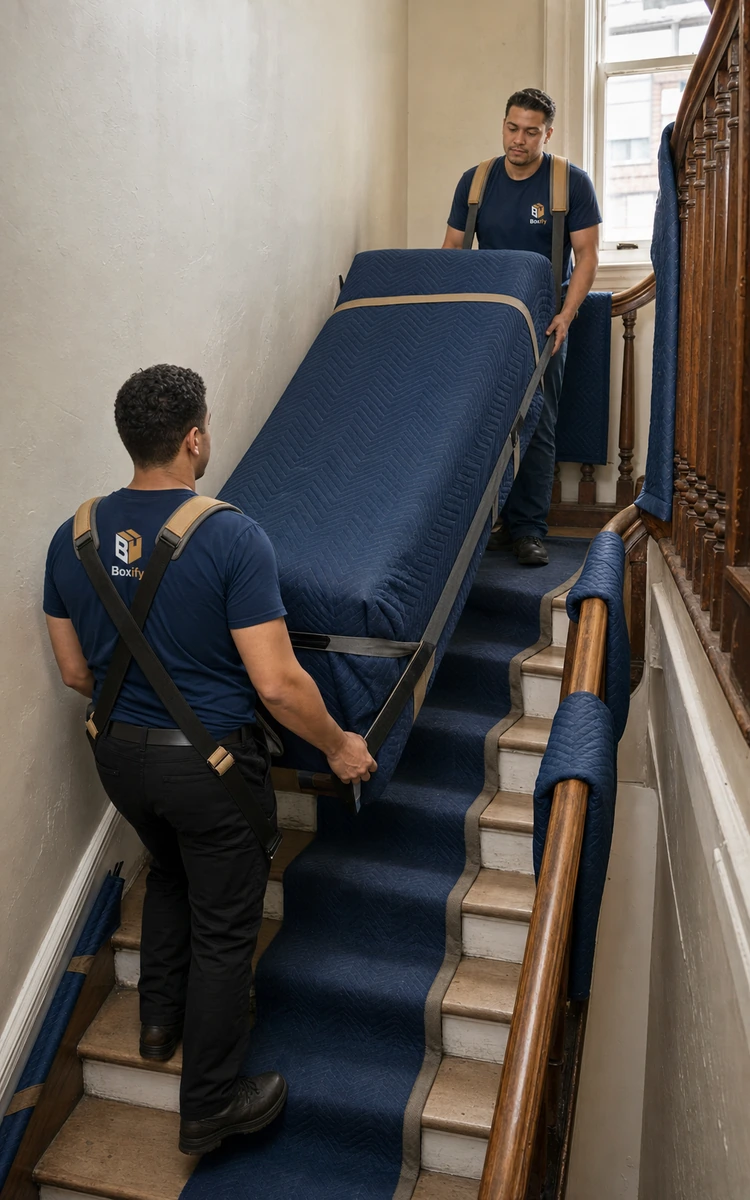
If the stairs become the fallback, that's its own job with its own method, covered in moving into a walk-up. And the elevator window is only half the day's logistics: where the truck can legally sit while the crew loads and unloads is a separate problem, covered in parking a moving truck in NYC.
Freight vs. passenger elevator for a move
A freight (service) elevator is the larger service car a building sets aside for moves and deliveries, separate from the passenger elevator residents ride day to day. Buildings route moves to the service car because it's built for the load and keeps hallways and lobbies clear.
If your building is small and has only a passenger elevator, moves still go through that car, and the building will still expect it reserved and padded. Either way, the reservation is what matters: the elevator you're allowed to use on move day is the one you booked, in the window you booked it for.
How a careful crew actually works a reserved elevator window
A careful crew treats a 2 to 4 hour elevator window as the whole plan, not a detail. Here's what that looks like from the inside.
First, the crew confirms your mover's COI is already on file, because a building won't release the reserved car without it. They arrive to a car the building has padded, and before the first load moves, they stage boxes and protected furniture right by the freight doors, so the elevator runs in tight, back-to-back cycles instead of waiting between trips. The goal is simple: finish inside the window you reserved, not a minute of it wasted circling for the car.
They also keep the written confirmation on hand, so if there's ever a question at the front desk about whose slot it is, the answer is already in writing. None of this is a trade secret. It's just what it takes to make a short, fixed window actually hold on a busy moving day.
Frequently asked questions
How do I reserve my building's elevator for a move?
Ask your building's management to book the service (freight) elevator, usually about two weeks ahead, for a 2 to 4 hour weekday window, and get your mover's COI on file first. Most buildings don't charge, and it's best to get the confirmed date and window in writing.
How far ahead do I need to book the elevator?
Usually about two weeks ahead, and more in peak season, when windows fill up faster. If you're moving in the busy summer stretch, ask even earlier, because the slot you want may already be spoken for.
How long is the elevator reservation window?
Typically a single 2 to 4 hour weekday window, somewhere in the 9-to-5 range. Pick a start time that fits the size of your move, since everything in and out of the building has to happen inside that slot.
Does the building charge to reserve the elevator?
Most buildings don't charge for the reservation, though some ask for a fee or a refundable deposit. Ask your management office rather than assume a number, so there's no surprise on move day.
What is a freight (service) elevator, and can it carry passengers for a move?
A freight (service) elevator is the larger service car a building sets aside for moves and deliveries, separate from the passenger elevator residents ride. Buildings route moves to that car, and if a smaller building has only a passenger elevator, moves go through it, still reserved and padded.
Book the window, and the day runs on time
Reserving your building's elevator is a small task with a hard deadline. Book the service elevator about two weeks ahead, get your mover's COI on file, take the 2 to 4 hour weekday window you're given, and most buildings won't charge you a thing. You can handle that call yourself, or hand it to a crew that handles these windows, but either way, the reservation is what keeps move day from stalling at the door.
Ready to hand the building side to someone else?
You can arrange the elevator reservation yourself with the steps above, or you can let a crew that handles these windows take the whole building side off your plate. If you'd rather not chase management for the paperwork and the window, see how Boxify handles building access.
Moving into an elevator building?
Get a free, upfront Boxify moving quote






- Your NYC move-in day playbook: the whole building-side checklist in one place, from the COI to permitted hours to parking.
- Moving into a walk-up: the stairs method a careful crew uses when there's no elevator to reserve.
- Parking a moving truck in NYC: where a truck can legally sit while the crew loads and unloads, and the permit question.
- How Boxify handles building access: the COIs, elevator windows, and building paperwork, handled for you.
The reservation practice described here reflects current guidance from NYC movers and New York real-estate outlets: reserving the service or freight elevator about two weeks ahead for a 2 to 4 hour weekday window, with the building padding the car and usually wanting the mover's certificate of insurance on file first, and most buildings not charging for the reservation. It describes general NYC building practice as it stands today; individual buildings set their own rules, so confirm the specifics with your management office.
Rita Penn, Author. Rita Penn is a copywriter with over eight years of experience writing for home service businesses and service providers. She specializes in the moving and storage industry and has created content for several moving companies, along with businesses across other service-based industries.
Eddie Torr, Editor. Eddie Torr is an AI content editor: the independent quality-and-compliance gate every draft passes before it advances. He checks each claim against its approved source, tests the piece against the editorial standards, ranks it, and returns a verdict. He never rewrites the piece himself and never approves delivery; a human reviewer does that.
Maya Ellison, Reviewer. Maya Ellison is an editorial lead with more than 11 years across copywriting, editing, content strategy, and editorial operations. She holds a bachelor's in Communications (Professional Writing and Digital Media) and a master's in Information and Knowledge Management. Those are the two sides of her work: creating clear content, and building the systems that produce it consistently. She gives every piece a final human review before it ships, confirming each claim is fairly represented, tied to a checked source, and dated.
Reviewed on this post: Maya confirmed that every reservation figure stays attributed to general NYC building practice, with no fee or deposit amount stated as fact. She also checked that the walk-up and truck-parking topics stay as cross-links rather than re-explanations, and that the certificate of insurance appears only as a one-line prerequisite.