
Moving Into a NYC Walk-Up: How to Get Furniture Up the Stairs Without Wrecking It
Moving into a NYC walk-up feels like a strength test. It isn't. The flights are the easy part. What actually beats people is the tight prewar landing, the quarter-turn with a newel post in the way, and the shared stairwell you'll be charged for if you gouge it.
Get the technique right and you can carry almost anything up the stairs without wrecking the furniture, the walls, or your back. This guide is part of your NYC move-in day playbook, and it walks you through the method a careful crew uses to get a heavy piece up the stairs.
How to move furniture up stairs in a walk-up
To move furniture up a walk-up's stairs without damage, measure the piece and the tightest turn first, then clear and pad the path. Carry with two people, one low taking the weight and one high guiding. Pivot, or "hook," each piece around the landings, rest between flights, and protect the stairwell.
Key takeaways
- The turns beat you, not the flights. The hard part of a walk-up isn't climbing; it's getting a big piece around the tight prewar landings.
- Measure the piece and the tightest turn before you lift anything, not just the doorway or the stairs.
- Carry with two people, one low and one high. The person below takes the weight; the person above steers.
- Hook-and-pivot at each landing. Tip a long piece and rotate it around the turn instead of trying to force it straight through.
- Protect the shared stairwell. Pad the piece and cover the banister and wall corners; in a co-op or brownstone you can be billed for the damage.
- Know when to stop. If a piece is beyond a safe two-person carry, get more hands or a professional crew. No dresser is worth an injury.
- Movers usually charge a stairs fee. When a crew does the carry, expect a per-flight walk-up fee; we cover it lightly below.
What you'll need before you start
You can carry a walk-up well with ordinary gear. None of this is a special kit, and you can gather all of it yourself:
- A tape measure: for the piece, the doorways, and the narrowest turn.
- Moving blankets or furniture pads: to wrap the piece so it can't scratch or dent.
- Lifting straps or a shoulder dolly: to share the weight and save your back and grip.
- A hand truck (or a stair-climbing hand truck): for the boxes, so you're not carrying them by armful.
- Corner and banister protection: cardboard, blankets, or padding for the stairwell's tight spots.
- A second person, ideally a third: one to carry high, one to carry low, and one to run boxes ahead.
Why the turns beat you, not the flights
The reason a walk-up is hard has almost nothing to do with how many flights there are. A walk-up is a building with no elevator, so every piece of furniture goes up the stairs by hand, and the real obstacle is the geometry, not the climb. What stops a dresser or a sleeper sofa is the turn: the quarter-turn or half-turn landing where the stairwell doubles back, often with a low ceiling and a newel post right in the pivot.
Generic moving guides tell you to lift with your legs and measure the doorway. That's fine for a suburban house with wide, straight stairs. A prewar NYC walk-up is a different problem. The landing is narrow, the ceiling is low, and the piece has to rotate through a space smaller than any doorway on the route.
So the measurement that matters is the diagonal at the tightest turn, not the width of the stairs. Stand at the landing and picture the piece tipped up on its end and swung around the corner. If the diagonal of the piece is shorter than the space it has to sweep through, it goes. If it isn't, you already know before you lift, and you can plan to take a door off its hinges, disassemble the piece, or accept that it simply won't go and choose another way in.
The walk-up method, step by step
Here is the method a careful crew uses to get a piece up a walk-up. Work the steps in order:
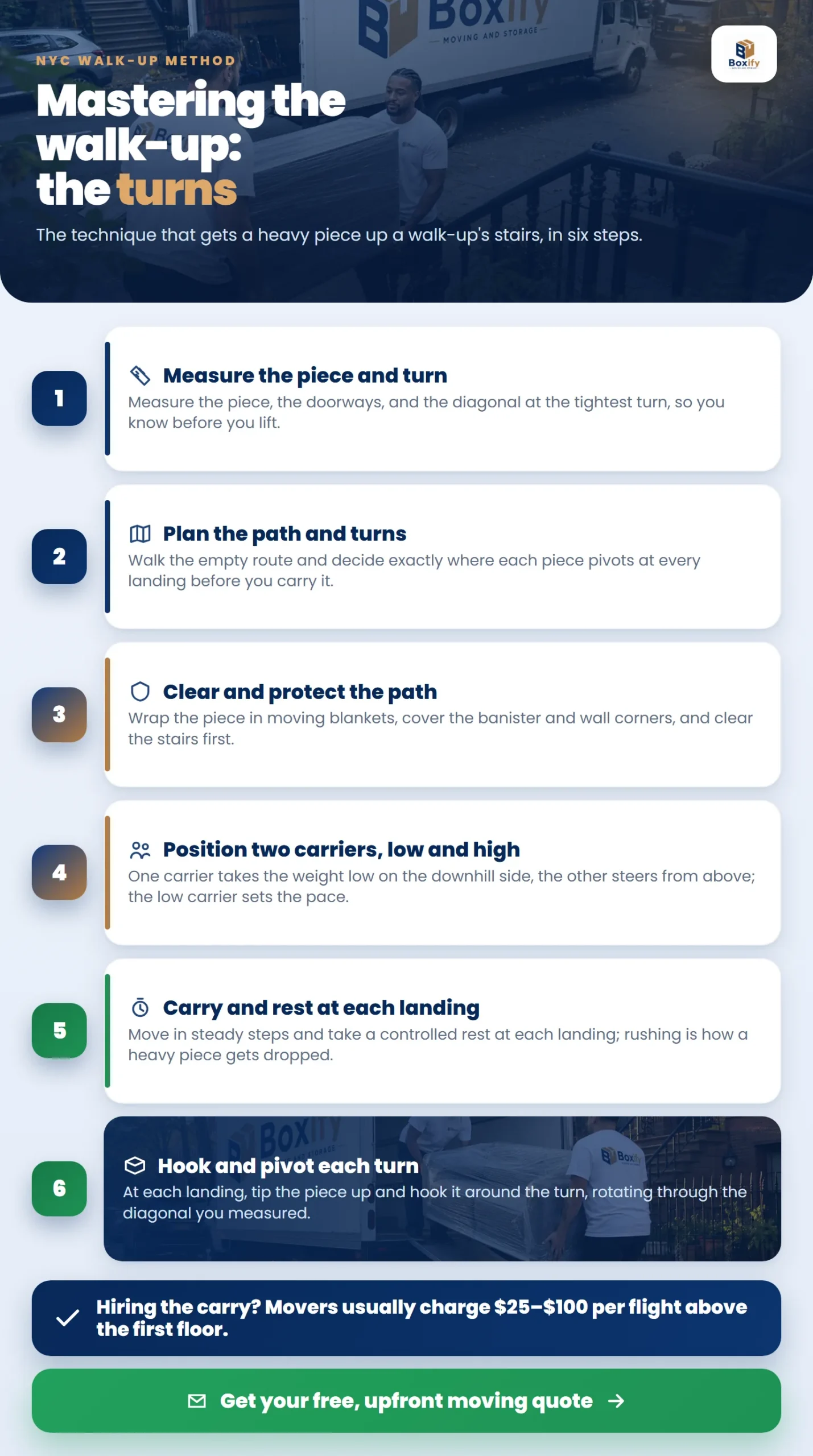
- Measure everything. Measure the piece, the doorways, and, most of all, the diagonal at the narrowest turn. Measuring first is what tells you whether a piece will go before you're stuck on a landing with it.
- Plan the path and the turns. Walk the route empty. Decide where each pivot happens and which way the piece rotates at each landing, so nobody is guessing mid-carry.
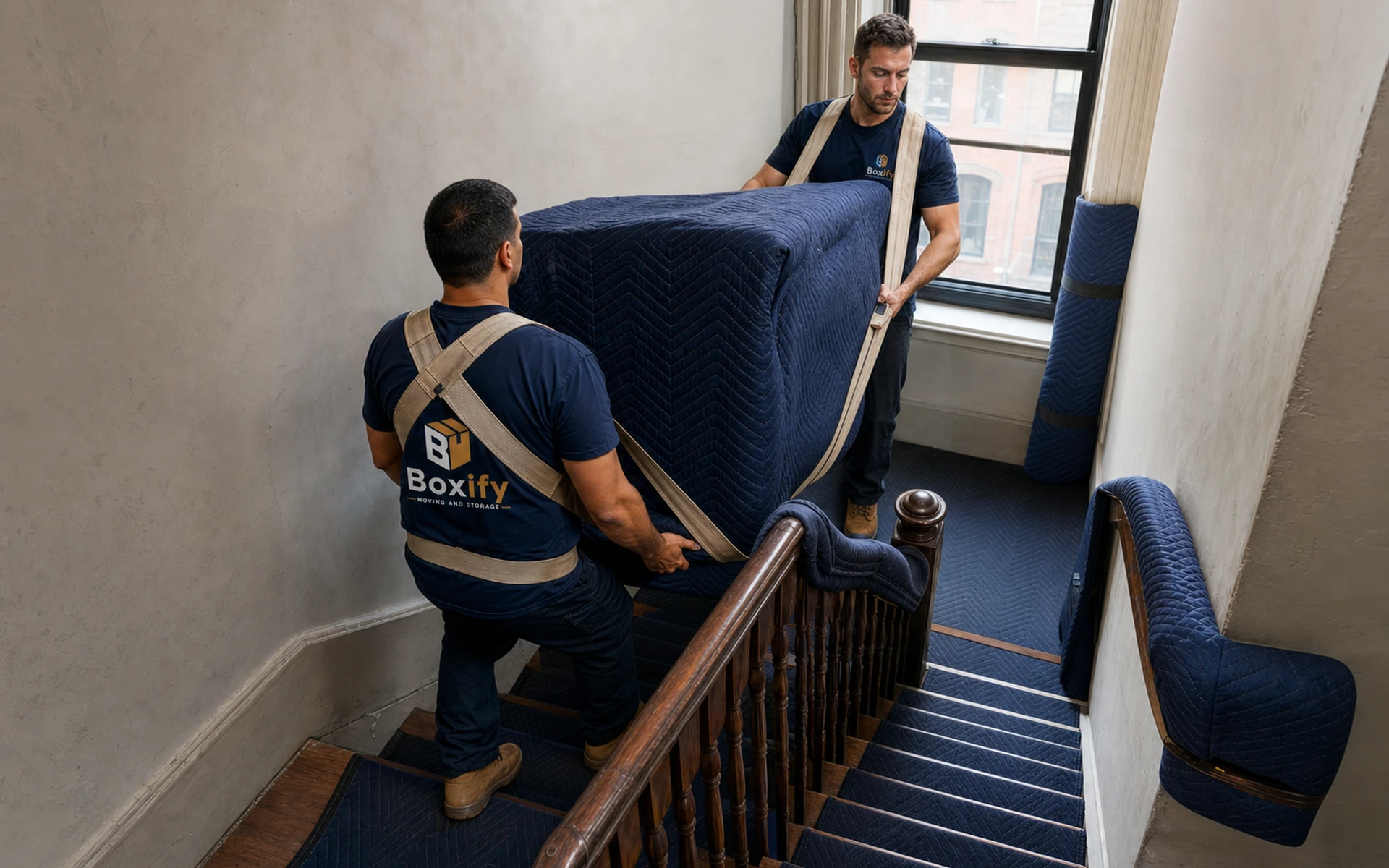
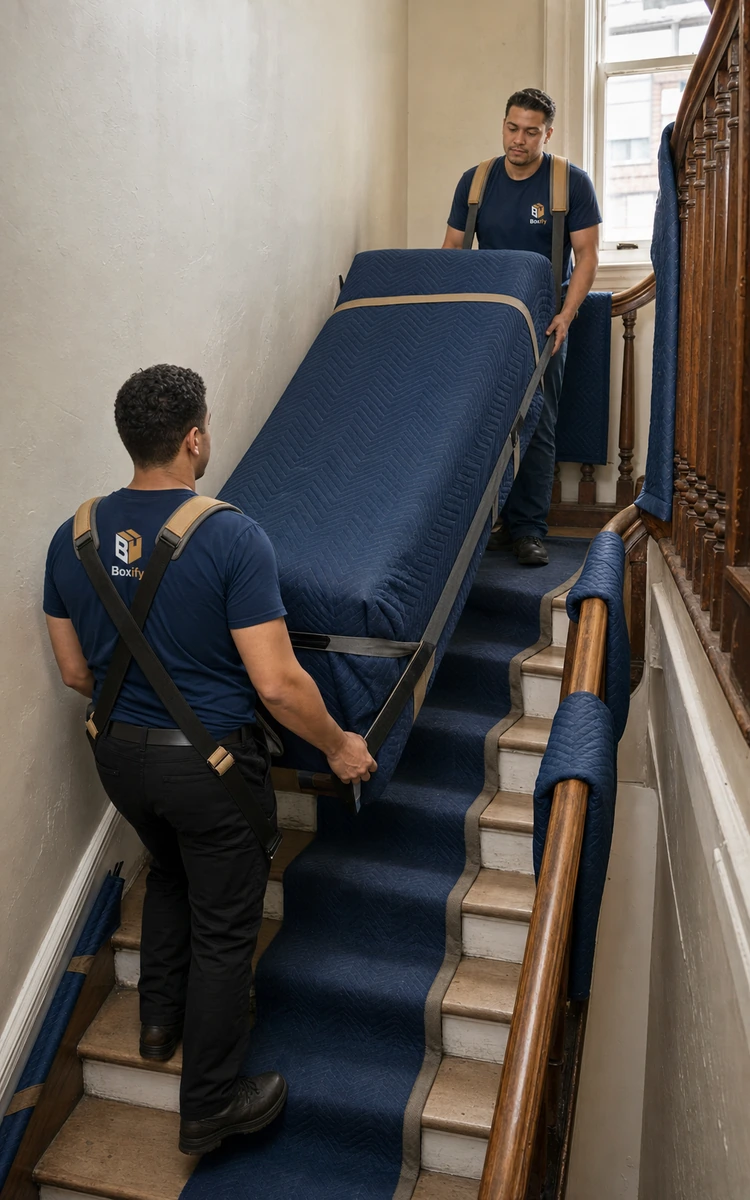
- Clear and protect the path. Wrap the piece in moving blankets, cover the banister and wall corners, and clear anything off the stairs. A padded piece and a protected stairwell is how you avoid gouging a wall you'll be billed for.
- Position two carriers. One person goes below, on the downhill side, taking most of the weight; one person goes above, guiding and steering. The low carrier calls the pace.
- Carry and rest. Move in steady, deliberate steps and take a controlled rest at each landing. Rushing a heavy piece up stairs is how people drop it or hurt themselves.
- Hook the turns. At each tight landing, tip the piece up and "hook" it around the turn, rotating it through the diagonal you measured, rather than forcing it straight. The hook-and-pivot is the move generic guides skip, and it's the one that actually gets a long piece around a prewar corner.
How a careful crew moves a heavy piece up a walk-up
When a crew handles moving heavy furniture up stairs, the method above is exactly what they do, just with more hands and more practice. Here's how a careful in-house crew takes a heavy dresser up a five-flight prewar walk-up on a residential move.
First they empty the drawers and measure the dresser against the tightest turn, so it's lighter and they know it will go. They pad it in moving blankets and protect the banister and the wall corners. Two carriers take it, one low on the downhill side holding the weight, one high steering, while a third person hand-trucks the boxes up ahead so the stairwell stays clear.
At each landing they tip and hook the dresser around the turn, then take a controlled rest before the next flight. A sleeper sofa gets hooked on its end the same way; a mattress is flexed through the turn; a tall bookshelf is emptied and walked up on a strap. The piece arrives without a mark on it, and so does the stairwell.
For a piano, an antique, or a large framed mirror, that same careful, piece-by-piece work is the specialty handling a crew does for you. It's a handling service, not a promise about what could go wrong; the point is that someone can do the wrapping, the measuring, and the pivots correctly so you don't have to.
Doing it yourself vs. calling in help: what stairs add to the cost
A two- or three-person DIY carry is realistic for most pieces if you measure first, protect the path, and take your time. It stops being realistic when the piece is too heavy for the people you have, or the crux turn is too tight to control. A loaded dresser or a sleeper sofa on a narrow landing is how people throw their backs out. If you're the person who said "I threw my back out last time," that's the signal to get more hands. No single piece of furniture is worth an injury.
When movers do the carry, stairs are almost always an add-on. Across NYC movers, a walk-up or stairs fee typically runs about $25 to $100 per flight above the first floor. It's the mover's charge, not the building's, and it's worth knowing before you compare quotes. For the full picture, see what stairs and long carries add to a move.
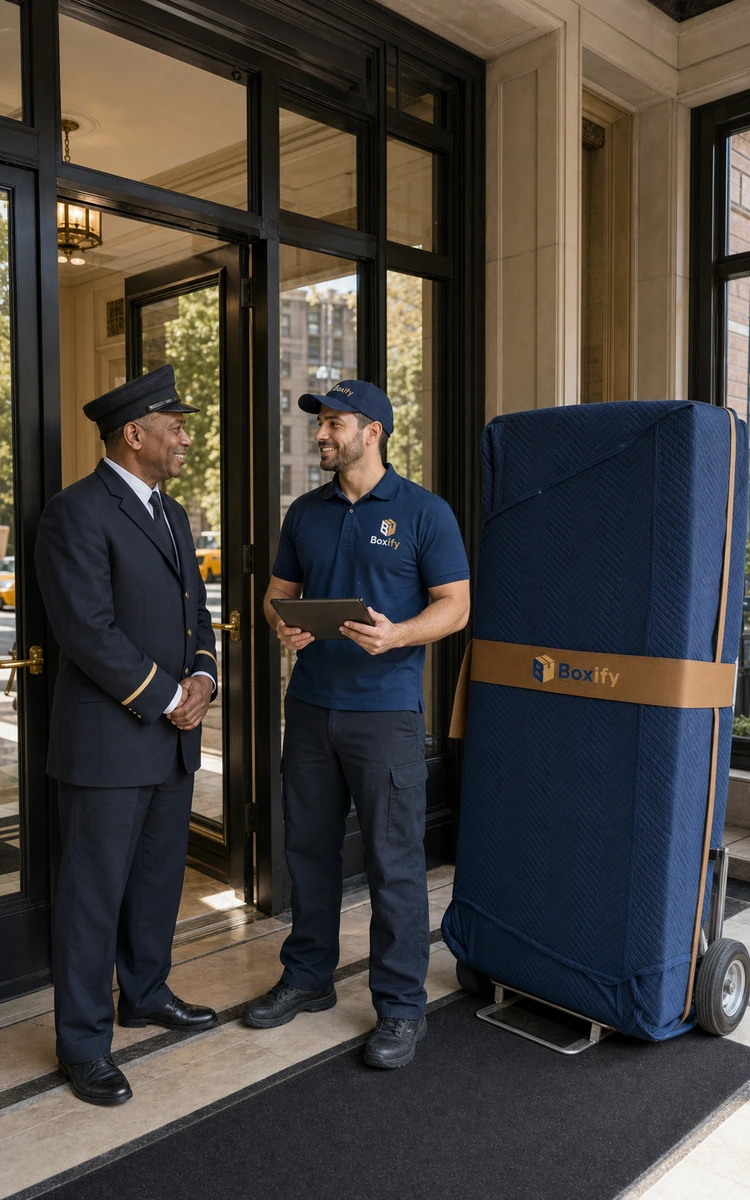
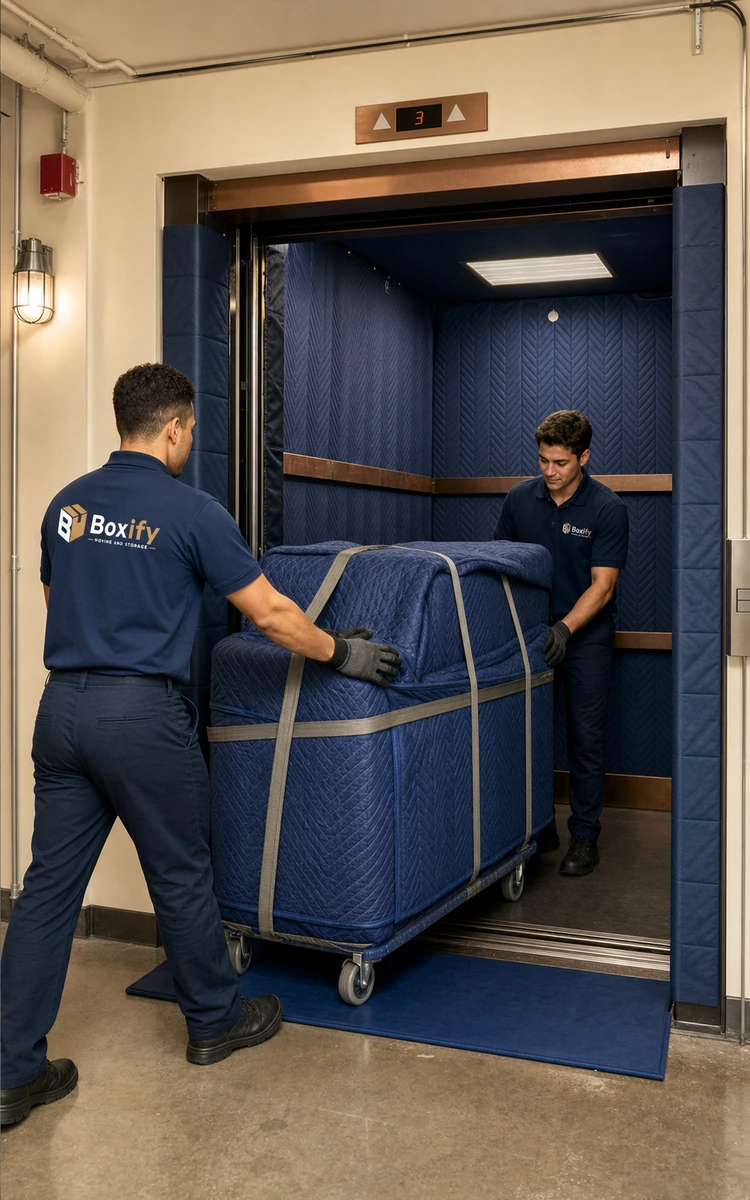
If your building actually has a service elevator, use it instead of the stairs. Reserving your building's elevator is its own short process, and it's worth doing early.
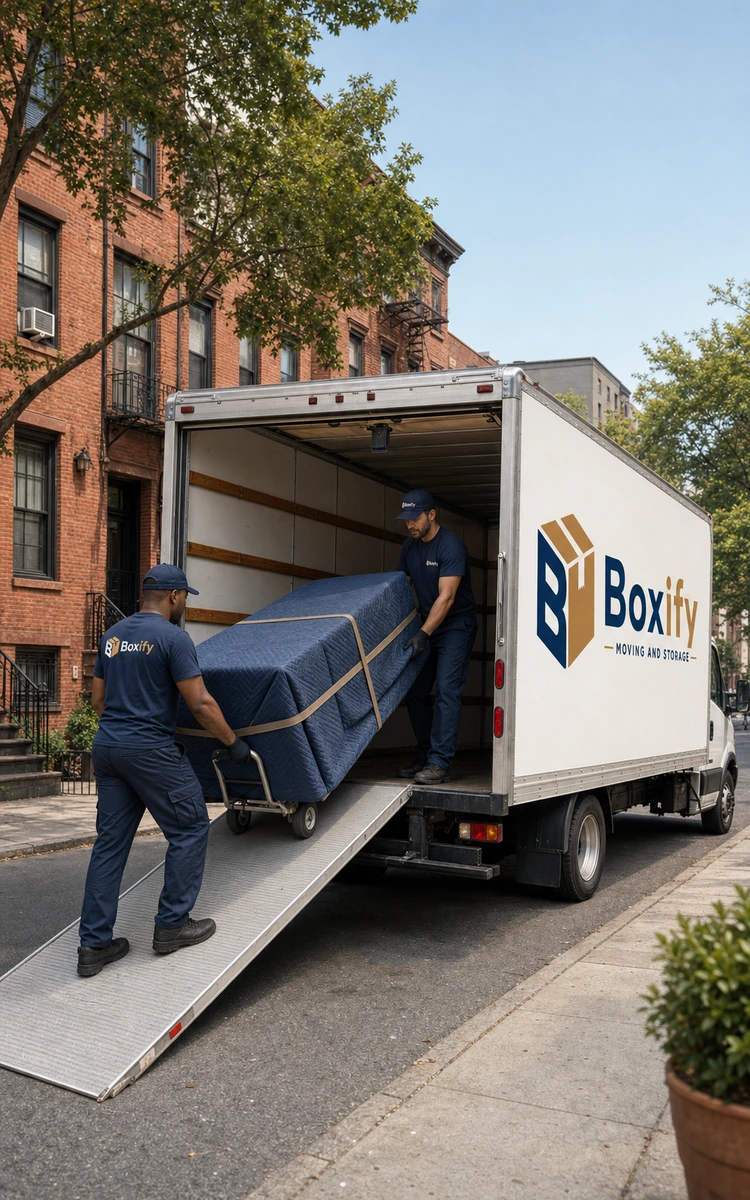
And if a piece is beyond a safe two-person carry, you don't have to force it. A careful in-house crew can take the walk-up off your hands. Here's how Boxify handles a tricky building.
Frequently asked questions
How do I move heavy furniture up stairs?
Carry with two people, one low taking the weight and one high guiding, and work in steady steps with a controlled rest at each landing. Empty and lighten the piece first, wrap it in moving blankets, and use lifting straps to share the load. For a genuinely heavy piece, more hands and a slower pace beat brute force every time.
How do I move furniture up narrow stairs or around a tight turn?
Measure the diagonal at the tightest turn first, then tip the piece up and "hook" it around the landing rather than forcing it straight. Picture the piece swung around the corner before you lift, so you know it will go. If the diagonal is too long for the space, take a door off its hinges or disassemble the piece.
Can I move furniture up stairs by myself?
For light pieces, yes; for anything heavy or bulky in a walk-up, you really shouldn't. A solo carry on stairs gives you no one to steer, no one to take the weight, and no one to catch a slip. If the piece is heavy or the turn is tight, get a second person or a professional crew. This is general good practice, not a substitute for your own judgment about your health.
How do I get a big piece up three flights without dropping it?
Take a controlled rest at every landing and let the low carrier set the pace. Most drops happen because someone rushed or lost their grip near the top, when they were tired. Steady steps, clear communication, and a rest each floor are what get a big piece up three-plus flights intact.
How do I keep from scratching the walls or the stairwell?
Pad the piece in moving blankets and protect the banister and wall corners before you start. In a co-op or a brownstone, the stairwell is shared, and you can be billed for gouges and scuffs. Wrapping the piece and covering the tight spots is cheap insurance against a repair bill.
What if the furniture won't fit around the turn?
First try taking the door off its hinges or disassembling the piece to shrink its footprint. If the measured diagonal still won't clear the tightest turn, the honest answer is that it won't go up those stairs, and you should plan another way in. Where the building has one, reserving your building's elevator is the usual alternative.
Do movers charge extra for a walk-up?
Almost always, yes. When a crew carries your things up stairs, a walk-up or stairs fee of roughly $25 to $100 per flight above the first floor is standard across NYC movers. It's the mover's add-on, separate from the building's own fees. For how it fits the whole bill, see what stairs and long carries add to a move.
Plan the turns, protect the stairwell, get help on the heavy piece
A walk-up is a technique-and-planning problem, not a strength test. Measure the piece and the tightest turn, clear and pad the path, carry with two people (one low, one high), hook-and-pivot around each landing, rest between flights, and protect the shared stairwell. Get help on anything beyond a safe carry. Do that and almost anything goes up the stairs without wrecking the furniture, the walls, or your back.
Rather not carry it up five flights yourself?
If a walk-up is more than you want to take on, a careful in-house crew can do the carry for you, from the heavy dresser to the tight top-floor turn. The quote is free and upfront, so you know the number before anyone lifts a thing.
Get a free, upfront Boxify moving quote


- Your NYC move-in day playbook, the hub guide to everything your building requires on moving day, from the COI to the elevator to the fees.
- Reserving your building's elevator, the alternative to the stairs when your building has a service elevator, and how to book it early.
- How Boxify handles a tricky building, what it looks like when a careful crew takes the walk-up and the paperwork off your hands.
- What stairs and long carries add to a move, the honest breakdown of the stairs fee and the other things that push a NYC move's price up.
The walk-up carry method here is general safe-moving practice (how careful movers actually work a staircase), not a proprietary technique. The one dated figure is attributed below.
- Stairs and walk-up moving fees (that movers almost always charge a per-flight fee for stairs, roughly $25 to $100 per flight above the first floor): reported consistently across multiple NYC movers, as of 2026.
The stairs-fee range reflects NYC moving-market context as of 2026 and is refreshed when the market moves.
Rita Penn, Author. Rita Penn is a copywriter with over eight years of experience writing for home service businesses and service providers. She specializes in the moving and storage industry and has created content for several moving companies, along with businesses across other service-based industries.
Eddie Torr, Editor. Eddie Torr is an AI content editor: the independent quality-and-compliance gate every draft passes before it advances. He checks each claim against its approved source, tests the piece against the editorial standards, ranks it, and returns a verdict. He never rewrites the piece himself and never approves delivery; a human reviewer does that.
Maya Ellison, Reviewer. Maya Ellison is an editorial lead with more than 11 years across copywriting, editing, content strategy, and editorial operations. She holds a bachelor's in Communications (Professional Writing and Digital Media) and a master's in Information and Knowledge Management. Those are the two sides of her work: creating clear content, and building the systems that produce it consistently. She gives every piece a final human review before it ships, confirming each claim is fairly represented, tied to a checked source, and dated.
Reviewed on this post: She confirmed the stairs method reads as general good practice, with no invented Boxify-only technique. She also checked that the stairs fee is attributed to NYC movers and framed as the mover's charge, not the building's, and that the piece names Boxify's crew and specialty handling without any claim about coverage against damage.