
How to Pack for Storage (Not for a Move) Without Wasting an Inch of Space
You already know how to pack for a move. Tape a box, wrap the fragile stuff, get it on the truck, done in a day. Packing for storage feels like the same job, so most people pack the same way, then open the boxes months later to a musty smell, a spotted leather chair, and a stack that caved in on itself.
Here's the surprise: your things don't move in storage. They sit. And things that sit still for months behave differently than things that survive one truck ride, which is exactly where mold, mildew, and crushed boxes come from.
The good news is that the difference comes down to a short, learnable method, whether you're loading a self-storage unit yourself or having it picked up. If the whole comes-to-you model is new to you, here's what full-service storage actually is: the short version is that a team picks up, stores, and redelivers your things, with no unit to rent or visit. Either way, packing for storage works the same way, and this post walks you through it.
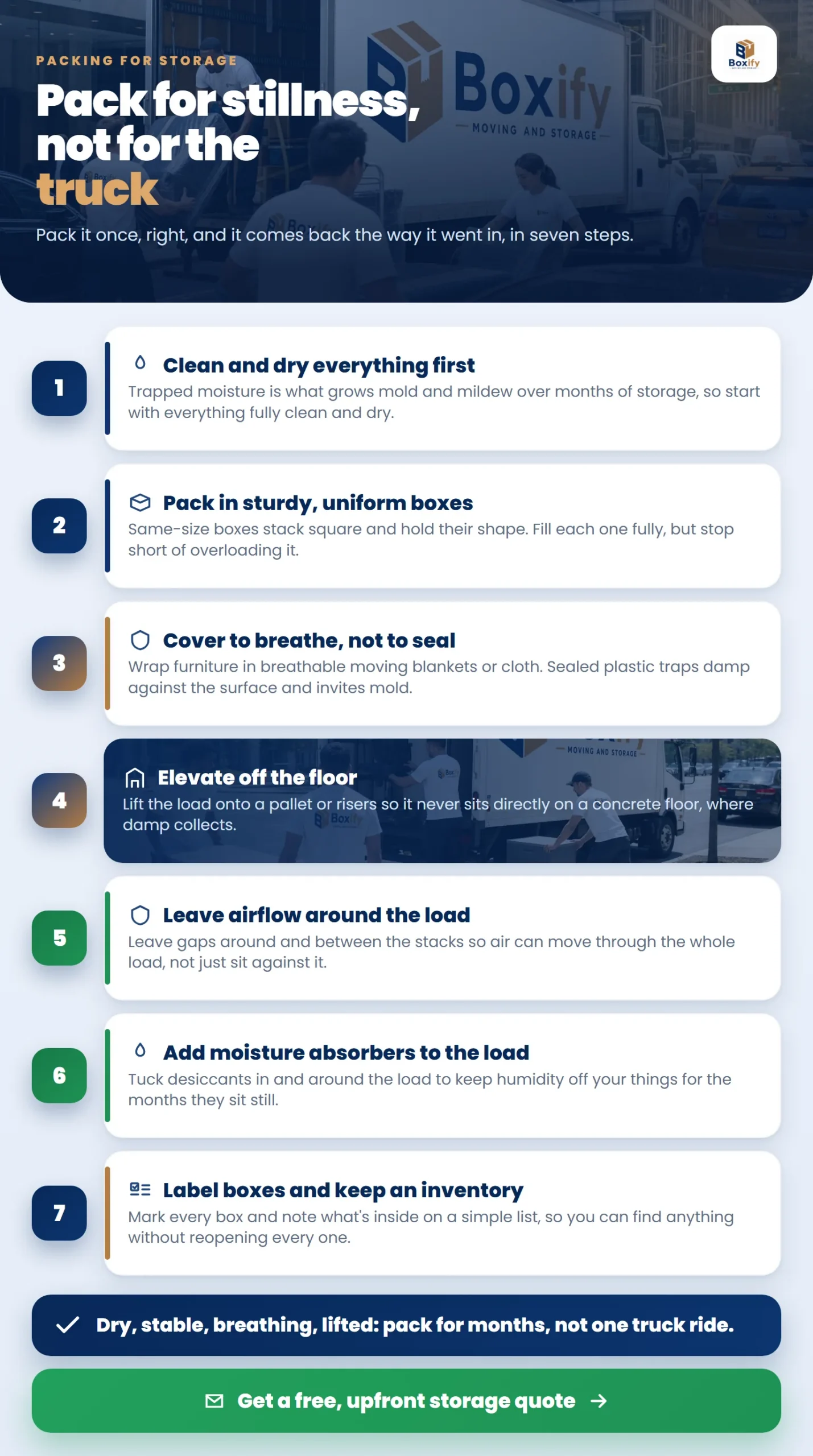
How to pack a storage unit, step by step
To pack a storage unit so your things come out the way they went in, work these steps in order:
- Clean and fully dry everything first: trapped moisture is what grows mold and mildew over months.
- Use sturdy, uniform boxes, filled but not overloaded, so they stack square.
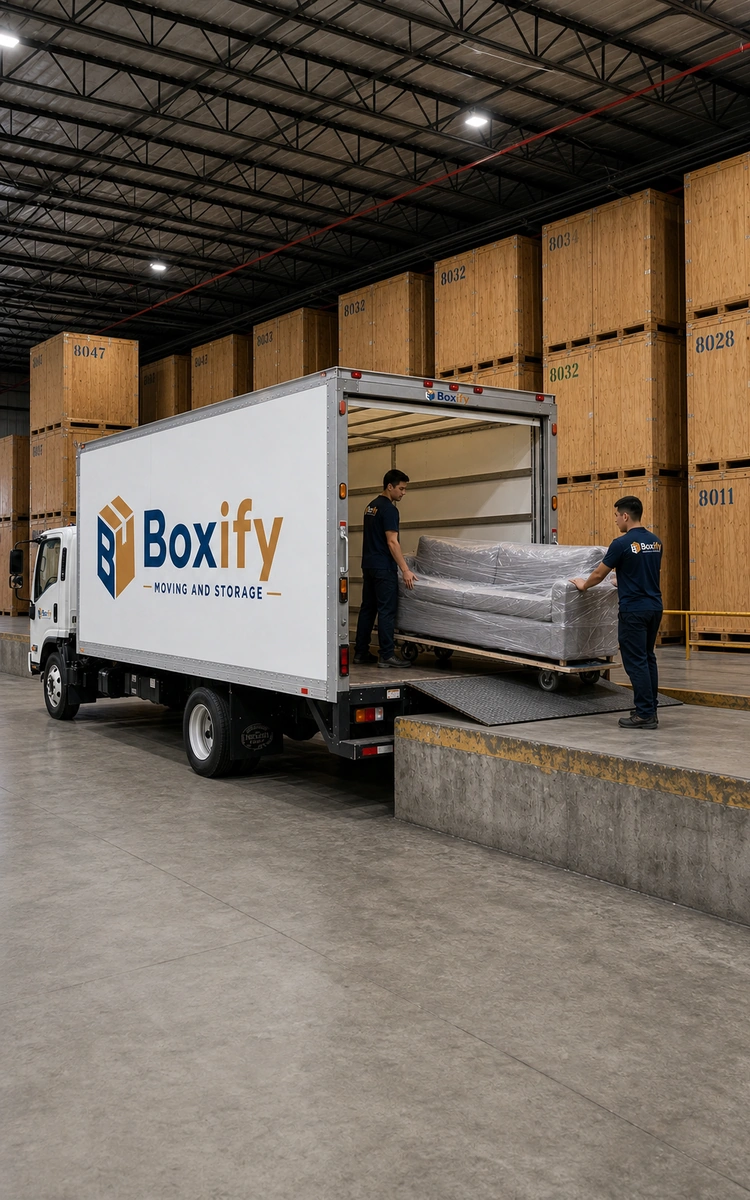
- Cover furniture with breathable moving blankets or cloth: never sealed plastic, which traps damp.
- Elevate everything off the floor on a pallet or risers.
- Leave airflow gaps around and between the stacks.
- Add moisture absorbers (desiccants) in and around the load.
- Label every box and keep a simple inventory so you can find things later.
Do those seven, and months of storage leave your things undamaged (no mold, no musty smell, no crushed boxes) in the least space possible.
Key takeaways
- Dry beats everything. Clean and fully dry each item before it goes in; trapped moisture is what grows mould over months.
- Breathable, never sealed. Cover furniture with moving blankets or cloth rather than shrink-wrap, which holds damp against the surface.
- Get it off the floor and leave gaps. Pallets or risers plus airflow between stacks do more for a load than any product you can buy.
- Uniform boxes stack square. Same-footprint boxes, filled but not overloaded, are what stop a stack leaning or crushing.
- Label as you go. A box list written while you pack is the difference between finding one thing and unpacking everything.
- Climate control protects the sensitive things. Wood, leather, electronics, art and documents are the items that suffer from temperature and humidity swings; our storage is temperature and humidity managed.
- You do not have to do it yourself. Boxify's crews pack and wrap as part of the job, and the quote for it is free and upfront.
What to have on hand before you pack
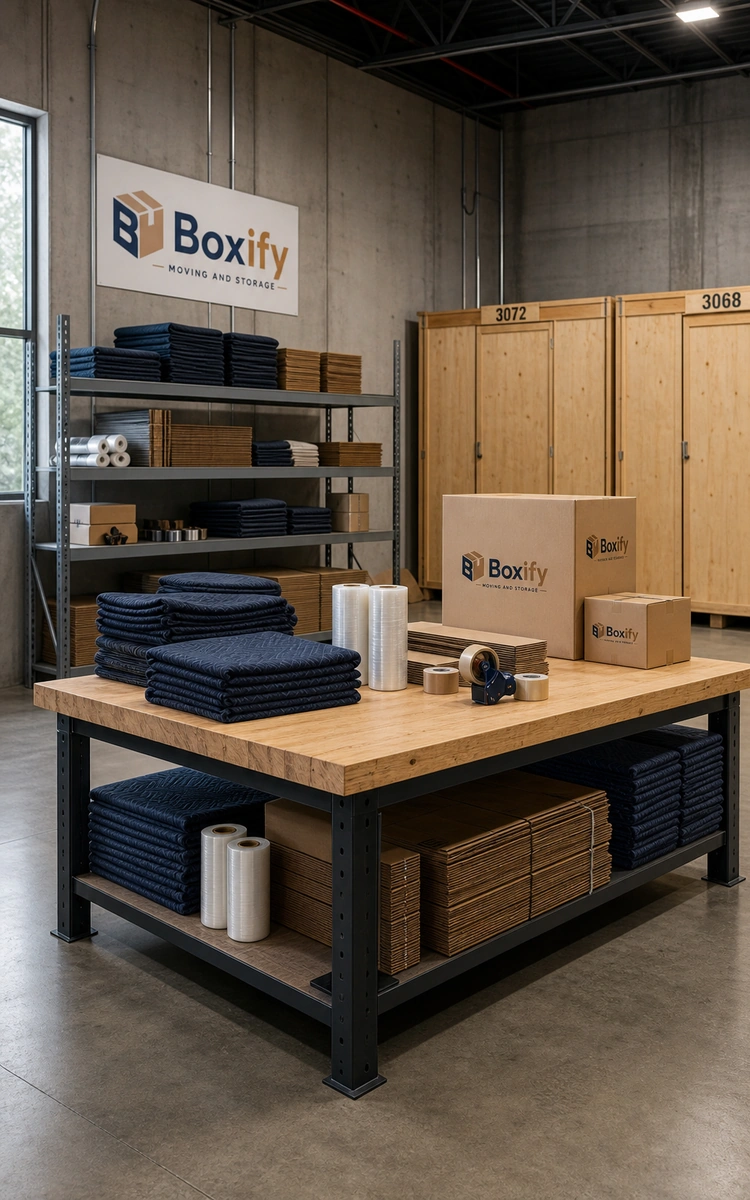
You can pack a storage unit well with ordinary supplies. None of this is a special kit, and you can gather all of it yourself:
- Sturdy, uniform-size boxes: same footprint stacks square and won't topple.
- Breathable covers: moving blankets or cloth for furniture, not shrink-wrap or sealed plastic.
- Packing paper or bubble for fragile and breakable items.
- Moisture absorbers (desiccants) to keep humidity off the load.
- A pallet or a few risers to lift everything off the floor.
- A marker and a simple inventory list so you know what's in each box.
Packing for storage vs. packing for a move: what actually changes
Packing for storage differs from packing for a move in three ways: your things sit still for months instead of days, so they have to be stacked to stay stable over time, kept off the floor with airflow, and covered to breathe rather than sealed in plastic. Put simply, packing for storage means packing for stillness: packing things that will sit for months, not survive one truck ride.
That one difference, stillness, is where every storage-specific rule comes from. Three variables change:
- Duration. A move lasts hours to a few days. Storage lasts weeks to months, and over that time trapped damp turns into mold and mildew, and a poorly packed box slowly settles and slumps.
- Stacking. For a move, a box only has to survive one trip. For storage, the whole load has to hold its shape for months without shifting or crushing what's underneath it.
- Climate exposure. For a move, plastic wrap for a day is harmless. For storage, sealed plastic traps moisture against your things, so the rule flips: cover to breathe, elevate off the floor, and leave airflow.
Here's the same box, packed two different ways:
| What changes | Packing for a move (days) | Packing for storage (months) |
|---|---|---|
| Time in the box | Hours to a few days: survive one truck ride | Weeks to months: sit still with no mildew, mold, or settling |
| Stacking | Loaded to survive one trip | A stable load that won't shift or crush over time |
| Covers | Plastic wrap is fine short-term | Breathable moving blankets or cloth, never sealed plastic |
| Floor + air | Straight onto the truck floor | Elevated off the floor, with airflow gaps around the load |
| Moisture | Rarely a concern | Clean and fully dry first, plus desiccants in the load |
Read the right-hand column top to bottom and you have the whole method: dry, stable, breathing, and lifted. Everything below is just how to do each one well.
Protecting fragile and climate-sensitive items
The items most at risk in long-term storage are the ones that react to damp and pressure: wood, leather, electronics, art, photos, documents, instruments, and (the highest mold risk of all) upholstery and mattresses. A few things, though, shouldn't go into storage at all, which is a short list worth checking first. For a move you'd just cushion them against bumps; for storage you're protecting them against time.
Wrap and cushion fragile pieces in packing paper or bubble, then box them snugly so nothing shifts. Cover furniture, mattresses, and upholstery with breathable moving blankets or cloth rather than plastic, which would seal moisture against the fabric and invite mold. Stand framed art and mirrors on edge, never flat under weight. Keep paper, photos, and electronics out of direct contact with any concrete floor, where cold and damp collect.
This careful, piece-by-piece protection is exactly the specialty and fragile handling Boxify does for you: pianos, antiques, and art included. It's a packing service, not a promise about what could go wrong; the point is that someone can do the wrapping and cushioning correctly so you don't have to.
Stacking and organizing to save space without crushing anything
To stack a storage load without crushing anything, put the heaviest, sturdiest boxes on the bottom, keep boxes a uniform size so they stack square, and never overload a box past the point it holds its shape. A crushed box in storage almost always started as an overfilled one on the bottom of a wobbly stack.
A few storage-unit organization tips that save space and your things:
- Heaviest and sturdiest on the bottom, lightest and most fragile on top.
- Uniform boxes stack square: mismatched sizes leave gaps and topple.
- Fill boxes fully but don't overload: a half-empty box collapses, an overstuffed one splits.
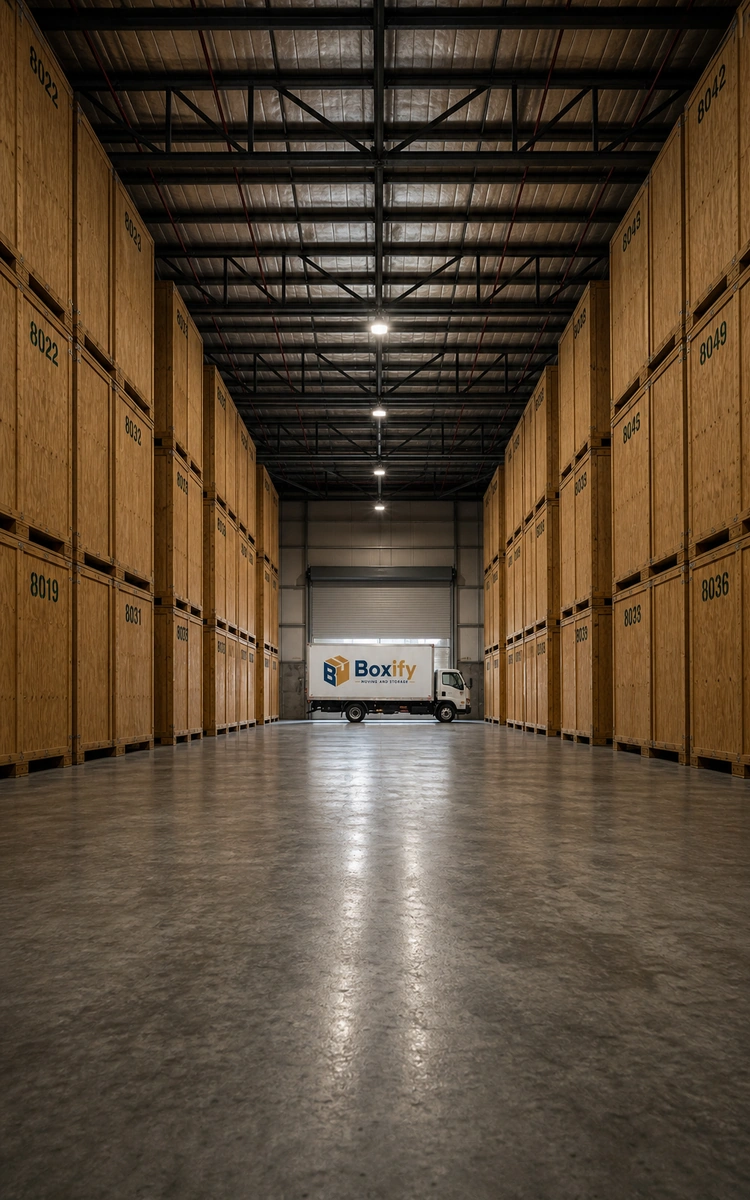
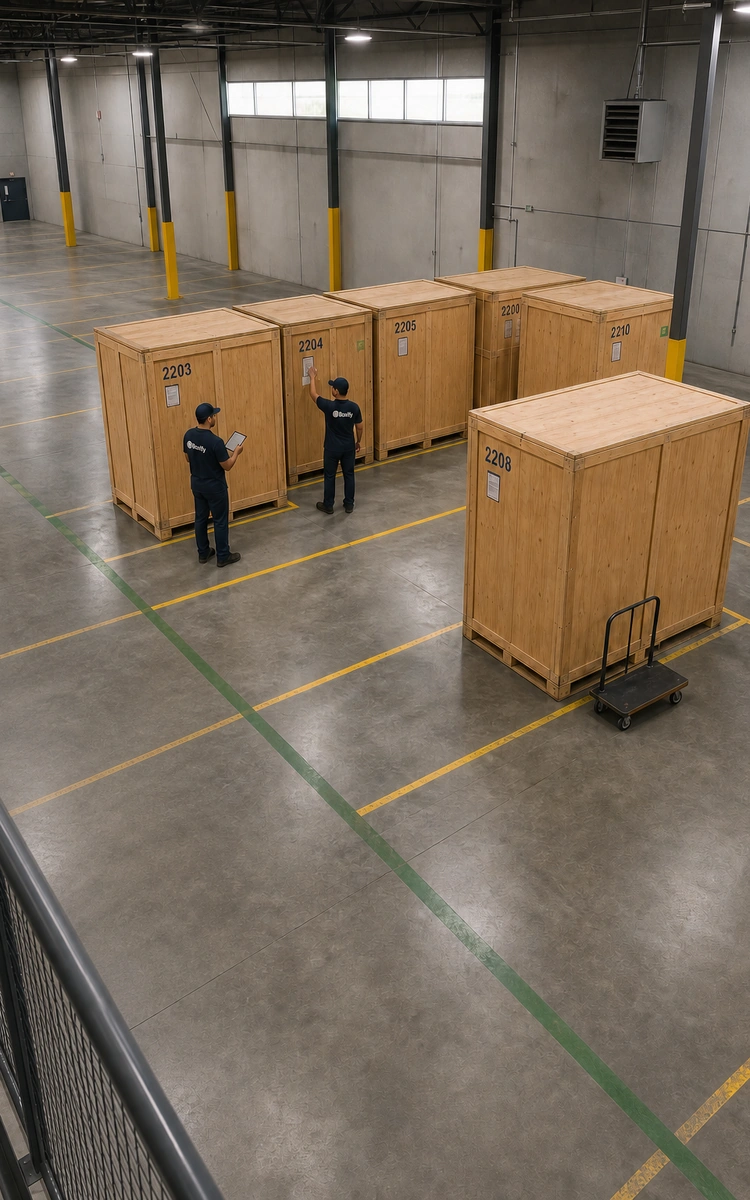
- Leave narrow aisles and airflow gaps so nothing presses tight and air can move.
- Keep a quick-access layer near the front for anything you might need before it all comes back.
Packing tips for a storage unit are really just these two goals held together: a stable load that won't crush itself, and a layout you can actually walk into months later.
Do you need climate control? Keeping mold and mildew out
You need climate control when you're storing anything that warps, cracks, or grows mold in heat and damp (wood, leather, electronics, paper, and instruments) over more than a few weeks. Humidity, not temperature, is the real enemy: it's what turns a closed box into a musty one.
Industry storage guidance puts a climate-controlled range at roughly 55 to 80°F and about 45 to 55% humidity, the band that keeps sensitive items from swelling, cracking, or growing mold (industry storage sources, as of July 2026). Separately, and as a first-party fact about our own service: Boxify's storage is climate-controlled: kept in a temperature- and humidity-managed environment.
If you're using a self-storage unit that isn't climate-controlled, you can still defend against damp: clean and fully dry everything before it goes in, cover with breathable cloth instead of plastic, elevate off the floor, leave airflow around the load, and tuck moisture absorbers in and around your boxes. None of it replaces true climate control for the most sensitive items, but it's the difference between a musty surprise and a clean one. Whether to rent a self-storage unit at all or have a team pick it up is a separate comparison worth reading.
Rather not pack it all yourself?
If you'd rather not pack it all yourself, a full-service storage team can do the whole pack-for-storage for you: the same steps, done by people who pack and store for a living. Here's what that actually looks like on a common job: a wood dresser and a box of books.
The dresser gets emptied and wiped down so no moisture or crumbs go into storage with it. The drawers are wrapped so they don't slide, and the whole piece is covered with a breathable moving blanket rather than plastic. The books go upright in a right-sized carton (spine-down flat, pages slump over months, so upright keeps them square), filled but not so heavy the box loses its shape.
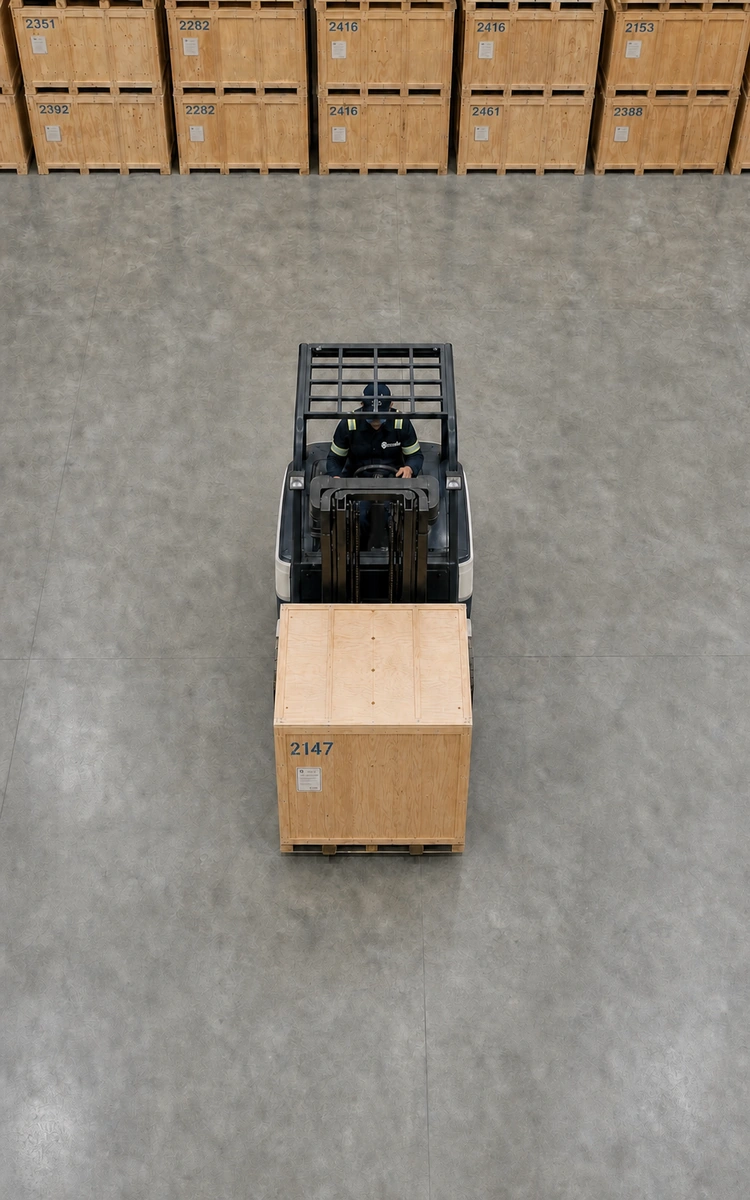
Then both are lifted onto a pallet, off the floor, with an airflow gap left around them. That's the exact hands-on packing our team does for you, into climate-controlled storage.
Here's a judgment drawn from years of writing about how these storage jobs actually go: the piece that comes back damaged is rarely the obvious fragile one. It's the leather chair or solid-wood dresser someone shrink-wrapped to keep it safe, sealing months of the item's own moisture against the finish until mildew blooms under the plastic. Experienced packers do the reverse, leaving the sturdy, valuable pieces breathing under a cloth blanket. With storage, under-wrapping the big furniture beats sealing it tight.
Whether you pack it yourself or hand it over, the method is the same: the only question is who does the wrapping.
FAQ
Is packing for storage different from packing for a move?
Yes. Packing for a move only has to get your things through one truck ride; packing for storage has to keep them safe while they sit still for months, which means stacking for long-term stability, covering to breathe instead of sealing in plastic, elevating off the floor, and keeping moisture out.
Should I use plastic bins or cardboard boxes for storage?
Use sturdy, uniform cardboard boxes and cover furniture with breathable cloth, not sealed plastic. Plastic wrap and airtight bins trap moisture against your things over months, which is what causes mold and mildew. If you use plastic bins, don't seal them fully airtight.
How do I keep mold and mildew out of stored items?
Start dry and stay ventilated. Clean and fully dry everything before it goes in, cover with breathable cloth rather than plastic, elevate off the floor, leave airflow gaps, and add moisture absorbers around the load. Trapped damp is the single biggest cause of a musty smell.
How do I pack fragile items for long-term storage?
Wrap fragile pieces in packing paper or bubble, box them snugly so nothing shifts, stand art and mirrors on edge, and keep electronics and paper off any bare floor. If you'd rather not, careful fragile and specialty handling (art, antiques, pianos) is a service Boxify performs for you.
How should I stack boxes so they don't get crushed?
Put the heaviest, sturdiest boxes on the bottom and the lightest on top, keep boxes a uniform size so they stack square, and fill each box fully but never overload it. Most crushed boxes started as an overfilled box at the bottom of an uneven stack.
Do I need climate-controlled storage?
You need it for anything that warps, cracks, or molds in heat and damp (wood, leather, electronics, paper, and instruments) stored more than a few weeks; industry storage guidance keeps such units around 55 to 80°F and about 45 to 55% humidity (as of July 2026). Boxify's own storage is climate-controlled.
Can someone just pack it for me?
Yes. Boxify offers full or partial packing services and specialty handling for fragile items like art, antiques, and pianos, so you can hand off as much of the pack-for-storage as you want. A free, upfront quote tells you what it costs before you commit.
Pack for stillness, not for the truck
Packing for storage is packing for stillness: for months of sitting, not one truck ride. Run the seven steps: clean and dry first, use sturdy uniform boxes, cover to breathe not to seal, elevate off the floor, leave airflow, add desiccants, and label everything. Do that and your things come back the way they left (no mold, no mildew, no crushed boxes) using every inch. Or hand the whole job to a team that packs and stores it for a living.
Ready to hand it over?
If you'd rather skip the packing entirely, Boxify can pack it and store it for you: full or partial packing, careful fragile handling, and climate-controlled storage. The quote is free and upfront, with no hidden fees, so you know the number before anything leaves your apartment.
Get a free, upfront storage quote, or ask us to pack it for you
- What full-service storage actually is: the plain-English guide to how a team picks up, stores, and redelivers your things, with no unit to visit.
- What to store when your apartment runs out of room: a room-by-room take on what to send to storage and what to keep.
- How storage pickup and delivery works. What happens after you pack: the pickup-store-redeliver cycle, step by step.
- Industry storage guidance (multiple storage-industry sources, as of July 2026): climate-control temperature and humidity ranges, the highest-mold-risk item list, and the core best practices: clean and dry first, elevate off the floor, cover with breathable cloth rather than plastic, leave airflow, and use moisture absorbers.
Climate and best-practice figures reflect industry storage guidance as of July 2026 and are refreshed when the guidance changes.
Rita Penn, Author. Rita Penn is a copywriter with over eight years of experience writing for home service businesses and service providers. She specializes in the moving and storage industry and has created content for several moving companies, along with businesses across other service-based industries.
Eddie Torr, Editor. Eddie Torr is an AI content editor: the independent quality-and-compliance gate every draft passes before it advances. He checks each claim against its approved source, tests the piece against the editorial standards, ranks it, and returns a verdict. He never rewrites the piece himself and never approves delivery; a human reviewer does that.
Maya Ellison, Reviewer. Maya Ellison is an editorial lead with more than 11 years across copywriting, editing, content strategy, and editorial operations. She holds a bachelor's in Communications (Professional Writing and Digital Media) and a master's in Information and Knowledge Management. Those are the two sides of her work: creating clear content, and building the systems that produce it consistently. She gives every piece a final human review before it ships, confirming each claim is fairly represented, tied to a checked source, and dated.
Reviewed on this post: She reviewed the packing method line by line, confirming that every climate figure and best practice reads as attributed industry guidance, that Boxify's own climate-controlled storage is stated as a separate first-party fact with no numbers attached, and that the piece names packing and fragile-handling services without making any claim about coverage against damage.