

Flat-Rate, Hourly, or Binding? A Plain-English Guide to NYC Moving Quote Types
You've got quotes in hand (or you're about to), and they don't even speak the same language. One says "$1,200 flat." One says "$200 an hour for a three-man crew." One just says "estimate." Which of those is a promise, and which one can grow on moving day?
That's the real question, and almost no one answers it straight. This guide compares the three ways NYC movers quote (flat-rate, hourly, and binding) in plain English: how each is priced, who each one fits, and, most of all, what each one isn't good for. By the end you'll know which structure actually protects you, so the number you're quoted is the number you pay, your slice of the full cost picture of a NYC move.
Flat-rate, hourly, and binding: the short version
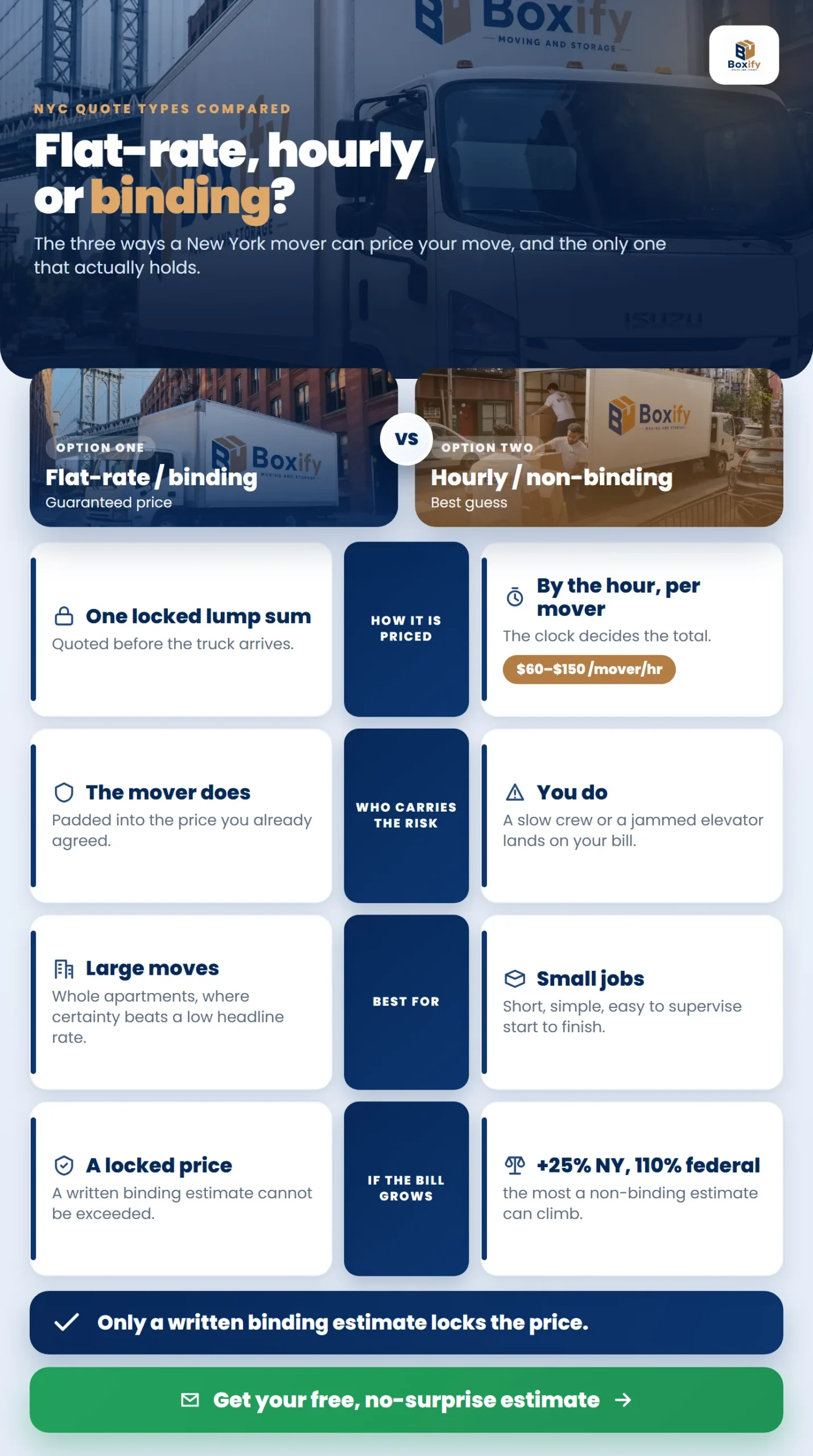
NYC movers quote three ways, and they split on one question: is the price guaranteed?
- Binding (flat-rate): a guaranteed price, locked up front. You pay that number, not a penny more.
- Hourly: billed by time (crew size × hours), commonly $60 to $150 per mover, per hour in NYC. The final number can land under or over the estimate.
- Non-binding: only the mover's best guess. The bill can climb, though the law caps how far.
The rule: for a predictable NYC apartment move, a written binding quote protects you best. In New York, only a written binding estimate locks the price up front. For a small, simple job you can watch the clock on, hourly can cost less.
Flat-rate, hourly, and non-binding NYC quotes, side by side
Three quote structures cover almost every NYC move, and each one shifts the risk differently. Here's how each is priced, who it fits, what it isn't good for, and what protects you if the number moves.
First, the three types at a glance (a few words a cell); the full detail and sources follow below.
| At a glance | Hourly | Flat-rate / binding | Non-binding |
|---|---|---|---|
| Priced | By the hour, per mover | One locked lump sum | The mover's best guess |
| Typical NYC cost | ~$60 to $150 /mover/hr | Guaranteed total | No guarantee |
| Best for | Small, simple, supervised jobs | Anyone wanting certainty | Rarely: least protective |
| Main risk | You carry the time risk | Can overpay a simple job | Most likely to surprise you |
| Your cap | +25% in NY | Can't be exceeded | 110% interstate |
Hourly figures are typical NYC market ranges (multiple NYC movers, 2025-26), not Boxify's prices. Your total hourly cost depends on how many movers work the job and how many hours it runs.
Hourly quotes: you pay for the time it takes
An hourly quote bills you for the crew's time (the rate times the number of movers times the hours), so the final number rises or falls with how long your move actually takes.
Hourly movers in NYC commonly charge about $60 to $150 per mover, per hour, with the total driven by crew size and how many hours the job runs (a typical NYC market range, not a Boxify rate). Three movers for four hours bills very differently from two movers for three, so always check two things: how many movers are on the clock, and whether there's a minimum number of hours built in.
Who it suits. Small, simple, predictable jobs (a studio or one-bedroom, an easy building, a short distance) where you can watch the clock and the work is hard to pad. On the right job, hourly is often the cheapest structure.
What it isn't good for. You carry the time risk. A slow crew, a walk-up, a long carry from the truck, or traffic across the boroughs all run the clock, and the final number isn't guaranteed. If your move has any of those wrinkles, an hourly "estimate" can drift well past what you were first told.
For what a full move actually totals by home size, this post stays in its lane. See the full cost picture of a NYC move for the studio-through-3BR ranges. Here we're comparing structures, not re-deriving the total.
Flat-rate and binding quotes: a price locked in up front
"Flat-rate" is just the everyday word for a binding quote: one guaranteed price for the whole job, locked in before the truck arrives. If it's written and binding, the number can't climb, so you pay exactly what's on the page.
This is where the three words stop being three parallel choices. Binding versus non-binding is the real fork: is the price guaranteed or not? Flat-rate versus hourly is just how the mover adds it up, one lump sum versus by the clock. A flat number is only a promise when it's a written binding estimate; in New York, that's the one pricing method that locks an exact price up front.
Who it suits. Anyone who wants certainty, and especially larger or more complex moves where the hours are hard to predict. It's why so many people search for flat-rate movers in NYC: they want one number they can trust, and if you'd rather know it now than watch a meter, a binding flat rate buys you that peace of mind.
What it isn't good for. A flat number can be padded, quoted high to cover the mover's risk, so a simple job ends up subsidizing the guarantee. And a "flat" price spoken over the phone is worth nothing: if it isn't written and binding, it isn't a guarantee, whatever it's called. (For how to read a binding quote line by line, see how to read your moving quote; here we're comparing types, not decoding the lines.)
Non-binding estimates: a best guess, and the caps that protect you
A non-binding estimate is only the mover's best guess at the price. The final bill can come in higher than the number you were quoted, but you're not defenseless: federal and New York rules cap how far it can climb.
On an interstate move, the FMCSA's rule is blunt: a mover can't require more than 110% of a non-binding estimate at delivery. If the bill runs higher, they must still hand over your goods once you pay that 110%, and bill the rest at least 30 days later.
Within New York State, NYSDOT caps it tighter: a non-binding in-state estimate can be exceeded by at most +25% on hourly moves and +10% on weight-based or binding moves, and you get 15 days to pay any balance. Check NYSDOT's Summary of Information for Shippers for the exact window. New York recognizes three pricing methods (hourly, weight-based, and a written binding estimate), and only the written binding estimate locks the price up front.
What it isn't good for. Most movers, most of the time. Of the three structures, a non-binding estimate is the one most likely to grow between the quote and the invoice. So if a mover offers only a non-binding number, keep the caps above in your pocket and ask them to put the guarantee in writing instead. And if a lowball feels too good to be true, vet the mover before you book.
Which quote type should you choose for your NYC move?
There's no quote type that's always best; the right one depends on the shape of your move. Match the structure to the job and you stop overpaying for certainty you don't need, or gambling on a clock you can't control.
- A predictable apartment or home move, or you just want certainty: get a written binding quote. The price is locked, and for a bigger or building-complicated move, that guarantee is worth more than a possibly-lower hourly number that could run over.
- A small, simple, short job you can supervise: hourly can cost less. A studio, an easy walk-out, a quick cross-neighborhood hop (where the work is hard to pad and you can watch the clock) often comes in cheaper by the hour than a padded flat rate.
- Any non-binding number: treat it as a starting point, not a promise. It can climb to the caps, so before you book, ask the mover to put a binding price in writing instead.
The honest short version: pay for a guarantee when the move is big or unpredictable; pay by the hour when it's small and you can keep an eye on it; and never assume a non-binding "estimate" is the number you'll actually pay.
How Boxify quotes a move
At Boxify, a Greater NYC mover, the quote structure is fit to the job, not to whatever pays the mover best. Here's how that works in practice.
Most Boxify moves are quoted as a binding, guaranteed price: the number you approve is the number you pay. When a job is small and simple enough that hourly would genuinely cost you less, that's offered instead, and fixed-price promotions run on select moves. The point isn't to sell one billing model; it's to put you in the structure that fits your move.
Whichever structure fits, the written quote is fully itemized: your inventory, both addresses, and the distance, all on the page, nothing buried. Quotes are free and upfront, and the price we quote is the price you pay, with no meter creeping past what you agreed to, no "estimate" that quietly grows on move day.
If that's the kind of number you want (one that fits your job, in writing), you can get a straight, no-surprise estimate with no pressure and no obligation.
FAQ
Is flat-rate the same as a binding quote?
Mostly, yes. "Flat-rate" is the everyday word for a binding quote: one guaranteed price for the whole job. The distinction that matters is written and binding versus not: in New York, only a written binding estimate actually locks the price up front, so a verbal "flat" number isn't a guarantee.
Are hourly movers cheaper in NYC?
They can be, on the right job. NYC movers commonly charge about $60 to $150 per mover, per hour, so for a small, simple, predictable move you can supervise, hourly often costs less than a padded flat rate. But because you pay for the time it takes, a slow or complicated move can end up costing more.
Can a mover charge more than a binding quote?
Not if it's a written binding estimate: that price is guaranteed and can't be exceeded. A non-binding estimate is different: the bill can rise, though only within legal limits (see the next question).
How much can a non-binding NYC quote go up?
Within New York, a non-binding in-state estimate can be exceeded by at most +25% on hourly moves and +10% on weight-based or binding moves, with 15 days to pay any balance. Check NYSDOT's Summary of Information for Shippers for the exact window. On an interstate move, the mover can't require more than 110% of a non-binding estimate at delivery.
What's the difference between a binding and a non-binding estimate?
A binding estimate guarantees the price (you pay that amount at delivery, no more), while a non-binding estimate is only the mover's best guess and can rise. In New York, only a written binding estimate actually locks the price up front. Flat-rate and hourly are billing methods, not the same thing as this binding-vs-non-binding distinction.
Pick the structure, not just the number
The three quote types aren't three flavors of the same price; they split on one question: is the number guaranteed? A written binding (flat-rate) quote locks it; an hourly quote bills by the clock and can go either way; a non-binding estimate is a best guess capped by law.
Match the structure to your move: binding when it's big or unpredictable, hourly when it's small and you can supervise, and a written guarantee any time a mover hands you a number that can grow. Do that, and moving day holds no surprise on the one line that matters most: the total.
Which quote structure fits your move?
If you'd rather skip the guessing and get a quote structured to fit your move, that's the whole idea behind a Boxify estimate: free and upfront, fully itemized, and quoted so the price you're quoted is the price you pay.
Get a free, no-surprise Boxify estimate.









- The full cost picture of a NYC move. The whole number, by home size, line by line.
- How to read your moving quote. Decode a binding or hourly quote line by line, and spot the add-on fees.
- Get a straight, no-surprise estimate. The free, itemized Boxify quote, fit to your move, so the price you're quoted is the price you pay.
- FMCSA: binding vs. non-binding estimates and the 110% rule on a non-binding interstate move; "Your Rights and Responsibilities When You Move."
- NYSDOT: New York's three in-state pricing methods, the written-binding lock, and the overage caps (+25% / +10%, 15 days), per the Summary of Information for Shippers (Rev. 11-2025).
- NYC moving-market ranges (multiple NYC movers, 2025-26): the hourly rate range, cited per mover as market context only, not a Boxify price.
Hourly figures reflect NYC market context (2025-26) and are refreshed when the market moves.
Rita Penn, Author. Rita Penn is a copywriter with over eight years of experience writing for home service businesses and service providers. She specializes in the moving and storage industry and has created content for several moving companies, along with businesses across other service-based industries.
Eddie Torr, Editor. Eddie Torr is an AI content editor: the independent quality-and-compliance gate every draft passes before it advances. He checks each claim against its approved source, tests the piece against the editorial standards, ranks it, and returns a verdict. He never rewrites the piece himself and never approves delivery; a human reviewer does that.
Maya Ellison, Reviewer. Maya Ellison is an editorial lead with more than 11 years across copywriting, editing, content strategy, and editorial operations. She holds a bachelor's in Communications (Professional Writing and Digital Media) and a master's in Information and Knowledge Management. Those are the two sides of her work: creating clear content, and building the systems that produce it consistently. She gives every piece a final human review before it ships, confirming each claim is fairly represented, tied to a checked source, and dated.
Reviewed on this post: She reviewed this comparison against its sources, confirming the binding, hourly, and non-binding definitions, the New York and interstate overage caps, and that every hourly figure reads as NYC market context, not a Boxify price a reader might mistake for a quote.