

How to Read a NYC Moving Quote (and Spot the Fees Nobody Mentions)
You have a number in hand. Maybe it came by text, maybe it's a tidy PDF. But something about it feels light, and you've heard the stories: the friend whose "quote" grew by hundreds on moving day, the charges nobody mentioned until the truck was half-loaded.
Here's the thing most movers won't tell you: a moving estimate and a moving quote are the same document, the written price a mover gives you before the job. The trouble isn't the word. It's that a quote can be built to grow, and unless you can read every line, you won't see it coming, starting with whether it matches what a NYC move actually costs.
This post decodes a NYC moving estimate the way we'd read one at Boxify: line by line, naming the fees other movers leave for moving day.
The 4-step way to read any NYC moving estimate
To read a NYC moving estimate, work four checks in order:
- Identify the estimate type. Is it binding (a guaranteed price) or non-binding (the mover's best guess that can rise)?
- Read what the base rate is priced on. Hourly (rate × crew × hours) or a flat/binding total for the whole job?
- Scan for add-on fees. Look for the surprise lines (stairs, long carries, elevator, COI, parking) and the ones that hide as vague "surcharges."
- Confirm what's guaranteed vs. what can still move. Know which numbers are locked and which can climb before you sign.
Do those four and you'll know the one thing that matters: whether the price is guaranteed or a best-guess, and exactly which fees could still be added. The rest of this post walks each step.
What you need in hand before you read
You can't decode a quote you don't fully have. Get these three things first:
- The estimate in writing. A verbal number is nothing: it isn't binding, it isn't enforceable, and it's the number most likely to change. If a mover won't put it in writing, stop there.
- The mover's itemized fee lines. Ask for the full breakdown: base rate, valuation, and every possible add-on, not just a bottom-line total.
- Your building's access facts. Walk-up floors, whether there's a service elevator, and whether your building requires a Certificate of Insurance (COI), the proof a mover carries the liability coverage your building demands before letting movers in. These drive the add-on fees, so name them up front and the estimate gets more honest.
Binding or non-binding: which quote am I holding?
A binding estimate is a guaranteed price: on an interstate move you pay 100% of it at delivery, no more. A non-binding estimate is only the mover's best guess, and the final bill can come in higher. This is the first thing to settle, because everything else (how far the number can grow, what protects you) flows from it.
The federal rulebook movers must follow, the FMCSA's "Your Rights and Responsibilities When You Move" booklet, lays out these two types plainly. One trap to skip early: flat-rate and hourly are billing methods, not federal estimate types. A mover can quote you an hourly rate that's still non-binding.
For a move within New York State, the rules come from NYSDOT, and there are three recognized pricing methods (hourly, weight-based, and a written binding estimate), but only a written binding estimate locks in an exact price up front. If your NYC-to-NYC quote isn't a written binding estimate, treat the number as a starting point, not a promise.
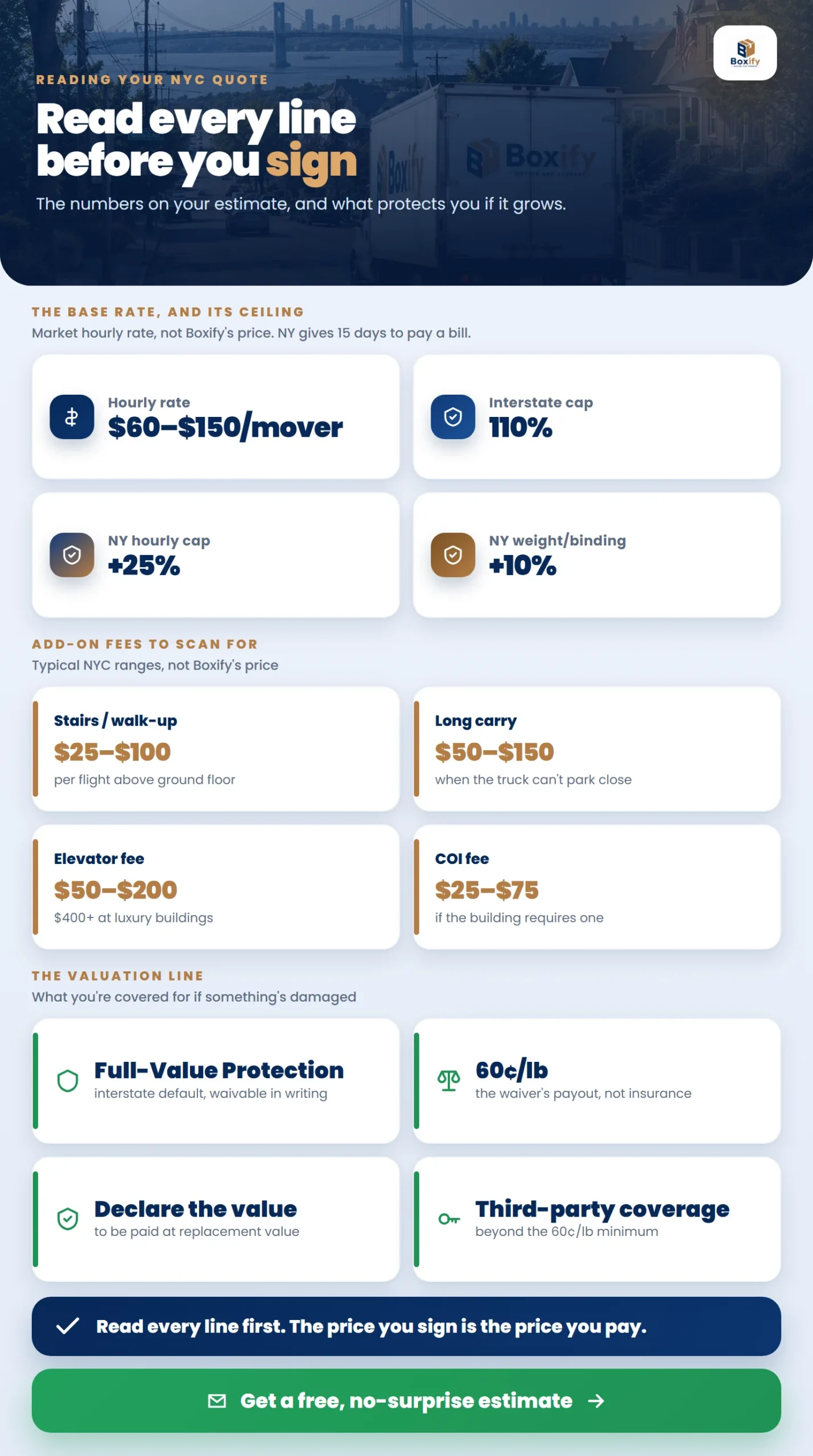
Then there's the line most readers skim: valuation. And valuation is not insurance. On an interstate move, Full-Value Protection is the default: your goods are covered at replacement value unless you actively waive it in writing. The waiver, Released-Value protection, is free but minimal: the mover is liable for just 60¢ per pound, per item, so a lost 10-lb item worth $1,000 pays only $6. If a quote looks cheap because a "released value" box is pre-checked, that's a coverage cut, not a discount.
(Which estimate type should you pick? That's a separate decision. Our guide to flat-rate, hourly, and binding NYC quotes covers it. Here, we're only reading the one you're holding.)
What each line on your NYC moving estimate actually means
Every honest estimate breaks into three parts: the base-rate line, the valuation line, and the total-or-guarantee line. Read them in that order and nothing hides.
The base-rate line. This is the engine of the price. On an hourly job it's rate × crew size × hours, and for market context, NYC movers commonly charge about $60 to $150 per hour, per mover, with the total driven by how many movers and how many hours (market context, not a Boxify rate). Two things to check: how many movers, and whether there's a minimum number of hours built in. On a flat/binding job, this line is the whole guaranteed number instead.
The valuation line. Confirm whether you're carrying Full-Value Protection (the default) or the 60¢-per-pound Released-Value waiver. If it's not stated, ask: a blank valuation line is a gap, not a saving.
The total-or-guarantee line. This tells you whether the bottom number is locked (binding) or a best guess (non-binding). It's the payoff of step 1, printed at the bottom of the page.
For the full cost of a move by home size (studios through 3-bedrooms), this post stays in its lane and hands that off; see the pillar guide linked below. Here we're reading lines, not re-deriving the total.
The surprise fees nobody mentions
Here's where quotes quietly grow: the add-on fees. Some are legitimate charges for real work; others are padding. The difference is whether they're disclosed up front or sprung on you mid-move. The table below is the one most NYC movers won't hand you: the common add-ons, what each is for, whether it's near-universal or situational, and the typical market range (as of 2026; these are typical NYC market ranges, not Boxify's prices). For why each of these fees applies to your move in the first place, see what makes a NYC move cost more.
| Fee | What it's for | Near-universal or situational | Typical NYC range* |
|---|---|---|---|
| Stairs / walk-up fee | Carrying items up/down flights above a set floor | Near-universal when it applies | ~$25 to $100 per flight |
| Long-carry fee | A long distance between the truck and your door | Near-universal when it applies | $50 to $150 |
| Elevator reservation fee | Reserving the building's service/freight elevator | Situational | $50 to $200 typical; $400+ at luxury/high-rise |
| Certificate of Insurance (COI) fee | Producing the COI your building requires before entry | Situational | $25 to $75 |
| Parking / permit access | Securing legal truck access for loading | Situational | $20 to $250 |
*Typical NYC market ranges (multiple NYC movers, 2026), not Boxify prices. Situational fees vary by building and job. Stairs are charged per flight above a set floor; the NYC DOT moving permit itself is free: the parking charge is the mover's service fee for pulling it.
Now the lines that have no reliable published number, which is exactly why you should hunt for them on your own quote and ask what triggers each:
- Travel / fuel surcharge: a charge for the truck's time to and from the depot. Ask whether it's included or added, and how it's calculated.
- Bulky / heavy-item fee: for pianos, safes, oversized furniture. Ask which of your items count.
- Trip or job minimum: a floor the job is billed to even if it finishes early. Ask what the minimum is before you book.
Because these three vary so widely mover to mover, treat any specific figure you're quoted as that mover's number to justify, not a market standard.
Here's the honest contrast. A no-surprise quote folds these fees in up front: the price we quote is the price you pay. Boxify quotes are free and upfront, priced flat-rate/binding or hourly to fit the job, with the add-ons named before moving day, not after. When you learn to spot where a fee hides, you learn to catch the tactic an honest mover simply doesn't use.
Worked example: reading a sample non-binding hourly estimate. Say a mover quotes a 1-bedroom, 4th-floor walk-up like this (illustrative, using market ranges, not a Boxify quote):
- Base rate: 3 movers at a mid-market ~$120/hr, 4-hour estimate → the hourly engine (within the $60 to 150 range). Check: is a minimum built in? Is this binding or a best guess?
- Stairs / walk-up: listed at ~$100 (a 4th-floor walk-up is ~3 flights above the first; at ~$25 to $100 per flight, that's in range). Legitimate: it's a walk-up, and the fee applies.
- Valuation: a pre-checked "released value" box. Watch this: it quietly drops you to 60¢/lb coverage.
- "Travel surcharge": a vague line with no basis shown. Ask: no published market number exists, so make the mover explain it.
Read top to bottom, and you can see the whole shape: an hourly (non-binding) base that can grow with the clock, one legitimate fee, one coverage cut disguised as a default, and one line to interrogate. Tipping, by the way, is not a fee a mover should add to your quote. It's discretionary and separate (see how much to tip movers in NYC, below).
What protects you if the final bill runs higher
You're not defenseless against a growing bill: federal and New York rules cap how far a non-binding estimate can be exceeded. These are the numbers to keep in your pocket.
On an interstate non-binding estimate, the mover can't require more than 110% of the estimate at delivery; if the bill is higher, they must still deliver on payment of that 110% and bill the rest at least 30 days later (FMCSA). So a non-binding number can grow, but only so far before you can take your goods and settle the rest later.
Within New York State, NYSDOT caps it too: a non-binding in-state estimate can be exceeded by at most +25% on hourly moves and +10% on weight-based or binding moves, and you get 15 days to pay any balance. Check NYSDOT's Summary of Information for Shippers for the exact window (NYSDOT). Print those caps next to your quote. If a mover on moving day claims you owe far more than the cap allows, you now know the rule they're breaking.
FAQ
Is a moving estimate the same as a quote?
Yes, "estimate" and "quote" are the same thing: the written price a mover gives you before the job. What matters isn't the word but the type: a binding estimate is guaranteed, a non-binding one is only a best guess and can rise.
Is my NYC moving estimate binding?
Only if it says so in writing. For a move within New York, only a written binding estimate locks in an exact price; hourly and weight-based methods are non-binding and can grow within the state's caps. If your estimate doesn't say "binding," treat it as a best guess.
What fees can a mover add after the estimate?
Common add-ons include stairs/walk-up, long-carry, elevator reservation, COI, and parking fees, plus travel/fuel surcharges, bulky-item fees, and job minimums. On a non-binding quote these can raise the bill, which is why you scan for them and ask what triggers each before you sign.
Can my final bill be higher than the estimate?
On a non-binding estimate, yes, but it's capped. Interstate, a mover can't require more than 110% of the estimate at delivery; within New York, the ceiling is the estimate +25% (hourly) or +10% (weight-based/binding), with 15 days to pay any balance. Check NYSDOT's Summary of Information for Shippers for the exact window. A binding estimate can't be exceeded at all.
How much am I covered for if the movers damage something?
By default, far less than an item's replacement value. Within New York, minimum liability won't pay near what your goods are worth unless you declare their value or buy full-replacement coverage; on an interstate move, Full-Value Protection is the default, but the free waiver, Released-Value, pays just 60¢ per pound, per item (a lost 10-lb item worth $1,000 pays $6). Check which valuation line your estimate lists before you sign.
Is the tip included in my moving quote?
No. A tip is never part of the quote or the final bill. Tipping is a discretionary courtesy you decide on moving day, separate from the price you were quoted. For the customary NYC range and when it's fine to skip it, see how much to tip movers in NYC.
Read every line before you sign
A moving quote is only honest if you can read every line. Run the four checks: name the estimate type, read the base-rate basis, scan for add-on fees, and confirm what's guaranteed. Keep the fee table and the overage caps next to your quote, insist on everything in writing, and moving day holds no surprises, because you already read them all on the page.
When to ask for a straight quote
Two moments are your cue to walk. If a mover won't itemize the fees (won't tell you what triggers the stairs charge, the surcharge, the minimum) or won't put the number in writing, that quote is built to grow. A straight, no-surprise estimate names every line up front, so the price you're quoted is the price you pay.
If that's the estimate you want, ask for one that's free, upfront, and itemized, so nothing shows up on moving day that wasn't on the page you signed.
Get a free, no-surprise estimate









- What a NYC move actually costs. The full, line-by-line cost breakdown by home size.
- Flat-rate, hourly, or binding quote types. Which quote structure actually protects you.
- How to vet a NYC moving company. The red flags behind a too-good-to-be-true quote.
- How much to tip movers in NYC. A straight answer on the one cost that shouldn't be on your quote.
- What a free, no-surprise Boxify estimate includes. Every fee named up front, so the price you're quoted is the price you pay.
- FMCSA: binding vs. non-binding estimates; the 110% rule; Full-Value vs. Released-Value protection; "Your Rights and Responsibilities When You Move."
- NYSDOT: New York in-state pricing methods and overage caps (+25% / +10%, 15 days), per the Summary of Information for Shippers (Rev. 11-2025).
- Multiple NYC movers: what a Certificate of Insurance (COI) is and why buildings require one before letting movers in.
- NYC moving-market ranges (multiple NYC movers, 2025-26): add-on fee ranges and hourly rates, cited as market context only.
Fee ranges reflect NYC market context (2025-26) and are refreshed when the market moves.
Rita Penn, Author. Rita Penn is a copywriter with over eight years of experience writing for home service businesses and service providers. She specializes in the moving and storage industry and has created content for several moving companies, along with businesses across other service-based industries.
Eddie Torr, Editor. Eddie Torr is an AI content editor: the independent quality-and-compliance gate every draft passes before it advances. He checks each claim against its approved source, tests the piece against the editorial standards, ranks it, and returns a verdict. He never rewrites the piece himself and never approves delivery; a human reviewer does that.
Maya Ellison, Reviewer. Maya Ellison is an editorial lead with more than 11 years across copywriting, editing, content strategy, and editorial operations. She holds a bachelor's in Communications (Professional Writing and Digital Media) and a master's in Information and Knowledge Management. Those are the two sides of her work: creating clear content, and building the systems that produce it consistently. She gives every piece a final human review before it ships, confirming each claim is fairly represented, tied to a checked source, and dated.
Reviewed on this post: She reviewed this walkthrough line by line, confirming the binding-versus-non-binding rules, the valuation facts, and the fee explanations all match their sources, and that every figure reads as NYC market context, not a Boxify price a reader might mistake for a quote.