

Certificates of Insurance for NYC Movers: What a COI Is and Why Your Building Demands One
If your building or your mover just handed you that acronym, here is the calm, complete version. Below we cover what a COI is, why your building demands one, what the form actually looks like so you can read your own, and how to make sure your movers provide it.
It is one piece of your NYC move-in day playbook, and it does not have to be the confusing one.
What a certificate of insurance for movers is, in one paragraph
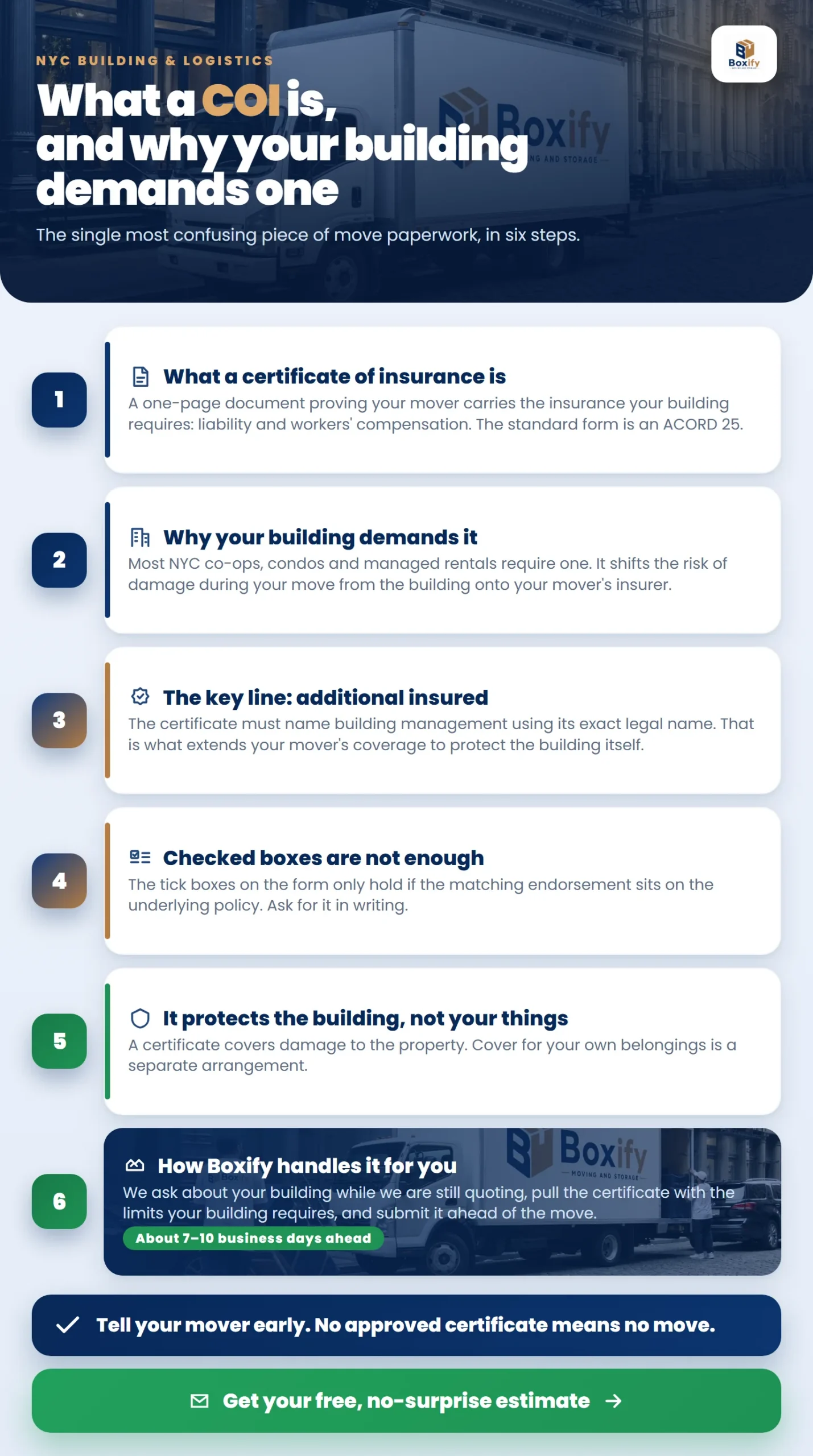
A certificate of insurance (COI) for movers is a one-page document proving your moving company carries the liability and workers'-compensation insurance your building requires. Most NYC co-ops, condos, and managed rentals demand a mover's COI, submitted for the building's written approval before move day, to shift move-damage risk onto the mover's insurer.
The short version
- A COI proves your mover carries the insurance your building requires.
- It names the building's management as additional insured and shows workers' compensation.
- The coverage limits are the building's requirement, commonly $1 to 2 million and higher at luxury addresses, not a figure your mover picks.
- A COI is usually submitted about 7 to 10 business days ahead for written approval, and the doorman gates access on move day.
- Tell your mover up front whether your building needs one, so it is handled without a last-minute scramble.
- A COI protects the building, not your belongings. Your own goods are a separate question (see the two sides of insurance below).
What is a certificate of insurance (COI)?
A certificate of insurance (COI) is a one-page document from your mover's insurer that proves the moving company carries the insurance a building requires before it will let movers in. It is also called a Certificate of Liability Insurance, and the standard version is the industry form known as the ACORD 25.
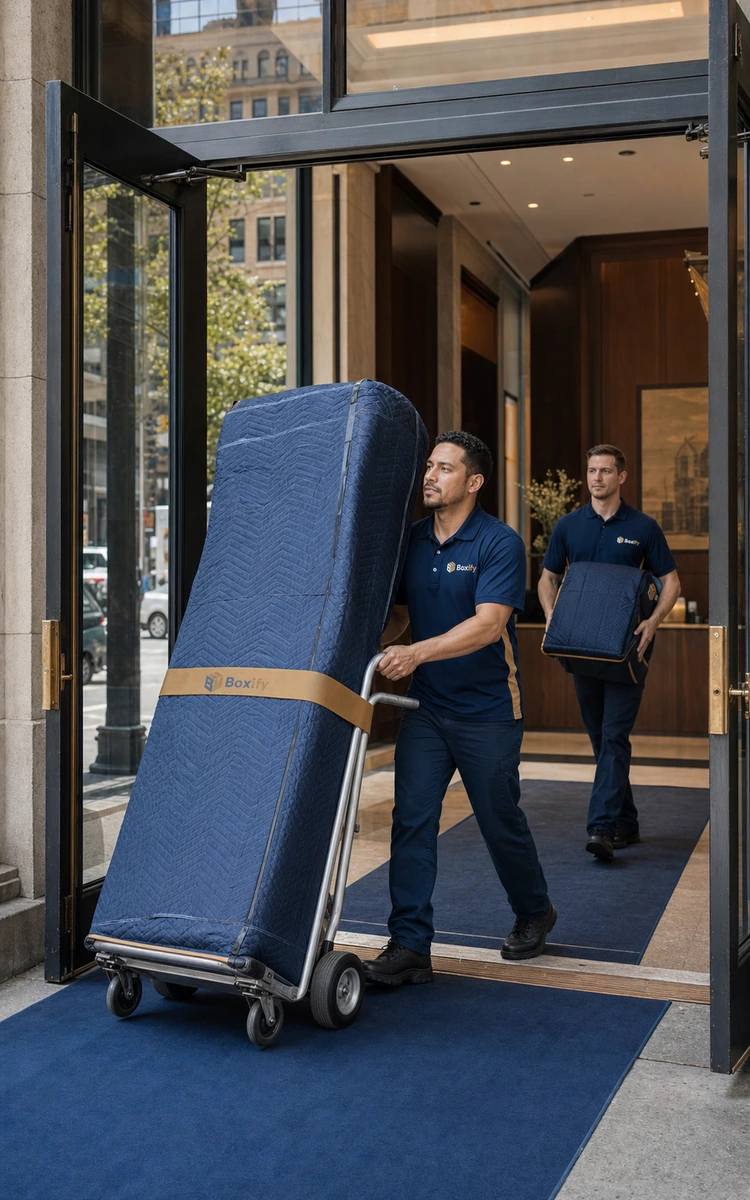
Most NYC co-ops, condos, and managed rentals ask for one before entry, so that if the move damages the lobby, an elevator, or a hallway, the cost falls on the mover's insurer rather than the building. A COI is not your insurance and it is not the building's. It is proof that your mover's coverage exists and that it lists the specific protections your building asked for.
Why your building demands one
Your building demands a mover's COI because a move puts its lobby, elevators, floors, and hallways at risk, and the certificate shifts that risk onto the mover's insurer instead of onto the building. A generic proof-of-insurance page is not enough on its own. The building is looking for two specific things.
First, the certificate must name the building's management as "additional insured," using the building's exact legal name. That is what extends the mover's coverage to protect the building itself. Second, it must show workers' compensation, because workers' comp comes up on every move, and no doorman building allows a move without a full COI and workers' comp.
The coverage limits are the building's requirement, not your mover's preference. NYC buildings typically require $1 to 2 million in general liability, and luxury buildings often ask for more. In practice, required limits vary widely from one building to the next: $1 million, $2 million, or $5 million in aggregate, and up to $7 million or more in excess coverage at the strictest addresses. Those numbers are what your building asks a mover to carry. They are the building's bar to clear, not a figure any one company advertises.
What a COI actually looks like
A mover's COI is almost always an ACORD 25 Certificate of Liability Insurance, a standard one-page form, so once you know where to look you can read your own. Here is what to check on a sample certificate. This is an illustrative example only, with no real insurer or policy number shown, and any dollar figures on it are the building's required limits used as an example:
- The coverage-limits column. This is where general liability and the aggregate limit appear. On a real certificate you would confirm the figure your building asked for here, for example $1,000,000 each occurrence and $2,000,000 aggregate (the building's required limits, shown only as an example).
- The "Description of Operations / Locations / Vehicles" box. This free-text field near the bottom is where your building's management is named as additional insured and the move address and dates are entered. A COI that does not name your building here, by its exact legal name, is not yet approvable.
- The "ADDL INSD" (Additional Insured) checkbox and the "SUBR WVD" (Waiver of Subrogation) checkbox. These are the two boxes some NYC buildings require checked.
- The honest catch. A checked box means nothing on its own. It only holds if the underlying policy carries the backing endorsement, the primary-and-non-contributory or waiver-of-subrogation endorsement the building requires. Some buildings ask to see those endorsements, not just the checked box.
That last point is the one thin explainers skip, and it is the one that trips up a rushed move. A box someone ticked on a form is a promise the policy behind it has to actually keep.
How to make sure your movers provide the COI
To make sure your movers provide the COI, tell them up front that your building requires one, and a crew that handles this daily takes it from there. Here is how a careful in-house crew works through it as routine, day-to-day work:
- It asks up front, while quoting, whether your building requires a COI and what your management office needs.
- It pulls the certificate your building requires, with management named as additional insured, workers' comp shown, and the building's required limits met.
- It submits the COI to management about 7 to 10 business days ahead, so the office has time to review it and issue written approval.
- On move day, the doorman or front desk checks for that approval before the crew comes up. No approved COI, no move.
COIs are a routine part of NYC moving and do not slow a move down. The one thing that does cause a scramble is a last-minute surprise: a customer says no COI is needed, and the building turns out to require one. Telling your mover early is what heads that off.
If you would rather not manage any of this, that is exactly what hiring a crew that does it every week is for. You can read how Boxify handles COIs for you, or get a free, upfront quote and hand the building paperwork over.
A COI protects the building, not your belongings
A COI protects the building, not your belongings. It covers damage your move might do to the property, not damage to your own furniture or boxes. Those are two different kinds of protection, and it is easy to assume the certificate covers your stuff when it does not.
Your own things are covered by a separate arrangement, valuation and real moving insurance, which we keep apart from the building's certificate on purpose. For that side, see the two sides of insurance on a move. Here, we stay on the building's COI.
Frequently asked questions
What is a certificate of insurance (COI) for movers?
A certificate of insurance (COI) for movers is a one-page document proving your moving company carries the liability and workers'-compensation insurance a building requires. Most NYC co-ops, condos, and managed rentals demand one before letting movers in, so move-damage risk shifts onto the mover's insurer rather than the building.
Do co-op and condo buildings require a COI for movers?
Yes. Most NYC co-ops, condos, and managed rentals require a mover's COI before they will let the crew in. The certificate is submitted to the management office for review, and the doorman or front desk checks that it is approved before move day.
What is a Certificate of Liability Insurance for movers?
It is the same thing as a COI. "Certificate of Liability Insurance" is the formal name, and the standard version is the ACORD 25 form. It proves your mover's coverage exists and lists the protections your building asked for, such as naming management as additional insured.
What should a mover's COI show?
A mover's COI should name your building's management as additional insured, using its exact legal name, show workers' compensation, and meet the coverage limits your building requires, commonly $1 to 2 million and higher at luxury buildings. If your building requires the "ADDL INSD" or "SUBR WVD" boxes checked, note that a checked box only holds with the backing endorsement on the policy. These are the building's requirements, not a mover's advertised coverage.
How far ahead does my mover need to submit the COI?
Usually about 7 to 10 business days ahead of move day. That gives the management office time to review the certificate and issue written approval, and on move day the doorman gates access until that approval is on file. Submitting late is the most common reason a move gets delayed.
How do I get my mover to provide a COI?
Tell your mover up front that your building requires a COI and what your management office needs. A crew that pulls these routinely handles the rest, submitting the certificate well ahead so it is approved before move day. If you want it handled for you, see how Boxify handles COIs for you.
A COI is a knowable piece of paperwork
A certificate of insurance is the single most confusing piece of NYC move paperwork, and it does not have to be. It is a one-page document proving your mover carries the insurance your building requires, it names your management as additional insured and shows workers' comp, and it is submitted for written approval before move day. Once you know what it is and what the form shows, the only thing left is making sure your movers provide it, and the surest way to do that is to tell them up front.
Let a crew that does this daily handle the building's COI
Facing a building that wants a COI before it will let your movers in?
Get a free, upfront Boxify moving quote
Tell us your building and your move date, and we will pull the certificate your building requires and submit it for approval well ahead of move day.





- Your NYC move-in day playbook, the master walkthrough of everything your building requires on moving day, from COIs to elevators to parking.
- How Boxify handles COIs for you, the building side handled for you, so the paperwork never lands on your desk.
- The two sides of insurance on a move, the other side of insurance: valuation versus real coverage for your own belongings.
Attributed facts are stated with their source and dated; building requirements describe the building's own rules, not a Boxify coverage figure.
- Multiple NYC moving companies: what a certificate of insurance is and why buildings require one, and the coverage NYC buildings typically require (management named as additional insured; $1 to 2 million general liability, higher at luxury buildings). Attributed market context, not a Boxify price or coverage figure.
- NYC movers and real-estate outlets: a mover's COI is typically submitted about 7 to 10 business days ahead, management gives written approval, and the doorman gates access on move day.
- ACORD and IA Magazine (the Big "I"): the anatomy of the ACORD 25 Certificate of Liability Insurance: the Description of Operations field, the "ADDL INSD" and "SUBR WVD" checkboxes, and the point that a checked box requires a backing endorsement on the underlying policy, as of 2026.
These attributed facts reflect current NYC building requirements and ACORD-form norms as of 2026; we refresh them when the requirements change.
Rita Penn, Author. Rita Penn is a copywriter with over eight years of experience writing for home service businesses and service providers. She specializes in the moving and storage industry and has created content for several moving companies, along with businesses across other service-based industries.
Eddie Torr, Editor. Eddie Torr is an AI content editor: the independent quality-and-compliance gate every draft passes before it advances. He checks each claim against its approved source, tests the piece against the editorial standards, ranks it, and returns a verdict. He never rewrites the piece himself and never approves delivery; a human reviewer does that.
Maya Ellison, Reviewer. Maya Ellison is an editorial lead with more than 11 years across copywriting, editing, content strategy, and editorial operations. She holds a bachelor's in Communications (Professional Writing and Digital Media) and a master's in Information and Knowledge Management. Those are the two sides of her work: creating clear content, and building the systems that produce it consistently. She gives every piece a final human review before it ships, confirming each claim is fairly represented, tied to a checked source, and dated.
Reviewed on this post: Maya confirmed that every coverage limit reads as the building's requirement and never as Boxify's own coverage. She also checked that the annotated form is labeled an illustrative example and that the customer's-goods coverage is only named and linked, not taught here.