

What Is a Move-In Fee in a NYC Building? A Plain, Honest Guide to Fees and Deposits
If "move-in fee" just showed up on your lease, your board package, or a building rider, your first reaction is probably suspicion: another NYC move-in cost nobody warned you about. It is a fair worry. Between the security deposit, the broker, and whatever the movers charge, the fees pile up fast, and this one sounds like a line somebody invented.
Before you pay anything, it helps to see your NYC move-in day playbook for the whole building picture. Here, we stay on the fee itself: what it is, who charges it, whether it is legal, whether you get it back, and the one honest answer to "how much."
What is a move-in fee in a NYC building?
A move-in fee is a one-time, non-refundable charge some NYC buildings, most often co-ops and condos, collect for the administration and wear-and-tear of a move. The resident pays it to the building, not to the movers or to Boxify. A separate move-in deposit is typically refundable if no common-area damage occurs.
The short version
- A move-in fee is non-refundable; a move-in deposit is refundable. The fee covers the admin and wear-and-tear of a move; the deposit is a hold that a co-op or condo typically returns if the move causes no common-area damage.
- The resident pays the building. It is not your mover's fee (the stairs, long-carry, and access charges are a separate category), and it is not a Boxify charge.
- Amounts vary by building and are not capped by law. There is no reliable range to quote, so the only way to learn your number is to ask your building's management office (no citable figure exists).
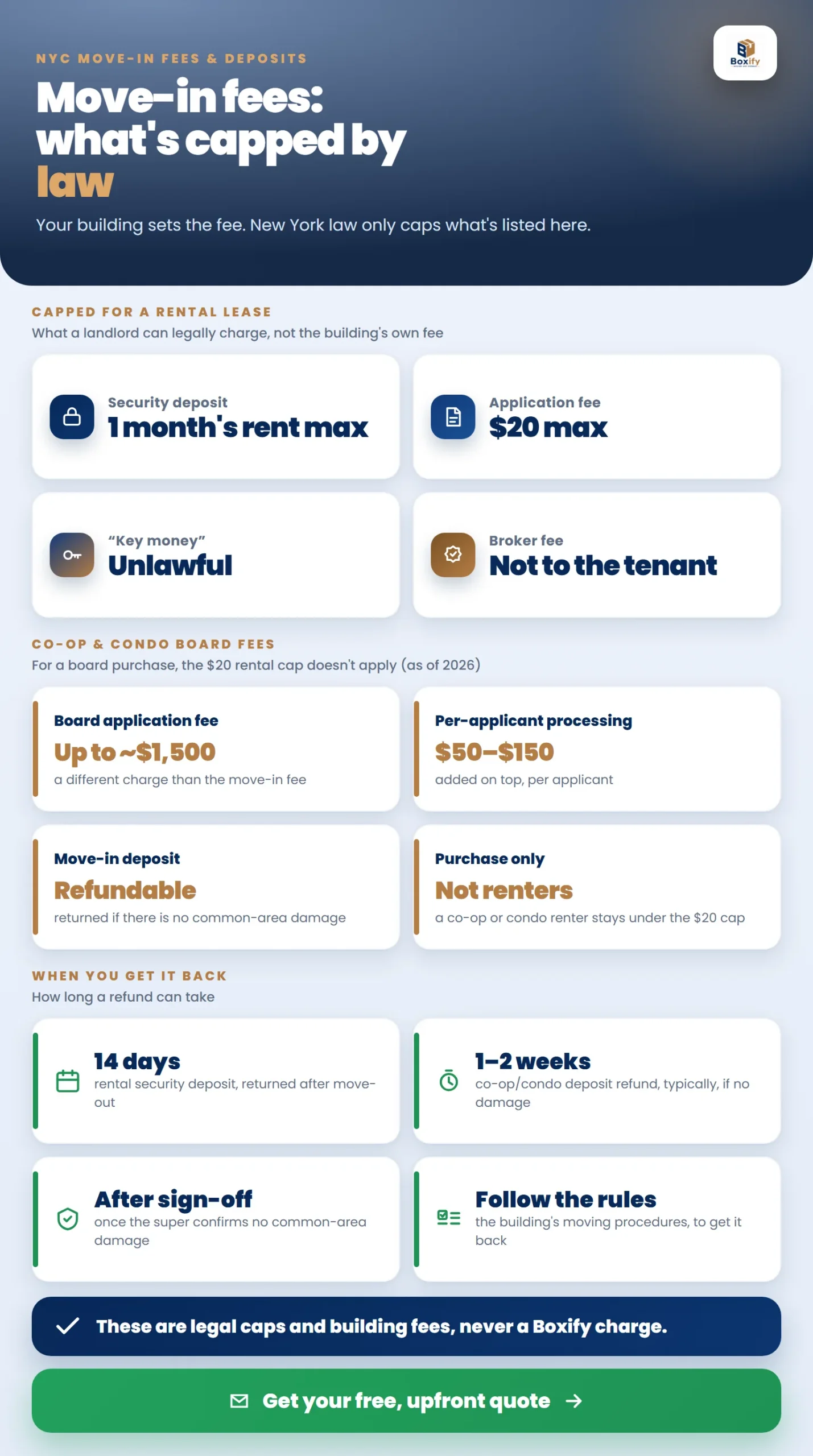
- NY law does cap the rental charges. A rental security deposit can't exceed one month's rent and must be returned within 14 days of move-out; a rental application fee is capped at $20; and "key money" is unlawful.
- Co-op and condo boards are the exception. A board can charge an application or board fee up to roughly $1,500, plus $50 to $150 in processing fees, and the $20 cap does not apply to boards. That is a different charge from the move-in fee.
What a move-in fee actually is, and what it isn't
Three different charges all get called a "move-in fee," and telling them apart is the key to knowing who you actually owe.
The first is the one this guide is about: the building's move-in fee and move-in deposit. The fee is a one-time, non-refundable charge for the paperwork and common-area wear of a move, and it is most common in co-ops and condos. The deposit is separate and is typically refundable, returned in part or in full once the super or managing agent confirms your move left no common-area damage. Both are charged by the building, and both are paid by the resident moving in.
The second is your mover's add-on fees. Charges for a walk-up, a long carry from the curb, elevator time, a certificate of insurance, or truck parking are billed by the moving company, not the building, and they are a completely separate category. If you want the numbers behind those, that is a different topic; see what stairs, long carries, and building access add to a move.
The third is the mover's own booking deposit. When you book Boxify, there is a $50 hold that is refunded in full if you cancel at least 48 hours before your move. It is a third, separate thing, and it has nothing to do with your building's move-in fee. So when a "move-in fee" surprises you, the first question is always the same: whose charge is this? Nine times out of ten, it is the building's.
Move-in fee vs. security deposit vs. application fee: a plain comparison
A move-in fee, a security deposit, and an application fee are three separate charges, and only some of them are capped by New York law. Here is how they line up:
| Charge | What it is | Who charges it | Refundable? | Capped by law? |
|---|---|---|---|---|
| Move-in fee | A one-time charge for the admin and wear-and-tear of a move | The building | No | No: per-building, uncapped |
| Move-in deposit | A hold against common-area damage during your move | The building | Yes, typically | No: per-building, uncapped |
| Security deposit | A hold against unit damage or unpaid rent | The landlord | Yes, returned within 14 days | Yes: no more than one month's rent |
| Rental application fee | A screening or background-check charge | The landlord | No | Yes: $20 maximum |
| Co-op / condo board fee | A board application or processing charge | The co-op or condo board | No | No $20 cap; up to roughly $1,500 plus $50 to $150 processing |
The pattern worth remembering: the law caps what a landlord can take on a rental, but it does not cap the building's move-in fee or deposit. That is exactly why an honest source can't hand you a dollar figure for the move-in fee, only for the charges the law limits.
Can a building legally charge a move-in fee? What NY law says
Yes, a NYC building can legally charge a move-in fee, but New York law caps several nearby charges and bars others outright. The rules that matter most:
- Security deposits are capped at one month's rent. Under New York's Housing Stability and Tenant Protection Act of 2019, a landlord may not demand more than one month's rent as a security deposit; asking for more is unlawful. That deposit also has to be returned within 14 days of you moving out.
- "Key money" is illegal. A landlord or manager can't require a payment or extra deposit simply to reserve or hand over an apartment. That practice, known as "key money," is unlawful in New York.
- Rental application fees are capped at $20. For a rental, New York law limits an application or background-check fee to $20.
- A landlord's broker can't bill you. As of June 11, 2025, New York City's FARE Act bars a broker who represents the landlord from charging their fee to the tenant.
- Co-op and condo boards are the exception. The $20 application-fee cap does not apply to co-op or condo boards. Boards commonly charge application or board fees from several hundred dollars up to roughly $1,500, plus per-applicant processing fees of about $50 to $150. Note this applies to purchase applications; if you are renting or subletting a co-op or condo unit, you are still under the $20 cap.
Here is the honest takeaway: the move-in fee itself is largely per-building and is not capped by law. The rules above govern the security deposit, the application fee, and broker fees, not the building's move-in fee, which is precisely why no reliable number for it exists.
Are move-in fees and deposits refundable?
A move-in deposit is usually refundable, but a move-in fee is not. That single distinction resolves most of the confusion.
The move-in fee is a one-time charge for the administration and wear of your move, and you do not get it back. The move-in deposit is a hold: a co-op or condo typically returns it, in part or in full, once the super or managing agent confirms your move caused no common-area damage and you followed the building's moving procedures, usually within one to two weeks.
Neither of these is your security deposit, which is a different animal. A rental security deposit protects the landlord against unit damage or unpaid rent, is capped at one month's rent, and must be returned within 14 days of your move-out. If a building blends all of these into one line on your paperwork, it is fair to ask which part is the non-refundable fee and which part is the refundable deposit.
How much is a NYC move-in fee? The honest answer
There is no reliable dollar figure for a NYC move-in fee, because the amount is set building by building and no law caps it. Any page that quotes you a firm range is guessing.
The real answer lives in your own paperwork: your building's house rules, your lease rider, or your co-op or condo board package. The only way to know your number is to ask your building's management office or managing agent directly, before moving day, so nothing surprises you at the door.
The only dollar figures anyone can responsibly attach to this topic are the legal caps, and they are not the move-in fee. A rental security deposit is capped at one month's rent, and a rental application fee at $20.
A co-op or condo board can charge an application or board fee up to roughly $1,500, plus $50 to $150 in processing, which is a different charge from the move-in fee, applies to purchase applications, and is set by the board, not the law. Beyond those, the honest response to "how much is a move-in fee" is: ask your building, because it is the only source that actually knows.
How an upfront mover keeps building costs from surprising you
An honest mover can't waive your building's move-in fee, but it can make sure no other moving cost catches you off guard. That is where an upfront, in-house crew earns its keep.
When you get a Boxify quote for a residential move, the crew that shows up is Boxify's own, not a subcontracted one. Before quoting, Boxify asks what to have ready, including whether your building requires a certificate of insurance and how access works at both ends. Then it gives you a free, fully itemized written quote under a simple commitment: no hidden fees, so the price quoted is the price paid.
That itemized quote does something useful for exactly this problem. Because every line is Boxify's own work, spelled out, you can see plainly that the building's move-in fee is the building's, not a charge the movers slipped in. An honest mover shows you its number so you can tell it apart from everyone else's.
Want a mover who names every line up front? Get a free, upfront Boxify moving quote, and you'll see exactly what is ours and what isn't before you commit.
Frequently asked questions
What does a move-in fee cover?
A move-in fee covers the building's cost of processing your move: the administrative paperwork and the ordinary wear-and-tear a move puts on shared spaces like lobbies, hallways, and elevators. It is a one-time, non-refundable charge, most common in co-ops and condos, and it is separate from the refundable move-in deposit some buildings also collect.
Is a move-in fee the same as a security deposit?
No. A move-in fee is a non-refundable charge from the building, while a security deposit is a refundable hold that your landlord takes on a rental. New York caps a rental security deposit at one month's rent and requires it back within 14 days of your move-out. The move-in fee has neither cap and is not returned.
Are move-in fees and deposits refundable?
The fee is not refundable; the deposit usually is. A move-in fee is a one-time charge you don't get back. A move-in deposit is a hold that a co-op or condo typically returns, in part or in full, once the super or managing agent confirms your move left no common-area damage and you followed the building's procedures, usually within one to two weeks.
Can a landlord charge a move-in fee?
Largely, yes, but with limits nearby. "Key money," a charge simply to reserve or hand over an apartment, is unlawful; a rental application fee is capped at $20; and as of June 11, 2025, a landlord's broker can't bill their fee to the tenant under the FARE Act. The move-in fee itself, though, is not capped by law.
How much is a move-in fee?
There is no reliable dollar range, because move-in fees vary building to building and are not capped by law. The honest answer is to ask your building's management office or check your house rules, lease rider, or board package. The only related figures the law fixes are the rental deposit cap of one month, the $20 rental application-fee cap, and co-op or condo board fees up to roughly $1,500 plus $50 to $150 processing, which are a different charge.
Do co-ops and condos charge differently from rentals?
Yes. Co-op and condo boards are exempt from the $20 application-fee cap and commonly charge application or board fees from several hundred dollars up to roughly $1,500, plus $50 to $150 in processing. Rentals stay under the $20 application-fee cap and the one-month security-deposit cap. For how these building types differ overall, see your NYC move-in day playbook.
Is a move-in fee the same as what the movers charge?
No. Your mover's add-on fees, such as a walk-up, a long carry, elevator time, a certificate of insurance, or parking, are a separate category billed by the moving company. The building's move-in fee is charged by the building. And a mover's booking deposit, like Boxify's $50 hold that is refunded if you cancel at least 48 hours ahead, is a third, separate thing. For the mover-side numbers, see what stairs, long carries, and building access add to a move.
The move-in fee is the building's, and only the building can quote it
A move-in fee is your building's one-time, non-refundable charge, separate from the refundable move-in deposit, separate from your security deposit, and separate from anything the movers charge. New York law caps the rental deposit and the application fee, but not the move-in fee itself, which is why no honest source can hand you a number for it. The one reliable way to learn your figure is to ask your building's management office. And when you're ready to price the move itself, you can get a number you can see in full.
Get a moving quote you can see all of
Ready to see what your move would cost, every line named up front?
Get a free, upfront Boxify moving quote
Tell us what you're moving and where, and we'll give you the number up front, for free, with no hidden fees so the price quoted is the price paid.








- Your NYC move-in day playbook: the master walkthrough of everything a NYC building asks for on moving day, with fees fitting into the whole picture.
- How Boxify handles a tricky building: how an in-house crew takes the COIs, access, and paperwork off your plate.
- What stairs, long carries, and building access add to a move: the mover-side add-on fees, and the actual numbers behind them.
- How to budget for a NYC move: where building fees fit within the whole cost of a move.
Legal and market figures are attributed to their source and dated; they describe building and rental rules in general, not Boxify charges, and this guide is not legal advice.
- NYS Homes and Community Renewal: the Housing Stability and Tenant Protection Act of 2019 one-month security-deposit cap, the unlawfulness of "key money", and the FARE Act limiting a landlord's broker fee to the tenant, in force June 11, 2025.
- NY Real Property Law §238-a: the $20 cap on a rental application or background-check fee.
- NY General Obligations Law §7-108: the requirement to return a rental security deposit within 14 days of move-out.
- NY Real Property Law §238-a: the $20 application-fee cap does not apply to co-op boards; per NY Department of State guidance the exemption also covers condo boards.
- Co-op and condo board fees (as of 2026): board application and board fees run up to roughly $1,500, plus per-applicant processing of about $50 to $150, per NY Department of State guidance and NYC real-estate reporting. Attributed market context, applicable to purchase applications, not a move-in-fee amount.
- Move-in deposit refundability: NYC co-op and condo move-in deposits are typically refundable when a move causes no common-area damage and the building's procedures are followed, per NYC real-estate and cooperative-housing reporting. Attributed context; no dollar amount exists.
- Mover add-on fees: common NYC mover charges for walk-ups, long carries, elevators, a certificate of insurance, and parking are billed by the moving company, per multiple NYC movers. A separate category from the building's move-in fee.
Legal and market figures are as of the dates shown and reflect current NYC context; we re-check the FARE Act's status and co-op/condo board fees when the law or market moves.
Rita Penn, Author. Rita Penn is a copywriter with over eight years of experience writing for home service businesses and service providers. She specializes in the moving and storage industry and has created content for several moving companies, along with businesses across other service-based industries.
Eddie Torr, Editor. Eddie Torr is an AI content editor: the independent quality-and-compliance gate every draft passes before it advances. He checks each claim against its approved source, tests the piece against the editorial standards, ranks it, and returns a verdict. He never rewrites the piece himself and never approves delivery; a human reviewer does that.
Maya Ellison, Reviewer. Maya Ellison is an editorial lead with more than 11 years across copywriting, editing, content strategy, and editorial operations. She holds a bachelor's in Communications (Professional Writing and Digital Media) and a master's in Information and Knowledge Management. Those are the two sides of her work: creating clear content, and building the systems that produce it consistently. She gives every piece a final human review before it ships, confirming each claim is fairly represented, tied to a checked source, and dated.
Reviewed on this post: On this legal-and-cost guide she confirmed that no move-in-fee or deposit dollar amount is stated anywhere, that every legal figure is tied to a checked source and dated, and that the building's fee is never presented as a Boxify or mover charge.