

How to Vet a NYC Moving Company: Red Flags, Licensing, and Rogue-Mover Tactics
You've read the horror stories. The "quote" that doubled once the truck was loaded. The crew that turned up as total strangers: subcontractors the company you hired never mentioned. The movers who wouldn't carry a single box off the truck until a much bigger number got paid, in cash.
Those aren't bad luck. They're tactics, and rogue movers count on you not knowing the warning signs until it's too late. Your best defense is a clear number you can check against what a NYC move costs.
This guide is the vetting checklist we'd hand a friend moving in NYC: the red flags that give a scam mover away, the licenses a legitimate NYC mover must hold (and how to check them yourself), and the honest practices a trustworthy mover uses instead, the ones we build every Boxify move around.
How to spot a rogue NYC mover before you book
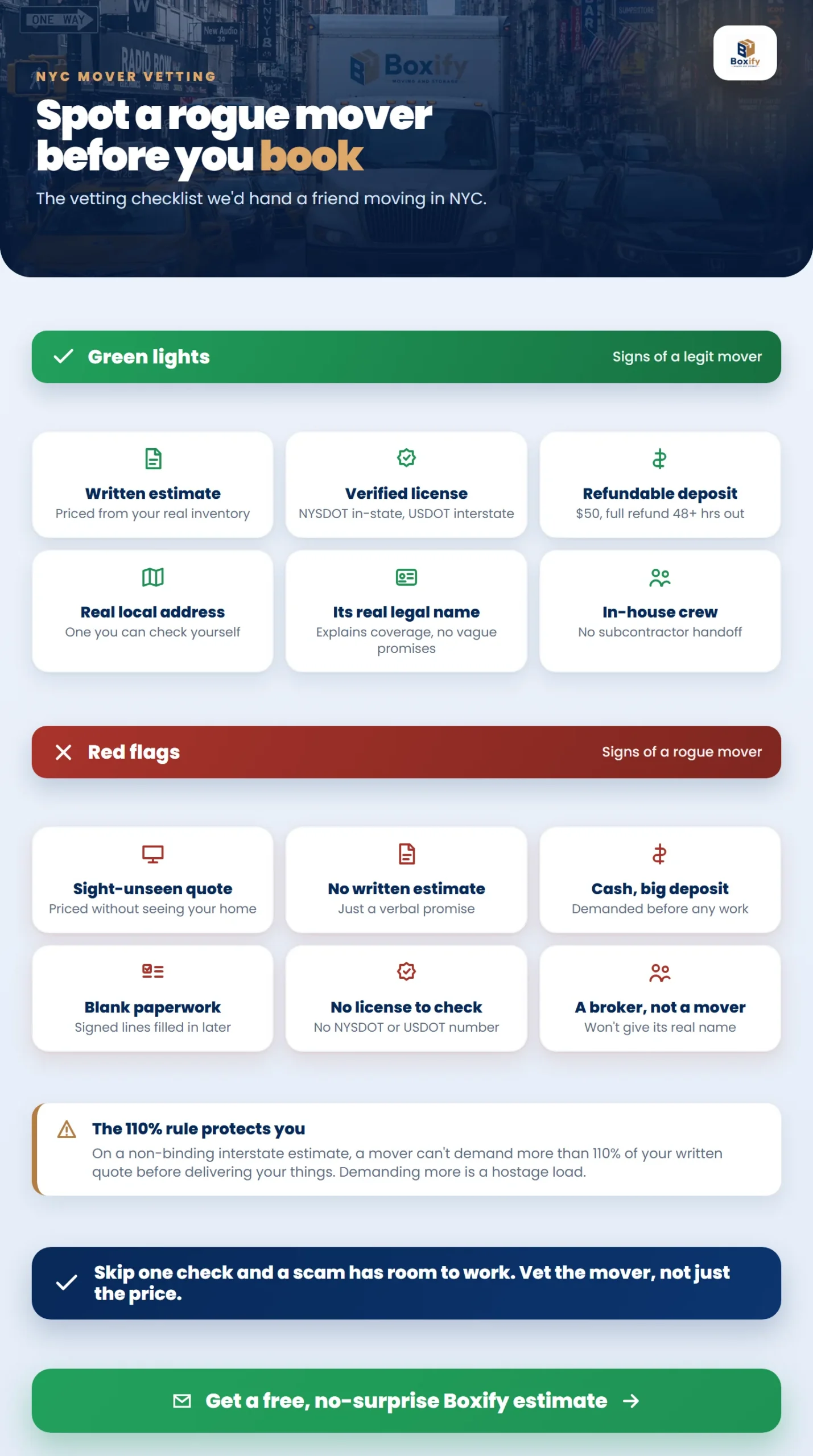
You can spot a rogue NYC mover before you book by watching for four red flags: an estimate given sight-unseen or by phone only, a demand for cash or a large deposit up front, no license you can verify, and a request to sign blank or half-filled paperwork.
The fix is short. Get every number in writing, verify the mover's license, keep any deposit small and refundable, and choose a company that sends its own in-house crew, not a subcontractor you've never met.
Do those four things and the scam has nowhere to hide: the tactics below all depend on you skipping at least one of them.
Key takeaways
- The red flags at a glance: a sight-unseen or verbal-only estimate, a large cash deposit demand, blank documents to sign, no local address, and "everything's covered by our insurance" are the classic rogue-mover signs.
- Two licenses to check, depending on the move: for a move that stays inside New York, a mover must hold NYSDOT operating authority; for an interstate move, verify the mover's USDOT number in the FMCSA's SAFER system.
- The two tactics to know: the bait-and-switch (a lowball that balloons on move day) and the hostage load (goods held until you overpay). Federal rules cap what a mover can demand at delivery.
- The safest structural signal: an in-house crew means no subcontractor handoff, so you know who actually shows up.
- The honest baseline: with a trustworthy mover, the price quoted is the price paid, with no hidden fees.
What's in this guide
- The red flags of a rogue NYC mover
- Check the license: what a legit NYC mover must hold
- The tactics: bait-and-switch and hostage loads
- Why an in-house crew is a safer bet
- Your vet-your-mover checklist
The red flags of a rogue NYC mover
The clearest rogue-mover red flags are the ones a company hopes you'll overlook: a price with no paper behind it, money demanded before any work, and a license you can't check. The FMCSA, the federal agency that regulates interstate movers, keeps a list of these warning signs on its consumer site, mover.gov. Here they are, with why each matters and how an honest mover behaves instead.
At a glance, each red flag and what an honest mover does instead:
| The red flag | What an honest mover does instead |
|---|---|
| A sight-unseen estimate | Prices from your actual inventory and building access, itemized in writing |
| No written estimate | Puts every number in writing before you book |
| Cash or a large deposit up front | Keeps any deposit small and refundable (Boxify: $50, fully refundable) |
| Blank or half-filled documents to sign | Gives you complete paperwork; the numbers match your written estimate |
| No verifiable address or license | Operates from a real local address, with a license you can look up |
| Generic greeting, "it's all covered" | Gives its exact legal name and explains how its coverage actually works |
| No federal moving booklets | Hands you the required FMCSA booklets by name |
Each flag, in detail:
1. A sight-unseen estimate
- What it is: a firm-sounding price quoted over the phone or by text, without ever seeing your home.
- Why it matters: a mover who hasn't seen your stuff or your stairs is guessing, and a guess is built to grow on move day.
- How to avoid it: insist on an estimate tied to your actual inventory and building access. An honest quote is fully itemized in writing, with nothing buried: the list of items, the pickup and delivery addresses, the distance.
2. No written estimate
- What it is: a verbal number and a promise to "sort it out on the day."
- Why it matters: a verbal number isn't binding and isn't enforceable, so it's the one most likely to change.
- How to avoid it: get every number in writing before you book, and treat any mover who won't put it on paper as your cue to walk.
3. A demand for cash or a large deposit up front
- What it is: a big deposit, often cash, required to hold your date.
- Why it matters: a large upfront payment hands the mover leverage; it's exactly how a hostage load starts.
- How to avoid it: a legitimate mover keeps any deposit small and refundable. Boxify's booking deposit is $50, refunded in full if you cancel at least 48 hours before the move, not a big cash sum you can't get back.
4. Blank or half-filled documents to sign
- What it is: paperwork with empty lines you're asked to sign "to save time."
- Why it matters: whatever gets written in later is what you agreed to.
- How to avoid it: never sign a blank line. Read every document in full, and make sure the numbers match your written estimate before you initial anything.
5. No local address you can verify, and no license you can look up
- What it is: no real, checkable place of business, which the FMCSA lists as a rogue-mover red flag, paired with no NYSDOT or USDOT number you can look up.
- Why it matters: an unlicensed, addressless mover has no accountability if your move goes wrong.
- How to avoid it: confirm the company operates from a genuine local address, and verify its license yourself. The next section shows you where. (Boxify is based in Queens and serves Greater NYC.)
6. A generic phone greeting and "it's all covered by our insurance"
- What it is: a phone answered "Movers," not a company name, paired with vague blanket-coverage promises.
- Why it matters: a broker or shell company won't name itself, and "fully covered" is not the same as valuation coverage you can rely on.
- How to avoid it: ask for the company's exact legal name, and ask how its liability coverage actually works before you assume anything's protected. (Our guide to reading a NYC moving quote breaks down what valuation really covers.)
7. No federal moving booklets
- What it is: an interstate mover that never gives you the required consumer paperwork.
- Why it matters: federal rules require a mover to hand you the "Your Rights and Responsibilities When You Move" booklet and the "Ready to Move" brochure, and not providing them is itself a red flag.
- How to avoid it: ask for both by name. A legitimate interstate mover will have them ready.
Check the license: what a legit NYC mover must hold
Before you hand any NYC mover a deposit, confirm it's actually licensed to operate, and in New York that means checking one of two different registrations, depending on where you're moving. This is the step most national scam guides skip, and it's the easiest one to do yourself.
For a move that stays within New York State, a company must hold NYSDOT operating authority. The state requires movers to be certified through its carrier system, to keep a bona-fide New York place of business, and to show at least two years' experience before they can legally operate as an in-state mover. If a company doing a Brooklyn-to-Queens move can't point you to its NYSDOT authority, that's a problem. A mover whose license you can't verify isn't one to trust with your move.
For a long-distance or interstate move, the mover needs federal authority instead: a USDOT number you can verify yourself. Look it up in the FMCSA's SAFER system through the agency's consumer site, mover.gov, and confirm the company is registered and active before you book.
Here's the gap worth knowing: most national "avoid moving scams" checklists tell you to check a USDOT number and stop there. For a move inside New York City, that misses the NYSDOT requirement entirely. Check the one that matches your move, in-state or interstate, and you've already ruled out a whole category of rogue operators.
The tactics: bait-and-switch and hostage loads
A rogue mover usually runs one of two tactics, and both start with a price that was never real. The bait-and-switch is a lowball estimate that balloons on move day, once your belongings are already on the truck. The hostage load goes further: the crew refuses to unload until you pay charges far above what you were quoted. The red flags above are how you see either one coming.
Watch for the pivot on move day. The moment a "final number" appears that's dramatically higher than your written estimate, especially paired with a demand for cash before anything comes off the truck, you're looking at a hostage load in progress, not an honest correction.
Your best protection is a written binding estimate: a guaranteed price the mover commits to up front, rather than a "best guess" that can climb. We define binding versus non-binding in plain English, and show how to spot the difference on your paperwork, in the guide to reading a NYC moving quote.
There's a federal backstop, too. On a non-binding interstate estimate, a mover can't require more than 110% of the estimate at delivery before it must release your goods; anything beyond that gets billed separately later. So a crew demanding double the quote in cash on the curb isn't just being pushy. It's breaking the rule. For what a move should actually cost in the first place, so you can recognize a lowball when you see one, start with what a NYC move actually costs.
Why an in-house crew is a safer bet
The single strongest signal that a mover won't run any of these tactics is structural: it sends its own crew. Boxify moves are handled by our own in-house crew, not subcontracted or handed off to whoever's available that day. That matters because the "who actually shows up?" question is where a lot of scams live: a broker's whole model is handing your move to a third party you never vetted, and a crew with no stake in the company's name has little reason to honor the quote you were given.
Look at how the honest practices line up against the red flags, one for one:
- The sight-unseen, no-paper flags are answered by a free, upfront quote you can request by phone, online, or in person, fully itemized in writing so nothing hides.
- The large-deposit flag is answered by a small, refundable deposit ($50, fully refunded if you cancel at least 48 hours out) instead of a big cash demand you can't recover.
- The bait-and-switch is answered by the simplest promise in moving: the price we quote is the price you pay, with no hidden fees.
That's not a claim to take on faith. It's a structure. A mover that shows you every number in writing, asks for almost nothing up front, and sends its own crew has removed the levers a scam needs to work.
Want a mover who names every fee up front, before you book? See exactly what you get in a free, no-surprise Boxify estimate.
Your vet-your-mover checklist
Run every NYC mover you're considering through these five checks before you book:
- ☐ Get it in writing. A fully itemized written estimate, never a verbal number.
- ☐ Verify the license. NYSDOT operating authority for an in-state move; a USDOT number in FMCSA SAFER for an interstate one.
- ☐ Keep the deposit small and refundable. Walk away from a large cash demand up front.
- ☐ Read before you sign. No blank lines, and the numbers match your estimate.
- ☐ Confirm an in-house crew. Know who's actually showing up: no surprise subcontractor handoff.
FAQ
How do I know if a NYC moving company is legit?
Start with the license and the paperwork. A legitimate NYC mover holds NYSDOT operating authority for in-state moves, or a verifiable USDOT number for interstate ones. It gives you a written, itemized estimate and asks only for a small, refundable deposit. Warning signs of a rogue mover include a sight-unseen estimate, a large cash deposit up front, no local address, and blank documents to sign.
What licenses does a NYC mover need?
It depends on where you're moving. For a move that stays within New York State, the company must hold NYSDOT operating authority, obtained through the state's carrier certification system. For an interstate move, the mover needs a federal USDOT number, which you can verify yourself in the FMCSA's SAFER system at mover.gov. Check the one that matches your move.
What are the biggest moving-company red flags?
The classic rogue-mover red flags are an estimate given sight-unseen, no written estimate, a demand for cash or a large deposit up front, being asked to sign blank documents, no local address, a phone answered generically, and vague "everything's covered by our insurance" claims. An interstate mover that won't give you the required federal moving booklets is another.
What is a rogue mover, and what's a hostage load?
A rogue mover lures you with a low estimate, then inflates the bill or holds your goods on move day. The hostage load is that second move: the crew refuses to unload until you pay charges far above the quote. You're not defenseless: on a non-binding interstate estimate, a mover can't require more than 110% of the estimate at delivery before releasing your things. A written binding estimate and an in-house crew are the best ways to avoid the situation entirely.
What paperwork should a NYC mover give me?
For an interstate move, federal rules require your mover to hand over two booklets: "Your Rights and Responsibilities When You Move" and the "Ready to Move" brochure. Not providing them is itself a red flag. For any move, insist on a written, itemized estimate before you book; a mover who won't put the price in writing is one to walk away from.
Should a mover use its own crew or subcontractors?
It matters more than most people realize. Boxify runs in-house crews: every move is handled by Boxify's own team, not subcontracted out or handed to a third party on the day. An in-house crew means the people who quoted your move are the ones accountable for it, which is one of the simplest guards against a bait-and-switch.
Vet the mover, not just the price
The cheapest quote is often the one hiding the most, so the number is never enough on its own. You have to vet the mover behind it. Watch for the red flags, verify the license that matches your move, keep any deposit small and refundable, read before you sign, and confirm an in-house crew. Do that, and the bait-and-switch and the hostage load have nowhere to take hold. The mover worth hiring is the one that names every tactic openly, because it doesn't use a single one.
Ready to book an honest mover?
If you want the opposite of everything above (every fee named up front, a written itemized quote, a small refundable deposit, and your own in-house crew) that's how a Boxify move works, so the price you're quoted is the price you pay.
Get a free, no-surprise Boxify estimate.






- What a NYC move actually costs. The full, line-by-line cost breakdown, so you can recognize a lowball when you see one.
- How to read a NYC moving quote. Decode the estimate line by line and spot the surprise fees a bait-and-switch hides.
- What a free, no-surprise Boxify estimate includes. Every fee named up front, in writing, from your own in-house crew.
Regulatory facts are cited to their primary source; the honest-practice details describe how Boxify operates.
- FMCSA: rogue-mover red flags on mover.gov; the required "Your Rights and Responsibilities When You Move" booklet and "Ready to Move" brochure; binding vs. non-binding estimates and the 110% non-binding delivery rule; USDOT verification via SAFER.
- NYSDOT: the operating authority a company must hold to move households within New York State, obtained through the state's carrier certification system.
Licensing and consumer-protection rules reflect current FMCSA and NYSDOT guidance as of 2026; we refresh this guide when the rules change.
Rita Penn, Author. Rita Penn is a copywriter with over eight years of experience writing for home service businesses and service providers. She specializes in the moving and storage industry and has created content for several moving companies, along with businesses across other service-based industries.
Eddie Torr, Editor. Eddie Torr is an AI content editor: the independent quality-and-compliance gate every draft passes before it advances. He checks each claim against its approved source, tests the piece against the editorial standards, ranks it, and returns a verdict. He never rewrites the piece himself and never approves delivery; a human reviewer does that.
Maya Ellison, Reviewer. Maya Ellison is an editorial lead with more than 11 years across copywriting, editing, content strategy, and editorial operations. She holds a bachelor's in Communications (Professional Writing and Digital Media) and a master's in Information and Knowledge Management. Those are the two sides of her work: creating clear content, and building the systems that produce it consistently. She gives every piece a final human review before it ships, confirming each claim is fairly represented, tied to a checked source, and dated.
Reviewed on this post: She reviewed this guide against its sources, confirming the red flags, the required booklets, and the licensing rules are cited to the FMCSA and NYSDOT as the general regulations a reader verifies, not as any one mover's own credential, and that no scam-prevalence figure is stated that its sources don't support.