

Your NYC Moving Budget Checklist: Every Cost to Plan For Before Moving Day
Before moving day arrives, it helps to see every cost in one place: not just the movers, but the fees, packing, tips, and the building charges people forget. This checklist gathers them all with an honest range for each, so you can build a realistic NYC moving budget and plan against real numbers instead of guesses.
How to use this checklist
This checklist pulls every one of those costs into one place, so nothing surprises you at the curb. Each line names an honest range and links up to the full guide that covers it in depth (the base cost, the fees, the tips, the timing) while the checklist itself just names the number and points you to the detail.
Work down the eight groups, mark the ones that apply to your move, and keep the one-page checklist below to plan against.
Every cost to budget for a NYC move, in one list
A complete NYC moving budget covers eight kinds of cost, not just the truck and crew: the line items behind the complete NYC moving cost guide. Plan for each of these before moving day:
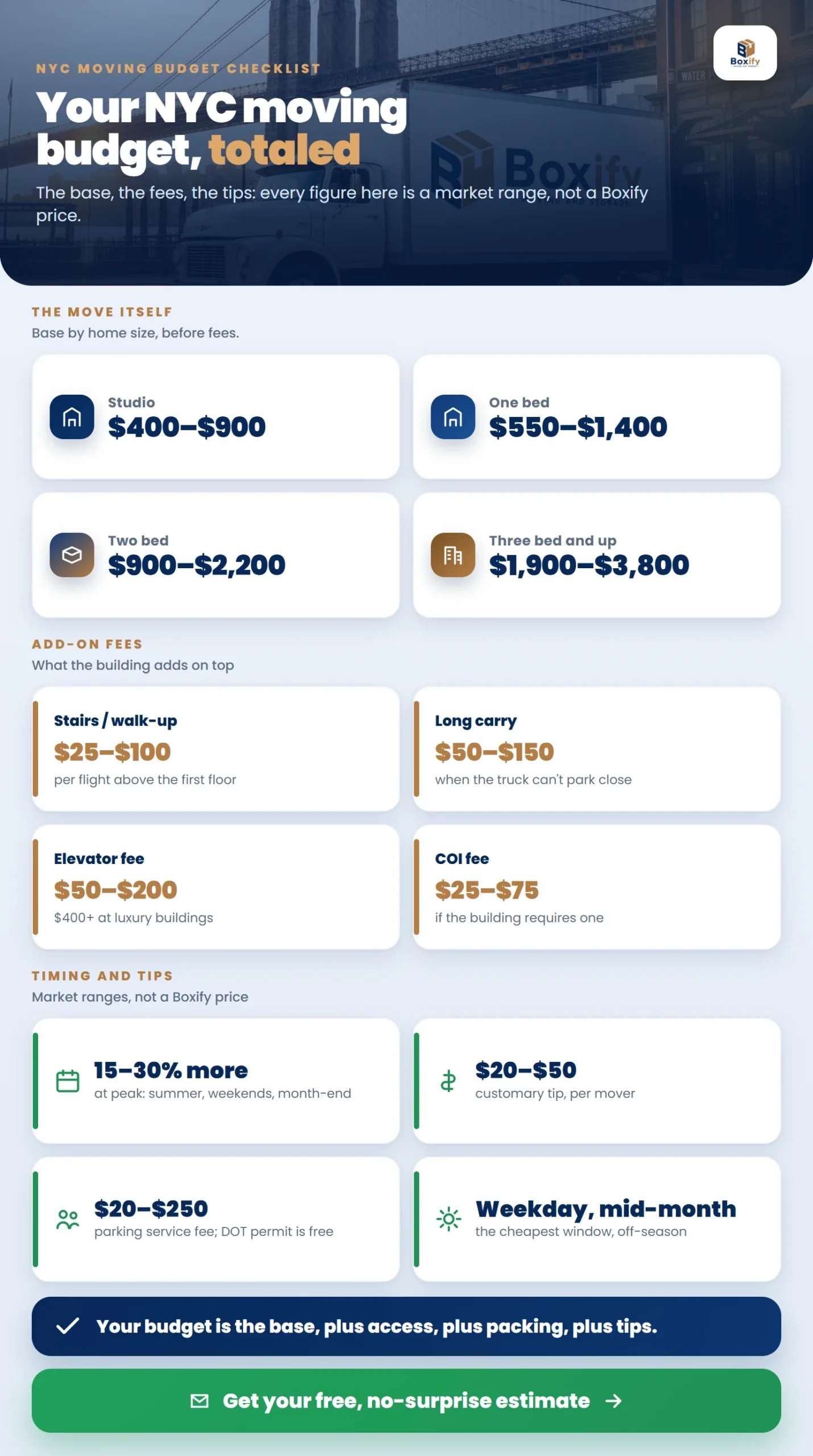
- A) The move itself: the base cost by home size, roughly $400 to $3,800+ depending on size, distance, and building access.
- B) Add-on & situational fees: stairs/walk-up, long carry, elevator reservation, COI, and parking.
- C) Packing: a packing service, or DIY supplies that vary by home size.
- D) Protection & valuation: the liability level your goods travel under.
- E) Tips: customary but discretionary, about $20 to $50 per mover.
- F) Building & admin: the COI, elevator reservation, and security deposit people forget.
- G) Storage if needed: for a gap between move-out and move-in.
- H) Timing: the one lever that can lower the whole total by about 15 to 30%.
Every dollar figure here is an attributed NYC market range as of 2025-26: not a Boxify price, and not a single "average." Your real numbers depend on your home, your building, and your date. The one Boxify-specific figure is the $50 booking deposit.
Key takeaways
- Budget for the move and the fees people forget: a Certificate of Insurance (COI), a service-elevator reservation, and your security deposit catch most first-time NYC movers off guard.
- Every figure here is an honest, attributed market range as of 2025-26: not a single average, and not a Boxify price.
- Timing is the biggest lever: an off-peak date can run about 15 to 30% lower than a summer, weekend, or month-end move.
- Tips are customary but discretionary, about $20 to $50 per mover, more for a harder job.
- The one Boxify-specific number: booking takes a $50 deposit, fully refunded if you cancel at least 48 hours ahead.
- Keep the one-page checklist and check off each line as you plan.
A) The move itself
The biggest line in your budget is the move itself, the crew, truck, and hours to get your home from door to door.
As of 2025-26, a local NYC move runs roughly $400 to $900 for a studio, $550 to $1,400 for a one-bedroom, $900 to $2,200 for a two-bedroom, and $1,900 to $3,800 or more for three bedrooms or larger, according to NYC moving-market sources. Those are wide ranges, not averages. Where you land depends on your home size, distance, crew and hours, and building access.
Movers price the job one of three ways (hourly, by weight, or as a written binding estimate), and for a move within New York State, NYSDOT recognizes all three; only a written binding estimate locks in an exact price up front. A binding estimate guarantees the number; a non-binding one is the mover's best guess and can rise. Most Boxify moves are quoted as a binding, guaranteed price, with hourly offered when it suits the job.
One first-party number to pencil in: booking a Boxify move takes a $50 deposit, fully refunded if you cancel at least 48 hours before the move.
For the full breakdown by home size and how each pricing method works, see the complete NYC moving cost guide.
B) Add-on & situational fees
Beyond the base move, a handful of add-on fees can apply depending on your building and your street. An honest quote names the ones that apply to you before you book, rather than springing them at the curb. The typical NYC ranges:
- Stairs / walk-up: about $25 to $100 per flight above the first floor, when there's no elevator.
- Long carry: about $50 to $150 when the truck can't park close to your door.
- Elevator reservation: about $50 to $200 typical, and $400 or more at luxury or high-rise buildings that require a booked service elevator.
- Certificate of Insurance (COI): about $25 to $75 when your building requires proof of the mover's coverage.
- Parking: about $20 to $250 as the mover's service fee for pulling a permit; the NYC DOT moving permit itself is free.
Stairs/walk-up and long-carry charges are almost always charged when they apply; elevator reservation, COI, and parking are situational.
For why each of these applies and how much it moves your total, see what makes a NYC move cost more; to spot them on an actual estimate, see how to read a NYC moving quote.
C) Packing
Packing is either a service you buy or a job you do yourself.
Boxify offers full or partial packing if you'd rather hand it off. If you pack yourself, budget for boxes, tape, and paper; those supply costs vary by home size, so price them against how many rooms you're moving rather than a flat figure.
D) Protection & valuation
Protection is the liability level your belongings travel under, and it is not the same as insurance.
On an interstate move, Full-Value Protection is the default: your goods are covered at replacement value unless you waive it in writing. The free waiver, Released-Value protection, pays only 60¢ per pound, per item, so a lost 10-pound item worth $1,000 pays just $6.
For what these levels mean on your paperwork and how to choose, see how to read a NYC moving quote.
E) Tips
Tips are customary for a NYC move but never required.
Most people tip about $20 to $50 per mover for a local move, more for a harder job like a high-floor walk-up. It's discretionary: a thank-you for careful work, not a line on your bill.
For per-mover-versus-total norms and when not to tip, see how much to tip movers in NYC.
F) Building & admin: the costs people forget
These are the costs most budget lists skip: the building-and-admin fees that come with moving in NYC. They're the ones that catch people off guard, so plan for them up front.
- Certificate of Insurance (COI). A Certificate of Insurance (COI) proves your mover carries the liability coverage your building requires; most NYC co-ops, condos, and managed rentals demand one before letting movers in.
- Elevator reservation. For an elevator building, you reserve the service or freight elevator, usually about two weeks ahead; most buildings don't charge, though some require a fee or a refundable deposit.
- Security deposit. If you're renting, budget your security deposit. Under New York's HSTPA, a landlord may not charge more than one month's rent, and demanding more is unlawful.
G) Storage if needed
If there's a gap between your move-out and move-in dates, budget for storage; the numbers below are NYC market context, not Boxify prices.
NYC self-storage runs roughly $84 a month for a 5×5, $260 for a standard 10×10, and $484 for a 10×20, about twice the $119 national average for that same 10×10, and down about 1.5% from last year (StorageCafe, as of May 2026). Climate control adds a little: a 10×10 averages $271.
Two other formats price differently: full-service (valet) storage is priced by plan rather than by unit size, and portable containers are quote-based in NYC rather than rate-carded. Ask for a written quote on either: the unit-size figures above won't tell you what they'll cost.
Boxify also offers full-service valet storage, with pickup, storage, and redelivery and no unit to rent or visit, if that fits your gap.
H) Timing: the lever, not a line item
Timing isn't a cost to add. It's the one lever that can lower everything above.
Moving off-peak (a weekday, mid-month, in the off-season) can run about 15 to 30% lower than a summer, weekend, or month-end move, driven by NYC's heavy first-of-month lease turnover. If your date is flexible, this is the single biggest way to shrink Group A.
For the cheapest windows in detail, see the cheapest time to move in NYC.
Your NYC moving budget checklist
Want the whole list in one place? Check off each cost as you plan, all eight groups, on a checklist you can keep next to your quote.
- ☐ A) The move itself: the base cost by home size
- ☐ B) Add-on & situational fees: stairs/walk-up, long carry, elevator reservation, COI, parking
- ☐ C) Packing: a service, or DIY supplies (varies by home size)
- ☐ D) Protection & valuation: Full-Value vs. Released-Value
- ☐ E) Tips: about $20 to $50 per mover
- ☐ F) Building & admin: COI, elevator reservation, security deposit
- ☐ G) Storage: if you have a gap between homes
- ☐ H) Timing: pick an off-peak date to lower the total
FAQ
What costs do people forget when budgeting a NYC move?
The costs that catch people off guard are usually the building-and-admin ones: a Certificate of Insurance (COI) your building may require (about $25 to $75), the service-elevator reservation you book roughly two weeks ahead (most buildings don't charge, some take a fee or deposit), and your security deposit (New York caps it at one month's rent). Tips (about $20 to $50 per mover) are the other line people leave out.
How much should I budget for a NYC move?
As of 2025-26, a local NYC move runs roughly $400 to $900 for a studio, $550 to $1,400 for a one-bedroom, $900 to $2,200 for a two-bedroom, and $1,900 to $3,800 or more for three bedrooms or larger, according to NYC moving-market sources. Then add the fees that apply to your building, plus packing, protection, and tips. For the full breakdown, see the complete NYC moving cost guide.
What add-on fees might I pay?
The common NYC add-ons are stairs/walk-up (about $25 to $100 per flight above the first floor), long carry ($50 to $150), elevator reservation ($50 to $200 typical, $400+ at luxury buildings), a COI ($25 to $75), and a parking service fee ($20 to $250, the DOT permit itself is free). Stairs and long carry are almost always charged when they apply; the rest are situational. For why they apply, see what makes a NYC move cost more.
Can I lower my moving cost?
Yes: timing is the biggest lever. Moving on a weekday, mid-month, in the off-season can run about 15 to 30% lower than a summer, weekend, or month-end date. Getting every fee named up front also keeps the final bill from creeping past the quote. For the cheapest windows, see the cheapest time to move in NYC.
How much should I budget for storage between places?
If your move has a gap, NYC self-storage street rates as of May 2026 ran about $84/month for a 5×5 up to $260/month for a 10×10, per StorageCafe. Boxify's own full-service valet storage is priced by plan rather than by the unit, so ask for a quote on exactly what you need to store.
Plan every line before moving day
A NYC move has more moving parts than the truck and crew, but none of them has to be a surprise. Plan against the whole list, keep the checklist handy, and you'll know your real number before moving day.
Get a number with every fee named
Want the fees checked before you book? Boxify names what applies to your move and puts the number in writing, so the price you're quoted is the price you pay.
Get a free, no-surprise Boxify estimate







This checklist pulls costs from across our NYC moving-cost series into one place. Go deeper on any line:
- The complete NYC moving cost guide. The whole number, line by line, by home size.
- How to read a NYC moving quote. Decode an estimate and spot the surprise fees before you sign.
- How much to tip movers in NYC. A straight answer on the range, per-mover vs. total, and when not to.
- What makes a NYC move cost more. The cost drivers behind the number, named.
Regulatory facts are cited to their primary source; NYC cost figures are attributed market ranges (as of 2025-26), not Boxify prices.
- FMCSA, "Your Rights and Responsibilities When You Move": binding vs. non-binding estimates, Full-Value Protection (default), and Released-Value protection at 60¢/lb.
- NYSDOT, "Summary of Information for Shippers" (Rev. 11-2025): New York's three intrastate pricing methods.
- NYS Homes & Community Renewal: the HSTPA one-month-rent security-deposit cap.
- NYC moving-market sources (multiple, 2025-26): cost-by-size ranges, add-on-fee ranges, customary tip ranges, the 15 to 30% timing swing, COI building norms, and service-elevator reservation norms. (Attributed market context from several NYC moving and real-estate sources; not a single source.)
- Storage market context: NYC self-storage street rates from StorageCafe, as of May 2026. (Market context only, not Boxify prices.)
Cost ranges are as of 2025-26 and reflect NYC market context; we refresh them when the market moves.
Rita Penn, Author. Rita Penn is a copywriter with over eight years of experience writing for home service businesses and service providers. She specializes in the moving and storage industry and has created content for several moving companies, along with businesses across other service-based industries.
Eddie Torr, Editor. Eddie Torr is an AI content editor: the independent quality-and-compliance gate every draft passes before it advances. He checks each claim against its approved source, tests the piece against the editorial standards, ranks it, and returns a verdict. He never rewrites the piece himself and never approves delivery; a human reviewer does that.
Maya Ellison, Reviewer. Maya Ellison is an editorial lead with more than 11 years across copywriting, editing, content strategy, and editorial operations. She holds a bachelor's in Communications (Professional Writing and Digital Media) and a master's in Information and Knowledge Management. Those are the two sides of her work: creating clear content, and building the systems that produce it consistently. She gives every piece a final human review before it ships, confirming each claim is fairly represented, tied to a checked source, and dated.
Reviewed on this post: On this checklist she confirmed that each range, fee, and regulation is stated accurately, tied to a checked source and a date, and that a market range never reads as a Boxify price.